

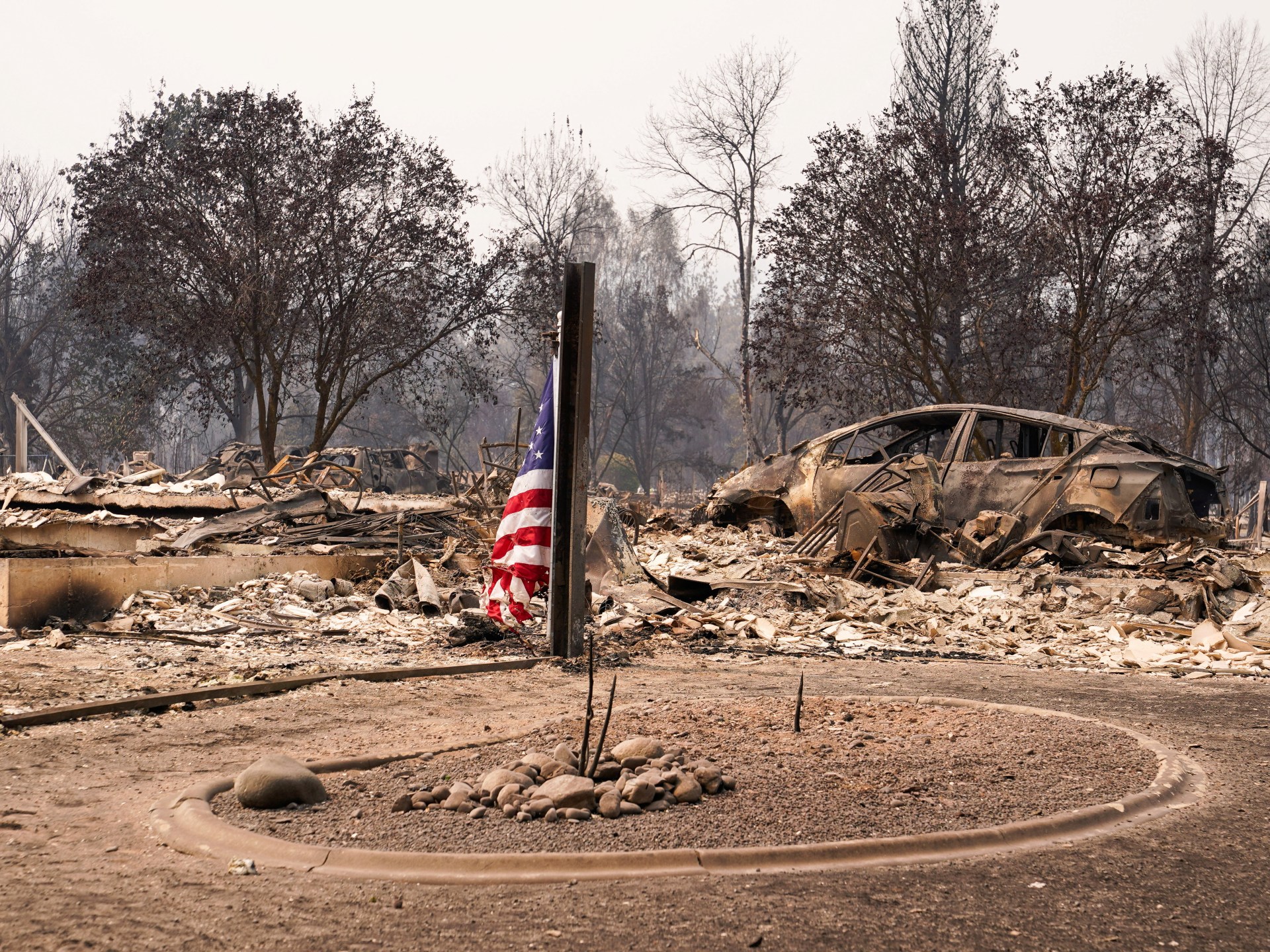

A cluster of fast-moving wildfires has devastated the outskirts of Spokane, Washington state, with 65,000 people told to leave their homes. More than 700 buildings have been destroyed as the fires spread from surrounding vegetation into residential neighbourhoods, posing an unprecedented threat to lives and property.
The blazes have become the top firefighting priority in the US because of their scale and the danger they pose to communities. While no deaths have been confirmed, authorities say it will take time to assess the full extent of the damage as search teams begin entering the hardest-hit areas.
end of list
The evacuation orders expanded from about 4,000 people on Sunday to 65,000 by Monday, highlighting the speed at which the fires spread into populated communities.
Here is what to know:
What is happening in Spokane, Washington?
Spokane, Washington’s second-largest city, is at the centre of one of the state’s most destructive wildfire emergencies in recent history after three fast-moving wildfires erupted on its northern outskirts over the weekend. Fanned by strong winds and fueled by exceptionally dry vegetation, the fires have burned more than 8,000 acres (3237 hectares) and spread from surrounding forests and grasslands into residential neighbourhoods, forcing approximately 65,000 people to evacuate, according to the Spokane Valley Fire Department.
Hundreds of buildings, most of them homes, have already been destroyed, with aerial surveys suggesting many more may have been damaged. Entire neighbourhoods have been reduced to charred rubble, with some properties left standing only as brick chimneys.
Advertisement
The scale of the disaster has overwhelmed local resources, prompting one of the largest firefighting operations in the state, with more than 1,000 firefighters deployed from across the region.
![A handout photo made available by the Spokane Valley Fire Department shows the Fairview Fire northeast of Spokane, Washington [EPA]](https://www.aljazeera.com/wp-content/uploads/2026/08/14192119-1785811036.jpg?w=770&resize=770%2C513&quality=80)
Despite the massive response, the fires remain uncontained, and officials say it could take days to fully assess the destruction. While no deaths have been confirmed, authorities initially received nearly 300 reports of missing people after the evacuations, though that number has since fallen significantly as families have been reunited. Emergency shelters have been opened across Spokane, and officials are urging residents not to return to evacuated areas or fly drones, which can disrupt critical aerial firefighting operations.
Firefighters are taking advantage of a brief period of cooler temperatures and lighter winds, but forecasters warn that hotter, drier and windier weather is expected to return later this week, raising fears that the fires could spread even further.
Washington is experiencing one of its worst wildfire seasons in more than three decades, with about 450,000 acres (182,000 hectares) burned so far this summer. More than 250,000 acres have burned in recent major fires alone.
![A handout photo made available by the Spokane Valley Fire Department shows the Fairview Fire northeast of Spokane, Washington [EPA]](https://www.aljazeera.com/wp-content/uploads/2026/08/14192121-1785811148.jpg?w=770&resize=770%2C513&quality=80)
What caused the fires?
Local news outlets have reported that the Spokane County Sheriff’s Office announced on Monday evening that a 37-year-old had been arrested on suspicion of arson in connection with the fire.
However, experts say the conditions that allowed the fires to spread so rapidly were already in place.
Washington has been experiencing severe drought and an unusually low winter snowpack, leaving vegetation exceptionally dry and highly flammable. Those conditions have been compounded by periods of extreme heat, low humidity and strong winds, creating an environment in which even a small ignition can quickly grow into a fast-moving wildfire.
Scientists have also linked increasingly severe wildfire seasons across the western US to human-caused climate change, which has contributed to hotter temperatures, longer droughts and drier landscapes. While climate change does not directly ignite wildfires, it makes them more likely to spread rapidly and become more destructive once they start.
Why are the Washington wildfires so severe?
The Washington wildfires have become particularly severe because several factors have converged, allowing the blazes to spread rapidly.
Advertisement
- Multiple large fires burning simultaneously: Spokane is dealing with three major wildfires at once, while dozens of other significant fires are burning across the western US. Managing multiple large incidents simultaneously has made it harder to concentrate resources on a single fire.
- The fires advanced rapidly into populated communities: Driven by strong winds, the flames jumped roads and rivers, allowing them to move from forests and grasslands into residential neighbourhoods. More than 700 buildings have been destroyed, making the fires far more difficult to contain as they threaten homes, businesses and critical infrastructure.
- Firefighting resources are stretched: More than 100 new wildfires have been reported across 15 US states over a single weekend, placing extraordinary pressure on national firefighting resources. Although more than 1,000 firefighters have been deployed to Spokane, emergency officials say aircraft, equipment and personnel are being shared across multiple emergencies.
- An ongoing threat despite improved weather: Firefighters have benefitted from a brief period of cooler temperatures and lighter winds, but officials warn that hotter, drier and windier conditions are expected to return. With the fires still not contained, there is a significant risk that they could grow further or ignite new areas.
What role are drought, heat and climate change playing?
Scientists say drought, extreme heat and climate change are making wildfire seasons longer, more frequent and more destructive across the western US.
Drought dries out vegetation, turning forests and grasslands into fuel that can ignite and burn more intensely.
Heat and low humidity accelerate fire spread by drying vegetation even further and creating conditions in which flames can move rapidly across the landscape.
Climate change amplifies these conditions, as rising global temperatures are increasing the likelihood of prolonged droughts, more frequent heatwaves and longer fire seasons, making large, destructive wildfires more likely once they ignite.

What is the weather forecast for midweek?
The weather is expected to worsen again by midweek.
While Monday and Tuesday offered a brief, helpful window of cooler temperatures and calmer winds, the midweek forecast calls for a return of:
- Extremely high temperatures, particularly on Thursday, with highs forecasted up to 37 degrees Celsius (99 degrees Fahrenheit). On Monday, it was at 22C (72F).
- Low humidity (very dry conditions).
- Gusty winds with speeds up to 26 km/h.
Because the fires remain completely uncontained, authorities are keeping evacuations in place. They warn that the worst outcome would be letting residents return to their homes, only to have to evacuate them again 24 to 48 hours later when the hot, windy weather returns.
Washington’s entire congressional delegation is awaiting a response from President Donald Trump regarding their request for an expedited emergency declaration to deliver immediate federal relief to displaced families.
Advertisement
According to the National Interagency Fire Center, most of the fire activity in the US remains concentrated across the country’s northwest.
Right now, the major fires are mostly grassland burns in Idaho, Oregon and Utah, as well as fires in Florida’s Everglades National Park, in addition to new fires reported in Left Creek in Wyoming, Antelope Creek Fire in Nevada and the Sand Creek and Middle Coulee fires in Montana.
A lightning-caused fire that has burned more than 530 square miles (about 1,370 sq km) of grassland in western Idaho and eastern Oregon continued to grow on Monday. The area is home to cattle ranches, and authorities said the fire is threatening more than 600 homes and 800 other structures.
In central Utah, a blaze quadrupled in size more than the weekend to nearly 109 square miles (282 sq km) by Monday afternoon. More than 100 cattle have died, according to law enforcement.
Related News

Sheinbaum rejects US claim that Mexico’s government is linked to cartels

Trump vows to help Lebanon but offers no timeline for Israeli withdrawal

Iran warns against ‘fire of war’ amid US strike threats on energy sites