

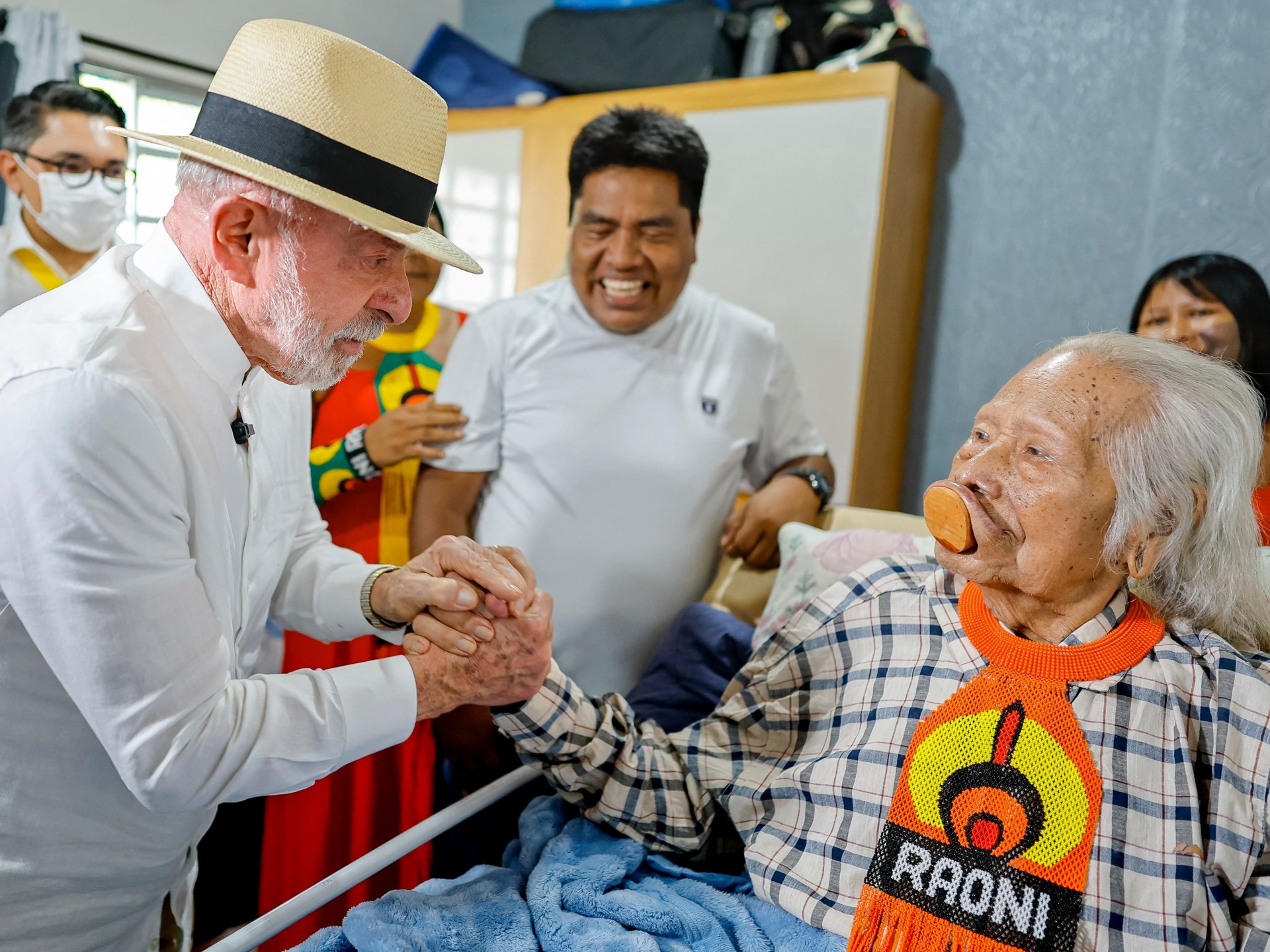

Brazil declared Kapot Nhinore the permanent land of the Mebengokre and Yudja peoples, a step towards formal demarcation.
Brazilian President Luiz Inacio Lula da Silva has visited the ailing Indigenous leader Raoni Metuktire, a lifelong defender of the Amazon rainforest, as the country’s government recognised the chief’s ancestral land as Indigenous territory.
Lula met the 94-year-old chief on Thursday in Peixoto de Azevedo, a city in Mato Grosso state, near the Amazonian village where Raoni has lived for decades.
Recommended Stories
list of 3 items
- list 1 of 3Rare video of Brazilian Amazon tribe
- list 2 of 3Photos: Pope Leo visits Peru’s Amazon and Andean regions during 12-day tour
- list 3 of 3Pope condemns murders of Peru’s Indigenous leaders, deforestation of Amazon
end of list
Raoni, who is known for his wooden lip plate, is receiving palliative care for gastrointestinal cancer and was hospitalised for a few days last week with a lung infection and low blood pressure.
“There is no Brazilian more authentic than our comrade Raoni,” Lula said. “He represents the past, he represents the present, and his ideas represent the future of Indigenous peoples in this country.”
At a ceremony later, Brazil’s Justice Ministry declared the Kapot Nhinore Indigenous Territory to be in the permanent possession of the Mebengokre, also known as Kayapo, and Yudja peoples. It is a crucial step towards formal demarcation of the land by presidential decree. Raoni has campaigned for its protection for three decades.
Lula said he was “deeply distressed” to hear of Raoni’s hospitalisation while he was at the COP31 climate summit in Turkiye. “I wanted to resolve the issue regarding the land where Raoni was born while he was still alive,” he said.
Raoni’s grandson, Roiti Metuktire, told the AFP news agency the decision had come as a surprise to the family. “It’s his last wish,” he said.
Why it matters
Raoni left his home in the Amazon in the late 1980s to travel the world, meeting presidents, popes and royals to warn about the destruction of the planet’s biggest rainforest. He walked beside Lula at his inauguration in 2023.
Advertisement
Experts see demarcated Indigenous territories as one of the best barriers against deforestation, as the Amazon moves closer to a tipping point at which it could become a drier, savannah-like ecosystem.
The territory covers about 362,000 hectares (nearly 900,000 acres). Eloy Terena, Brazil’s minister of Indigenous peoples, said it is 84 percent forest.
A 2023 Greenpeace report said more than 47,000 hectares (116,000 acres) were used for pasture or soy.
A battle ahead
Rural producers have campaigned against the demarcation, saying it would have severe economic consequences for thousands of non-Indigenous people who live and farm there.
“There is still a bit of a battle ahead. There are over two hundred properties on this land,” Lula said.
Brazil has almost 800 Indigenous lands, about 60 percent of them fully regularised. Lula resumed demarcations after returning to office in 2023, with 20 territories fully demarcated in three years. They remain under pressure from agribusiness, illegal gold mining and logging.
This week, about 20 emaciated members of an isolated Indigenous group emerged from the forest in another part of the Amazon to ask for food, highlighting the challenges faced by Indigenous communities nationwide.
Related News

If hackers can take over a supermarket fridge, what else is at risk?
Netanyahu outlines achievements, future plans as Likud leads polls

Algeria’s military deployment to Niger: What’s behind the move?