
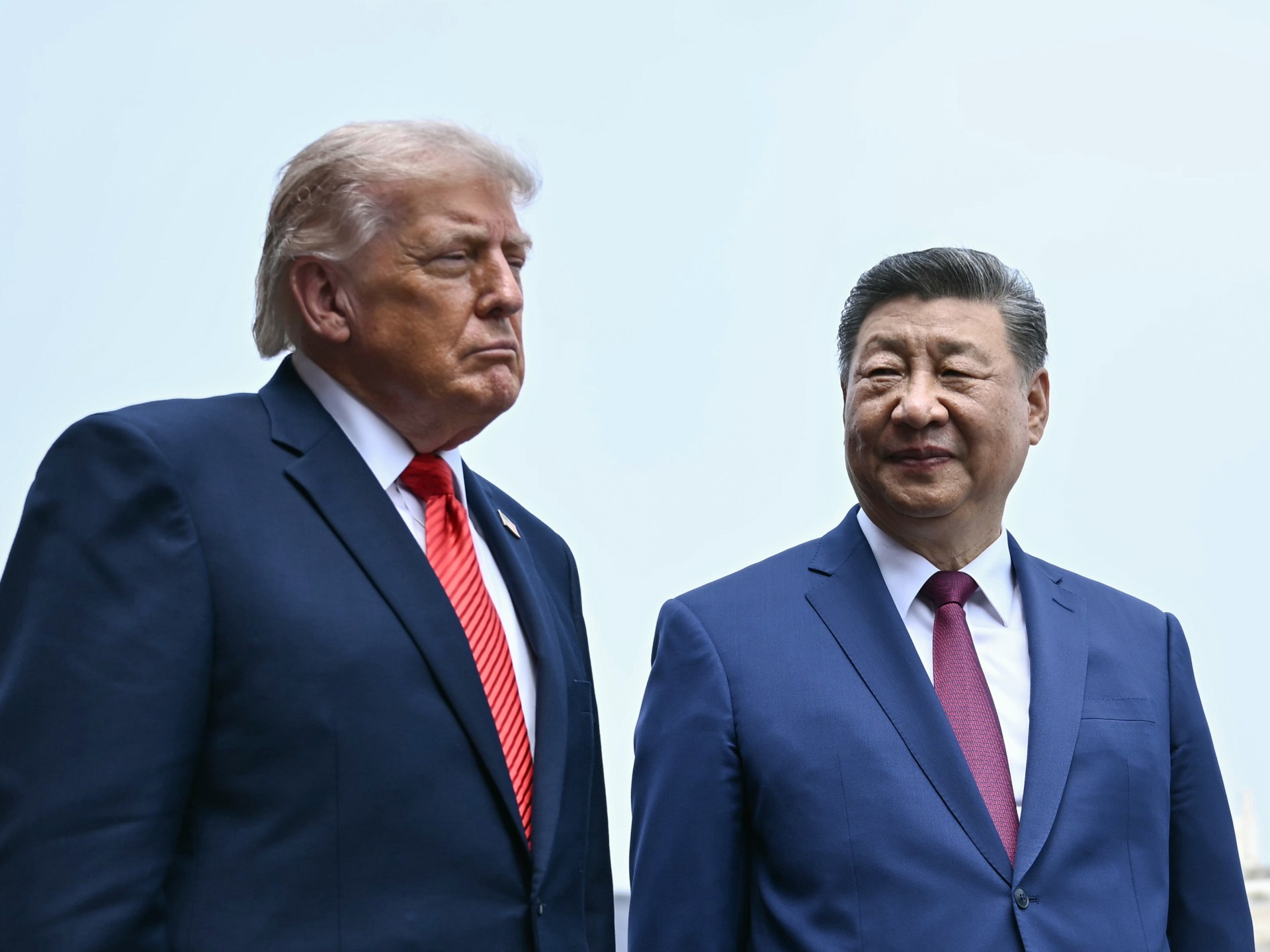

On the sidelines of this month’s Asia-Pacific Economic Cooperation (APEC) summit in Shenzhen, China, an unprecedented three-way meeting between United States President Donald Trump, Chinese President Xi Jinping and Russian President Vladimir Putin could take place.
“China is in communication with relevant parties regarding a meeting between the three heads of state,” Chinese Foreign Ministry spokesperson Mao Ning told reporters in Beijing on Wednesday.
- list 1 of 4Trump says Russia-Ukraine deal is near after meeting Putin’s envoy
- list 2 of 4Iran’s security chief meets Putin, delivers message from Khamenei
- list 3 of 4Why is Iran exempting India, China, Qatar, Iraq from Hormuz restrictions?
- list 4 of 4US judge halts construction of Trump’s triumphal arch in Washington, DC
end of list
“Work is under way to coordinate such a meeting,” Kremlin spokesman Dmitry Peskov said on Tuesday, adding: “We hope that it will be finalised in the coming days.”
Trump has said he is open to three-way talks focused on nuclear weapons. “If President Xi wants to have it, I’d have it,” he told reporters last month.
The three leaders have met separately but have never held formal talks together.
So could the meeting, pencilled in for November 18-19, actually happen, and what would it mean for the rest of the world? Here’s what we know:
What would Russia get out of a three-way meeting with the US and China?
At the very least, a photo opportunity.
“It is a big event,” Alexander Bratersky, a Moscow-based journalist and political analyst, told Al Jazeera.
He pointed to Pyotr Tolstoy, chairman of the Russian parliament’s foreign affairs committee, who he said has described the meeting as a path towards a new Yalta – the 1945 conference where the leaders of the Soviet Union, the US and the United Kingdom shaped the post-war order in Europe.
That allows Moscow to “talk big”, Bratersky said, while putting Ukraine on the sidelines.
Advertisement
Simply being at the table would make Putin “first among equals”, he added, giving him a photo opportunity to show the world that he will be among those deciding the future of Europe’s security architecture after the war in Ukraine.
If the meeting produced results, he said, it would reflect China’s influence on Russia.
“We should take into account that we are dealing with a much weaker US leader after elections,” Bratersky said.
Trump remains in charge of foreign policy, he explained, but will have less leverage if Democrats, who won control of both chambers of Congress in this week’s midterm elections, start sending money to Kyiv.
“A meeting by itself will be a success,” he said. “Putin will be able to sell it at home”.
Whether anything comes of it should become clear within a month or so, Bratersky said, and the meeting could lead to another during the Group of 20 (G20) summit in Miami in December.
If nothing is produced before Christmas, he added, “it will be just a photo op.”
What does Trump want?
Optics and leverage.
Trump wants “a personal, high-drama encounter” that lets him claim he is “dealing with” the other two great powers on his own terms, Inderjeet Parmar, a professor of international politics at City St George’s, University of London, told Al Jazeera.
A three-way meeting would allow Trump to present himself as “the indispensable deal-maker”, Parmar said, talking up potential deals on Ukraine, trade, energy or arms control.
“After the midterms the domestic political need for a foreign policy ‘win’ is real,” he said.
Any image of Trump sitting with Xi and Putin could be spun as evidence that American power still commands the table, he said, “even if the substance is limited or largely symbolic”.
“The domestic audience, and his eroding MAGA base, matters at least as much as the diplomatic one,” Parmar said.
What does China want?
Not a summit on Ukraine.
German President Frank-Walter Steinmeier said he raised the idea of discussing Ukraine with Xi when they met in Beijing on October 30, and could see the “surprise” on his face, Germany’s DPA news agency reported.
Steinmeier told public broadcaster ARD that Xi said the three presidents would probably meet in Shenzhen, but not to discuss Ukraine.
He said Xi explicitly pointed out that the Russia-Ukraine war is a European conflict in which the “Europeans must sit at the table”.
Beijing is also likely to swat away Trump’s push for nuclear talks.
Last month, China’s Foreign Ministry said it would be “neither fair, reasonable nor realistic to ask China to join the so-called trilateral nuclear disarmament negotiations at this stage”.
Advertisement
What would a meeting mean for the rest of the world?
Allies could be sidelined.
Parmar said a three-way meeting would mark “a clear break from the post-1945 pattern”, in which Washington coordinated closely with its European and Asian allies before engaging with Moscow or Beijing.
“A free-standing trilateral [meeting] risks treating those allies as secondary players whose interests can be managed after the fact,” he said, adding that those interests could even be traded.
That would be a shift towards “personalised great-power diplomacy”, he said. But the Trump administration still has hopes to drive a wedge between Russia and China, Parmar added.
Fears of a “G3” are “understandable but overstated in institutional terms”, he said, because the three capitals’ interests diverge sharply on Ukraine, Taiwan, technology and the rules of the international economy.
“The real risk is not a formal G3 secretariat, but the normalisation of great-power deals struck with little consultation of those most affected,” he said.
“History offers many examples of such moments. They rarely produce stable order and often leave the excluded feeling the costs,” Parmar said.
Related News
Algeria’s president orders troop deployment to neighbouring Niger
Indonesian president’s chief of staff dismissed over alleged wiretapping
Israel committing crimes against humanity in occupied West Bank: UN