
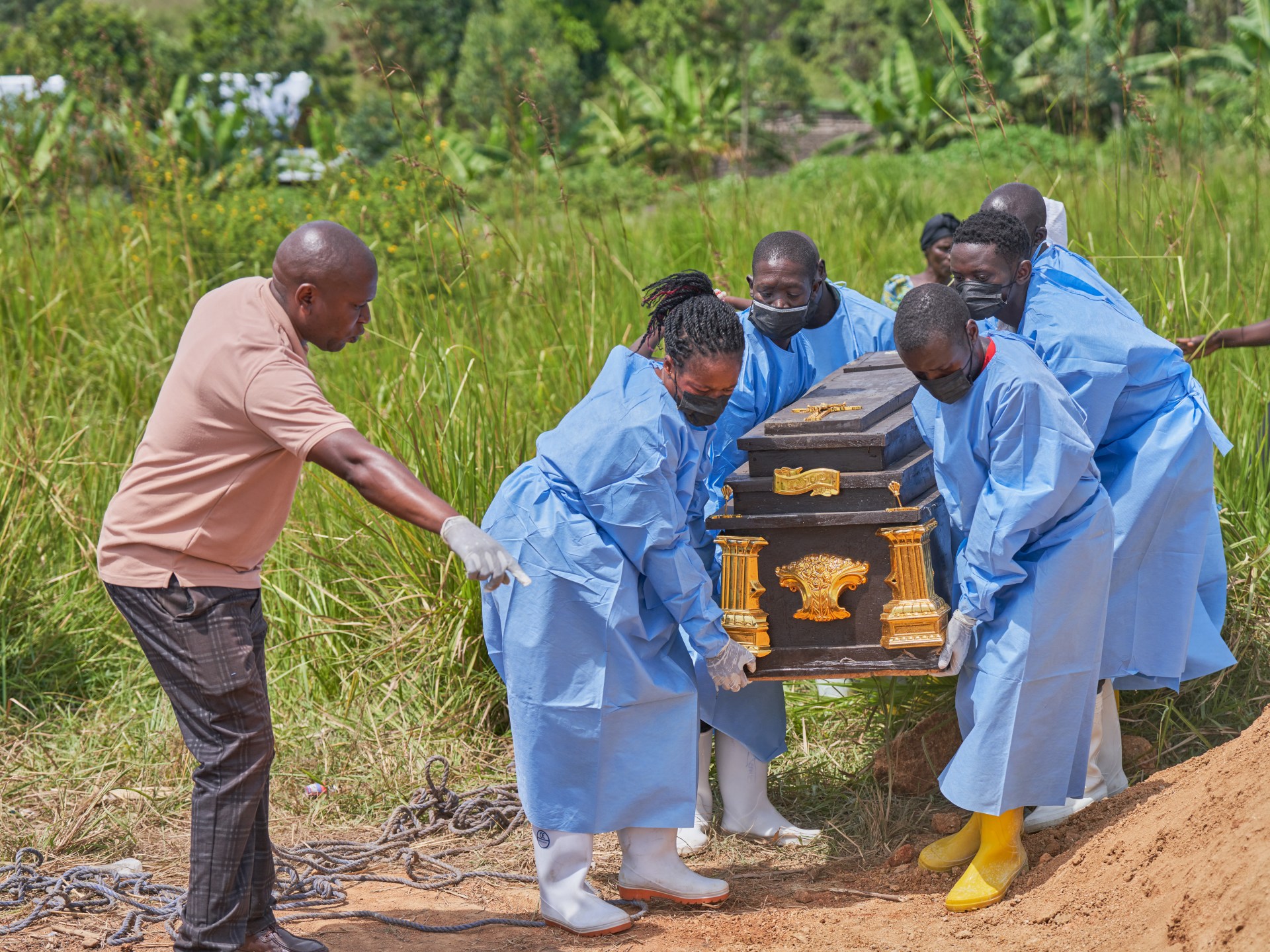

The number of confirmed cases in the Democratic Republic of the Congo (DRC)’s Ebola outbreak has surged to 782, with 178 deaths, marking one of the largest daily jumps so far as regional conflict, patient escapes, and limited contact tracing undermine containment efforts.
The Ministry of Public Health confirmed 72 new cases on Sunday over the previous 24 hours, a record single-day increase, with 29 additional deaths.
- list 1 of 3DR Congo arrive in the US for the World Cup after Ebola quarantine
- list 2 of 3Alarm as Ebola spreads into new areas of DR Congo
- list 3 of 3Clashes break out at DRC rally against presidential term-limit change
end of list
The Bundibugyo virus strain has a 22.8 percent death rate so far, with 40 patients recovering, officials said.
“We remain committed to supporting affected countries until transmission is stopped. We call on partners and donors to urgently mobilise resources to strengthen the response and save lives,” Jean Kaseya, director general of the Africa Centres for Disease Control and Prevention, said on Sunday.
The outbreak stems from the rare Bundibugyo strain, which has no approved vaccine or treatment, unlike the Zaire virus responsible for the DRC’s previous 16 Ebola outbreaks.
Contact tracing coverage has plummeted to 56.5 percent, a sharp decline from the 95% target, Health Ministry officials said.
Doctors Without Borders, known by its French initials MSF, warned that “no one knows the true scale” of the outbreak due to dangerous gaps in surveillance and testing.
Eastern Ituri province remains the outbreak’s epicentre, harbouring nearly 95 percent of all confirmed cases. The virus has since breached into North Kivu and South Kivu provinces and spread across the border to Uganda.
Advertisement
Ituri’s humanitarian crisis exacerbates the medical emergency. Nearly one million residents have fled overlapping armed conflicts involving multiple groups, including the M23 rebel movement that controls Goma, the capital of North Kivu province. The area has endured decades of instability, with United Nations reports documenting massacres of more than 100 civilians in gold-rich Ituri villages as various factions vie for control of the region’s mineral wealth.
Thousands of artisanal miners routinely shuttle between clandestine mining sites scattered across the mineral-dense region, creating transmission hotspots that evade health monitoring. The outbreak is believed to have originated in the mining-intensive Mongbwalu Health Zone in Ituri province.
The World Health Organization announced it is ramping up diagnostic testing and contact surveillance operations. However, MSF reports a critical funding gap of $21.5m hampering response efforts.
Related News
Iran war day 103: US strikes after helicopter shot down, Tehran hits back

Zelenskyy asks Putin for meeting: What’s he offering, could Russia accept?
Iran war live: Trump warns Netanyahu as Israel, Tehran halt fighting