‘Marathon’ shines light on Gaza’s orphaned children and humanitarian crisis
 01 August 2026
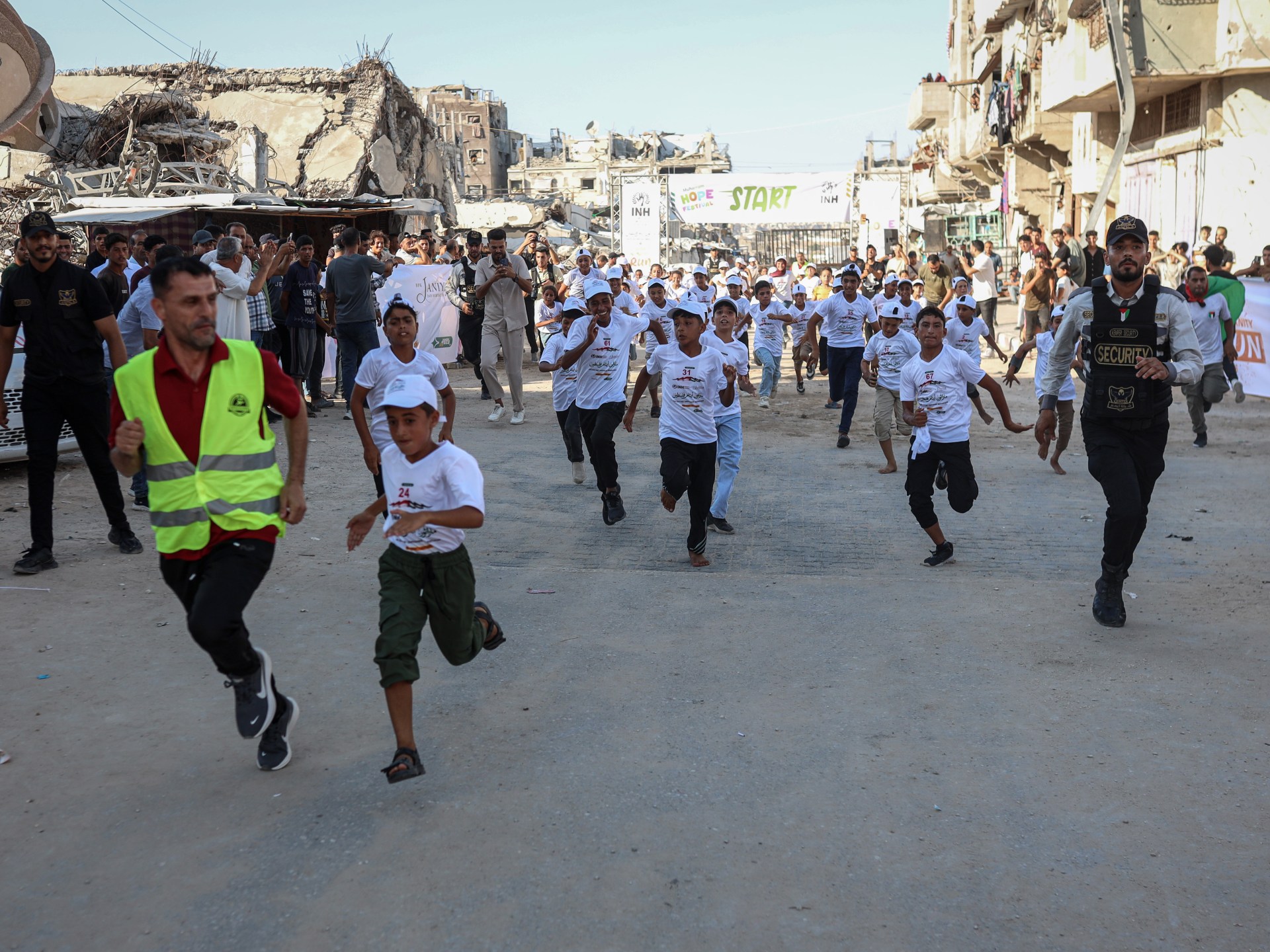

Khan Younis, Gaza Strip – As soon as the whistle blew, they all dashed off – and for a brief moment, nobody focused on the destruction surrounding them.
Cheered on by relatives and friends, dozens of young boys and girls on Friday took part in a race aimed at highlighting the struggles of children who have lost one or both parents during Israel’s genocidal war against Palestinians in the Gaza Strip.
- list 1 of 3Israeli strikes kill at least six, including children, across Gaza Strip
- list 2 of 3Several children killed and wounded in Israeli attacks across Gaza
- list 3 of 3War and shortages push Gaza hospitals to breaking point
end of list
“I miss my father every day. He used to take care of everything for us,” said 13-year-old Saif Hijazi, whose father, Rami Hijazi, was killed in an Israeli attack that hit the family home in northern Gaza in January 2024.
Unlike the other children, Saif was not able to join in the running. Paralysed since January 2025, when Israeli artillery shelling hit near his displaced family’s tent, he watched from his wheelchair as his younger siblings ran alongside other orphaned children.
“Since I was injured, I can’t walk or move on my own anymore,” he said, speaking slowly. “I just want my life to get better.”
![Warda Hijazi with her children: Saif, 13, who was severely injured and left paralysed during the war, her daughter Sarah, 9, and her son Ammar, 10 [Abdelhakim Abu Riash/ Al Jazeera]](https://www.aljazeera.com/wp-content/uploads/2026/08/873A9041-copy-1785605016.jpg?w=770&resize=770%2C513&quality=80)
‘Most affected’
Since October 2023, Israeli attacks on Gaza have killed more than 73,000 people, according to health officials in the territory. The United Nations children agency, or UNICEF, says more than 58,000 children in Gaza have lost one or both parents, while more than one million children require protection and psychosocial support due to the impact of the ongoing war.
Advertisement
UNICEF has also previously estimated that about 17,000 children were unaccompanied or separated from their families, creating one of the largest child protection crises facing children in Gaza.
Many of these children are living through repeated displacement, loss of income and limited access to essential services, including healthcare, education and protection.
In an effort to raise awareness about the plight of orphaned children in Gaza and encourage support for families caring for them, International Networking for Humanitarian (INH) Indonesia organised Friday’s running event in the southern city of Khan Younis. Dubbed a “marathon”, the race brought together orphaned children from across Gaza, giving them a space to participate in a public activity and feel supported by their community.
“Orphans are always among the most affected groups in wars,” said Mohammed Yassin, project coordinator at INH Indonesia. “No matter how much effort we make as an organisation, we cannot reach all of them,” he added.
“Through these activities, we try to remind the world and encourage people to support them and provide sponsorship that can help them in their daily lives.”
Yassin said families in Gaza that still have a provider “are already struggling” to secure the minimum necessities because of the loss of purchasing power and the challenging daily conditions amid a worsening humanitarian crisis.
“But when a family loses its main provider, the suffering becomes much greater in securing basic needs such as water and food,” he added.
![Children run in an orphan marathon organised in Gaza to raise awareness of the rights of orphaned children and the hardships they and their families face during the war [Abdelhakim Abu Riash/ Al Jazeera]](https://www.aljazeera.com/wp-content/uploads/2026/08/0Q1A9554-copy-1785605004.jpg?w=770&resize=770%2C513&quality=80)
‘No choice’
It is a reality that Saif’s mother, Warda Hijazi, knows all too well.
Since her husband’s killing, the 33-year-old has been facing a daily battle: caring for Saif, who also suffers from kidney paralysis, at “every moment”, while also trying to meet the needs of his younger siblings, nine-year-old Sarah and 10-year-old Ammar.
“Everything has become my responsibility,” said Warda. “Their food, their medicine, raising them, and trying to make up for the love and care they lost,” she added.
After multiple displacements, Warda and her children are now temporarily sheltering in al-Zawaida, in central Gaza.
She said losing her husband and then seeing Saif severely wounded pushed her into severe depression, before receiving psychological support through a community programme that helped her regain some ability to cope.
But that support has not changed the reality of her daily life. She remains solely responsible for her children’s needs under extremely difficult conditions.
Advertisement
“Sometimes, I feel the burden is greater than what I can handle, but I have no choice except to continue,” said Warda.
“Orphaned children are living through a very difficult reality,” she added. “They do not only need food; they need someone to make them feel safe, to embrace their grief and give them the love they lost.”
![Samah Abu Amra, a mother of five orphaned children, lost her husband during the first months of the war in Gaza in an Israeli strike [Abdelhakim Abu Riash/ Al Jazeera]](https://www.aljazeera.com/wp-content/uploads/2026/08/873A8925-copy-1785605007.jpg?w=770&resize=770%2C513&quality=80)
‘An orphan needs to be seen and heard’
The story of Saif and his mother reflects a wider crisis affecting thousands of families across Gaza.
“Life is extremely difficult, and the situation is beyond what anyone can bear,” said Samah Abu Amra, a 43-year-old mother of five children aged between seven and 19.
The displaced widow from Rafah became the sole caregiver of her children after her husband was killed in an Israeli attack while walking on the street in Khan Younis during the first year of the war.
“I cannot provide everything they need,” she said. :Children need psychological, financial and emotional support. They need food, clothes, education and even time for recreation. These are many responsibilities for one mother to carry alone.”
Abu Amra said many children orphaned during the ongoing war are not receiving the same level of support that was available in previous conflicts, urging greater attention to the issue.
“An orphan needs to be seen and heard. Their needs must be met. They need someone who asks about them and cares for them, not just temporary assistance,” she added.
Yassin, of INH Indonesia, agreed.
“We call on international organisations and human rights bodies to focus more humanitarian efforts on these cases because they are among the groups most affected in societies impacted by war,” he said.
![Organisers honour orphaned children who participated and won in the marathon[Abdelhakim Abu Riash/ Al Jazeera]](https://www.aljazeera.com/wp-content/uploads/2026/08/873A9231-copy-1785605289.jpg?w=770&resize=770%2C513&quality=80)
Back at the makeshift running track, a chorus of cheers erupted as the young runners crossed the finish line. As soon as the race was over, the children began lining up,
excited to receive their medals.
The organisers also symbolically honoured 100 orphaned children – Saif’s name was the first to be called as a tribute to his courage and the journey he has endured since losing his father and becoming dependent on others after his injury.
“My son needs to feel that he is still part of this world, that people see him and care about him,” said Warda, as she watched her son receive his medal.
“These orphaned children have lost so much, but they still deserve more support and hope.”
![Organisers honour orphaned children who participated and won in the marathon[Abdelhakim Abu Riash/ Al Jazeera]](https://www.aljazeera.com/wp-content/uploads/2026/08/873A9181-copy-1785605019.jpg?w=770&resize=770%2C513&quality=80)
Related News
James Comey’s lawyers say US government distorted details in seashell case
Bayeux Tapestry smuggled into Britain for first visit in 1,000 years
Iran warns Ukraine of retaliation after deadly Caspian Sea strike