
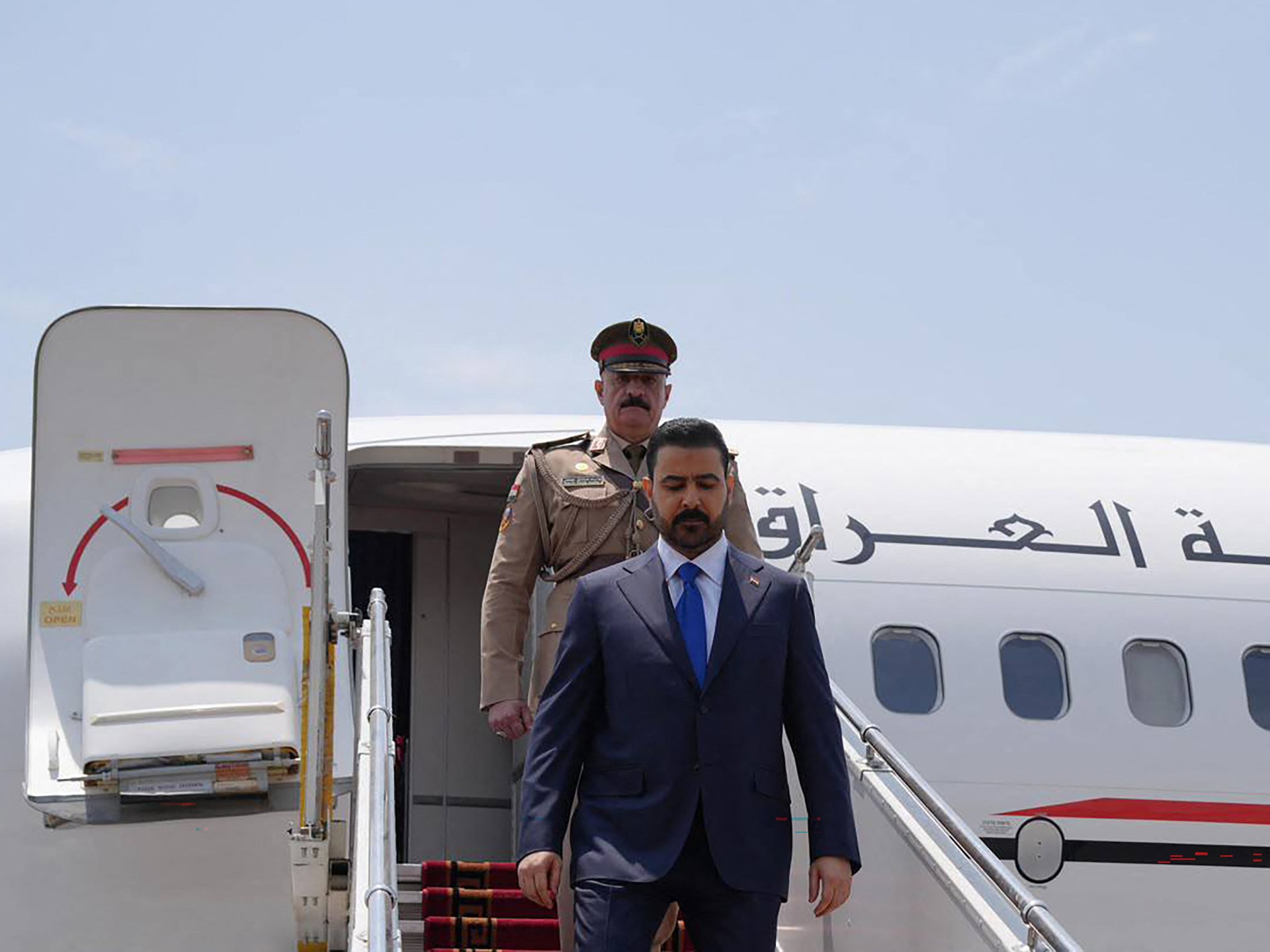

Iraqi Prime Minister Ali al-Zaidi is in Iran on his first official visit since assuming office in May.
The Iraqi News Agency (INA) on Thursday said al-Zaidi and Iranian President Masoud Pezeshkian oversaw the signing of several agreements and memoranda of understanding (MoUs) pertaining to foreign affairs, finance, the economy and energy in Tehran.
- list 1 of 4Iraq PM heads to Iran: Can Baghdad redefine its relationship with Tehran?
- list 2 of 4Rubio says Iran ‘begging’ for a deal with US but not ready to make one
- list 3 of 4Why is Iran still able to conduct deadly attacks on US military sites?
- list 4 of 4Which Middle East nations have nuclear programmes, and how were they built?
end of list
Speaking at a joint meeting of senior Iranian and Iraqi delegations in Tehran, al-Zaidi thanked Iran for helping Iraq in its fight against the ISIL (ISIS) group, and reaffirmed his country’s commitment to security cooperation with Tehran, saying that Iraq would not accept hostile action against Iran by any party.
“Iraq will never forget Iran’s support in the fight against the [ISIL/ISIL] terrorist group,” he said, according to Pezeshkian’s office.
Pezeshkian said a comprehensive strategic cooperation plan would serve as a roadmap for expanding relations between Tehran and Baghdad, stressing that the security of the two neighbouring countries was closely linked.
Over the course of the two-day visit, al-Zaidi will hold talks with other senior Iranian officials on bilateral cooperation, shared interests and regional security, he said on X.
“We will meet with senior officials of the Islamic Republic of Iran to discuss issues of mutual interest, bilateral cooperation, regional developments, and ongoing efforts to consolidate security and stability across the region,” he said.
“Iraq and Iran are bound by historic and civilizational ties, shared borders, and common interests. These enduring bonds call for continued engagement in a spirit of dialogue, cooperation, and mutual respect in a manner that promotes sustainable development and prosperity for the peoples of both countries, while contributing to security and stability at the regional and international levels.”
Advertisement
Iraq remains heavily reliant on Iranian natural gas and electricity, while bilateral trade exceeds $12bn annually, making it one of Iran’s largest trading partners.
A deep religious bond also exists between the two countries, as millions of Iranian Shia pilgrims cross the border to visit Iraq’s holy sites every year. During the week-long funeral held for Iran’s slain Supreme Leader Ayatollah Ali Khamenei earlier this month, the procession travelled through the Iraqi Shia pilgrimage cities of Najaf and Karbala.
The Iranian government has also cultivated close ties with influential Shia parties and armed groups in Iraq that form the backbone of Iraq’s security forces.
Political analyst Ghaleb Al-Daami told Al Jazeera that al-Zaidi’s visit came as Baghdad tries the difficult task of maintaining relations with both the warring parties, the United States and Iran.
Al-Daami said the main objectives of al-Zaidi’s visit were to tell Iran to stop its support for armed groups in Iraq and to deliver a message from the US, which has expressed support for Iraq acting as a mediator amid the US war on Iran.
Related News
Houthi attacks on gov’t forces hint that a major battle in Yemen is brewing
US attacks southern Iran, as Tehran hits Gulf countries: What’s the latest?

Who will win the 2026 FIFA World Cup? Here’s what AI predicts