

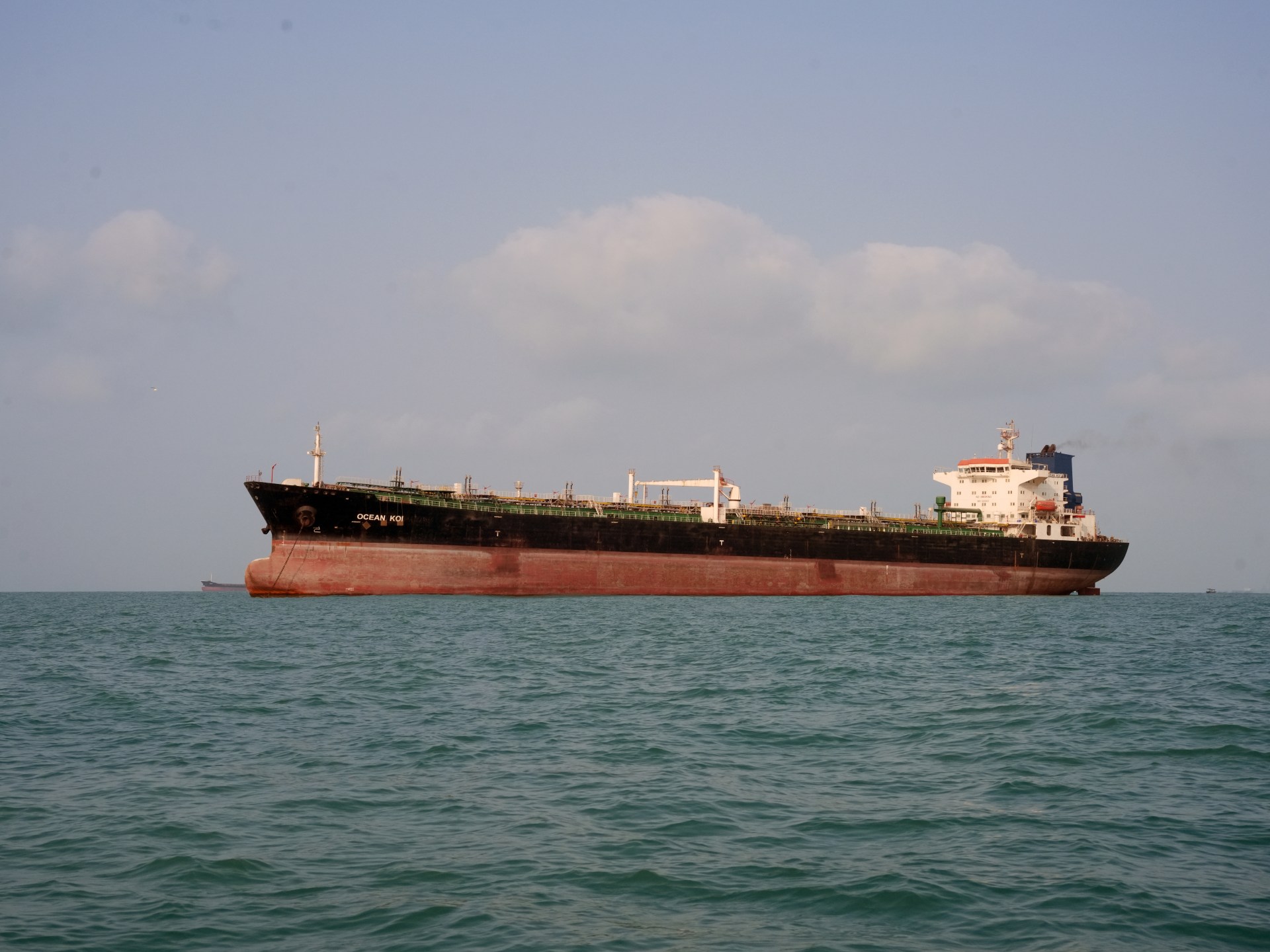

At least five tankers have been damaged in the Strait of Hormuz, Iranian forces said, making clear that shipping would remain in peril as long as the United States and Israel’s war on the country is unresolved.
Since the war on Iran began in late February, Tehran has severely restricted traffic through the strategic waterway, which normally carries about one-fifth of global oil consumption.
- list 1 of 3Iran says US reply to Hormuz plan ‘unconvincing’; Trump confirms strikes
- list 2 of 3Who determines Iran’s fighting and negotiating position amid US threats?
- list 3 of 3Iran’s Khamenei warns Trump loss at polls won’t end US hostility
end of list
“Last night … a large oil tanker attempting to pass through the illegal passageway south of the Strait of Hormuz suffered a fire after striking a mine and was brought to a halt,” Iran’s Islamic Revolutionary Guard Corps (IRGC) told the Fars news agency on Thursday.
“Another supertanker was halted by a massive fire while exiting the eastern Strait of Hormuz. A tugboat that had approached the supertanker to extinguish the fire also caught fire,” the IRGC added.
The Iranian army later said three more tankers were hit by naval mines and caught fire.
“Early this morning, a violating oil tanker – navigating through an unsafe area east of the Strait of Hormuz – caught fire and came to a halt after striking a naval mine,” the army said, according to the official IRNA news agency.
“Today at around noon, two more oil tankers struck naval mines and caught fire in the unsafe waters east of the Strait of Hormuz,” said another army statement carried by IRNA.
Separately, the British military said a tanker was struck by two projectiles off Qatar’s coast.
The vessel was hit about 50 nautical miles (about 93 kilometres) north of Qatar’s Madinat ash-Shamal on Wednesday at 23:20 GMT, the United Kingdom Maritime Trade Operations (UKMTO) agency said on Thursday.
Advertisement
UKMTO did not identify the tanker or which country’s flag it was sailing under. There was no immediate claim of responsibility for the attack.
In an incident last week, a Qatari tanker was hit by “unidentified objects” while sailing in the Gulf.
The liquefied natural gas (LNG) carrier Al Mayeda was hit on October 30, the Qatar Gas Transport Company (Nakilat) said on Sunday.
No crew members were injured, and there was no environmental impact, the company said, adding that the vessel remained safe and operational while the impact was being assessed.
Attacks on tankers in the Gulf are still running close to a record pace.
UKMTO said in a report last month that it was “struggling to accurately report” the true number of attacks as the majority of ships now refuse to report them.
Qatar has stepped up mediation efforts to resume talks on ending the war in recent days.
Qatar’s Ministry of Foreign Affairs’ spokesperson said on Tuesday that both sides were reviewing proposals put forward by mediators, with talks continuing.
But unnamed Pentagon officials and military commanders told The New York Times on Wednesday that thousands of US air and naval forces on more than a dozen ships and at bases around the Middle East and in the US are poised to resume major combat operations against Iran on President Donald Trump’s orders.
Iranian government and military leaders, however, have warned of repercussions if the US or Israel pursue further military action.
On Wednesday, Iranian Supreme Leader Mojtaba Khamenei said there should not be “even the slightest inclination towards submission” to the US, which he said would remain hostile towards Iran no matter which party was in power.
IRGC Ground Force commander Brigadier General Mohammad Karami said on Wednesday that the continuation of “hostile and brutal actions by Iran’s enemies” would lead to “further Iranian victories and greater national pride”, while accelerating the expulsion of foreign powers from the region and the collapse of Israel.
Related News

What to know as Brazil prepares for tense presidential run-off
Israeli forces turn Hebron homes into military posts amid lockdown
Four killed as Indonesia battles worst forest fires in more than a decade