

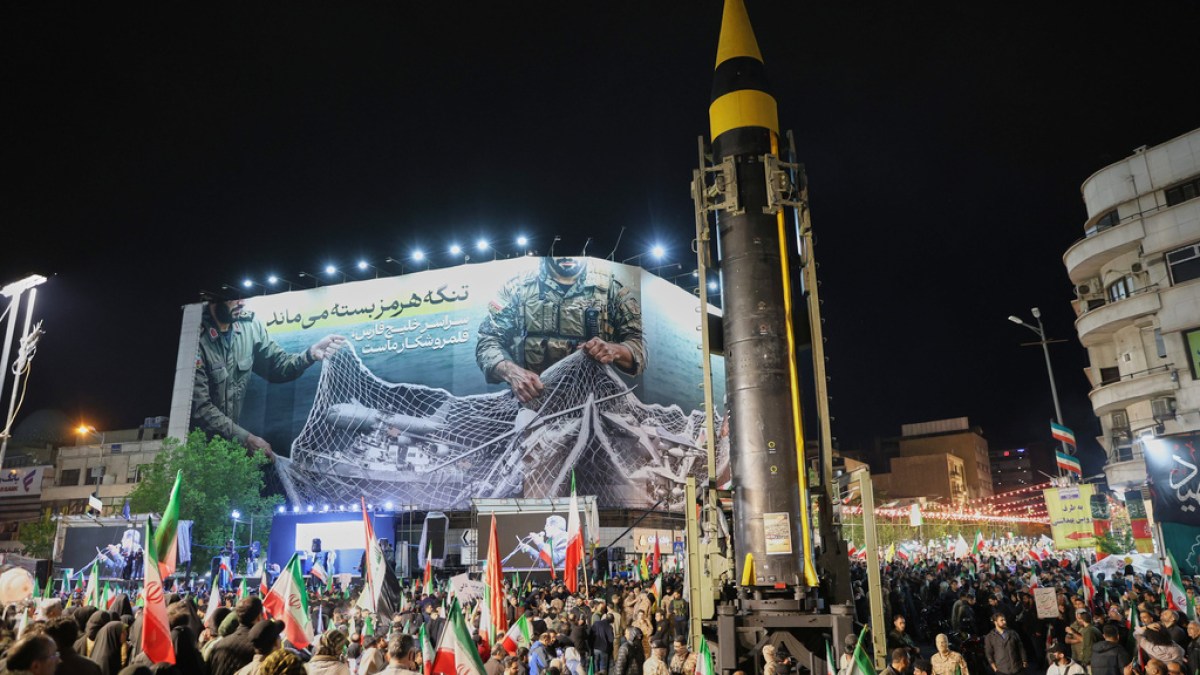

Iranian officials have blamed the United States for the impasse in the negotiations and the continued closure of the Strait of Hormuz, stressing that Tehran will not submit to “bullying” by Washington.
Parliament Speaker Mohammad Bagher Ghalibaf said on Wednesday that there can be no full ceasefire between the two countries if the US naval blockade on Iranian ports persists.
- list 1 of 3Iran says ‘fully prepared’ for football team’s World Cup participation
- list 2 of 3At least four killed in Israeli attacks on Lebanon, journalists wounded
- list 3 of 3Bad optics? Israel jails soldiers who smashed Jesus statue in Lebanon
end of list
In his first comment since President Donald Trump announced he would extend the US-Iran truce, Ghalibaf, one of Iran’s lead negotiators, suggested that Tehran will not capitulate to Washington’s demands because of the siege.
“A complete ceasefire only makes sense if it is not violated by the maritime blockade and the hostage-taking of the world’s economy, and if the Zionist warmongering across all fronts is halted,” Ghalibaf wrote on X.
“Reopening the Strait of Hormuz is impossible with such a flagrant breach of the ceasefire,” he added, saying that the US and Israel “did not achieve their goals through military aggression, nor will they through bullying”.
Iranian President Masoud Pezeshkian echoed that position, stressing that diplomacy, not pressure, was necessary for peace talks.
“The Islamic Republic of Iran has welcomed dialogue and agreement and continues to do so,” he said in a social media post, addressing the US and Israel.
“Breach of commitments, blockade and threats are main obstacles to genuine negotiations. World sees your endless hypocritical rhetoric and contradiction between claims and actions.”
Although both countries have said they are ready to return to war, the ceasefire has so far appeared to hold on Wednesday, the day its initial two-week period expired.
Truce extension
The ceasefire’s extension came only a day earlier, after it became apparent that Iranian officials would not attend talks scheduled in Pakistan in protest against the US blockade.
Advertisement
Amir-Saeid Iravani, Iran’s ambassador to the United Nations, said that breaking the siege is a necessary condition for the negotiations to proceed.
Asked whether the relative calm of the truce will continue, Iravani told reporters, “We have not initiated the military aggression. They initiated the war against us, and we are ready. If they want to sit at the table and discuss and find a political solution, they will find us ready.”
Trump did not set a deadline for the extended ceasefire to expire, but he suggested on Tuesday that the naval siege on Iran would continue to serve as leverage for future talks.
“People approached me four days ago, saying, ‘Sir, Iran wants to open up the Strait, immediately.’ But if we do that, there can never be a Deal with Iran, unless we blow up the rest of their Country, their leaders included,” the US president wrote in a social media post.
Hours before the extension of the ceasefire on Tuesday, Trump had said that he opposed lengthening the truce, and he warned Iran that time is running out before the US launches a huge attack on its infrastructure.
Subsequently, he agreed to hold off the strikes at the request of Pakistani mediators.
‘No war, no peace’
With the blockade still in place and no new date set for the talks, there are concerns that the fighting could resume at any moment.
Reporting from Tehran, Al Jazeera correspondent Ali Hashem said Iran is experiencing a “situation of no war, no peace”.
“Sanctions are still there. The blockade is there. No one can plan for the next week or the week after. Businesses are just waiting to see how this war is going to end,” Hashem said.
The US and Israel launched the war against Iran on February 28, killing hundreds of civilians and several top officials, including Supreme Leader Ali Khamenei.
Tehran responded with missile and drone attacks against Israel and US assets across the entire region. Iran also closed the Strait of Hormuz, sending oil prices soaring.
Iran agreed to re-open the waterway as part of the two-week truce that came into effect on April 8, but it ultimately kept the waterway closed in response to Israel’s refusal to include Lebanon in the ceasefire.
That was a condition originally stipulated in the deal announced by Pakistan.
After a 10-day ceasefire was announced in Lebanon last week, Iran said the Hormuz Strait would re-open, but it shut down the waterway again after Trump said the US naval blockade against the country would persist.
The US military has seized one Iranian vessel during the siege.
Advertisement
For its part, Iran’s Islamic Revolutionary Guard Corps (IRGC) captured two foreign commercial ships in the Strait of Hormuz on Wednesday, saying they violated maritime regulations.
Trump claims Iran executions halted
Despite the rising tensions, Trump said on Wednesday that he “appreciates” that Iran halted the execution of female dissidents at his request.
The US president had shared photos of eight alleged detainees in Iran a day earlier, claiming that they were set to be killed.
“I have just been informed that the eight women protestors who were going to be executed tonight in Iran will no longer be killed. Four will be released immediately, and four will be sentenced to one month in prison,” Trump wrote on his Truth Social platform on Wednesday.
“I very much appreciate that Iran, and its leaders, respected my request, as President of the United States, and terminated the planned execution.”
Later in the day, the White House dismissed US media reports saying that Iran still has significant military capabilities.
“Iran’s defense industrial base was almost completely destroyed,” White House spokesperson Karoline Leavitt wrote on the social media platform X.
“Iran’s ability to build and stockpile ballistic missiles and long-range drones has been set back by years. The vast majority of Iran’s ballistic missiles, launcher vehicles, and long-range attack drones were destroyed.”
Iran was able to launch missile attacks against Israel daily throughout the war.
Related News

Israeli settlers block Palestinian children from school in the West Bank
US panel approves Trump’s design for massive arch in Washington, DC
Report finds Gaza needs more than $71bn in next decade for recovery