

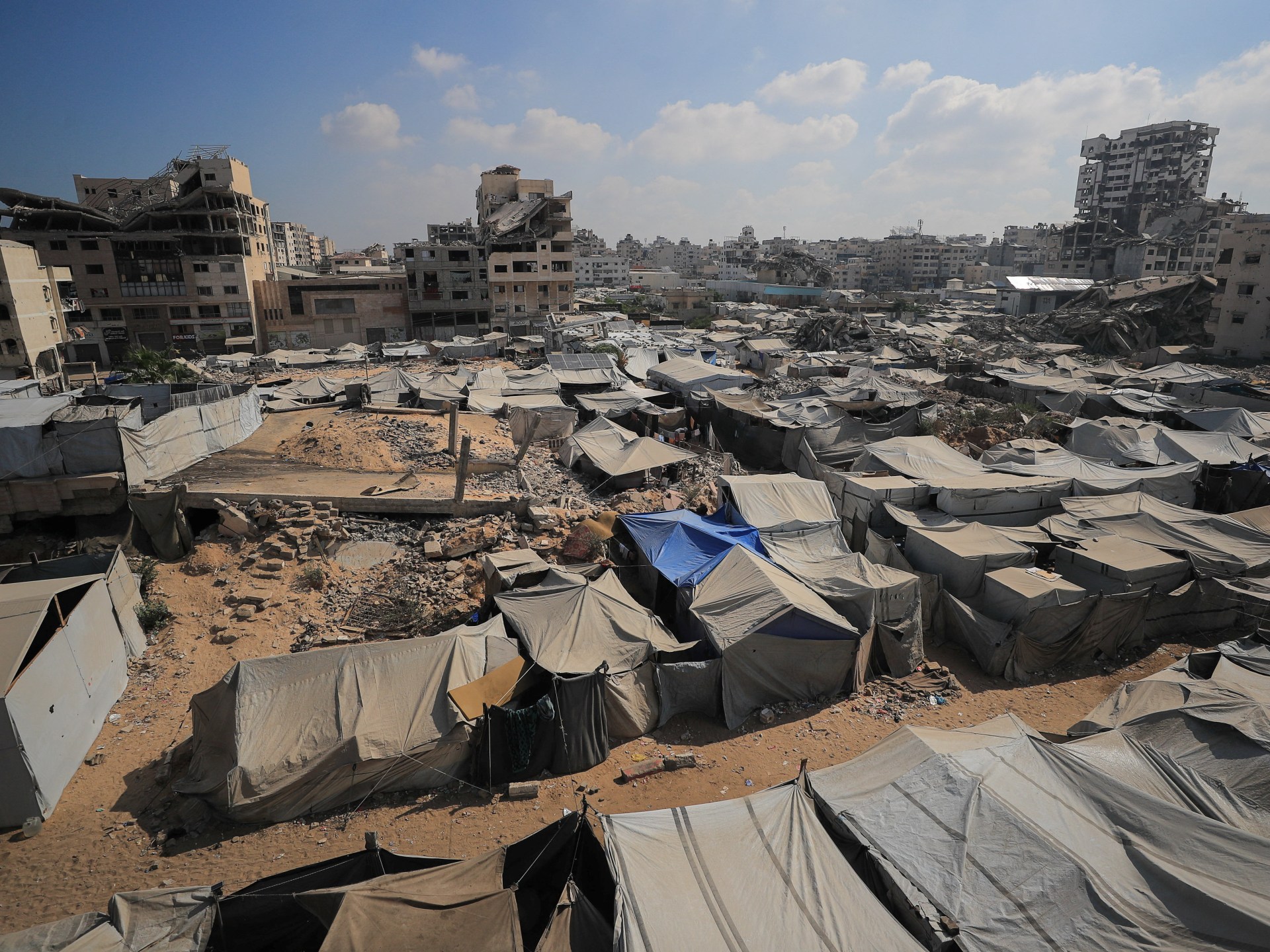

Gaza City – For three years, Palestinians in Gaza have lived with the destruction of their cities and displacement from their homes. Israel’s genocidal war, which started in October 2023, has taken more than 70,000 lives and determined the fates of those who remain.
On October 27, Israelis will vote in a national election that will determine the next government and shape the country’s policies on Gaza.
- list 1 of 4NAZA: Why are old Gaza allegations causing new fury in Israel?
- list 2 of 4What are Iran’s latest conditions to end its war with the US?
- list 3 of 4Israeli settlers storm Al-Aqsa in latest targeting of East Jerusalem sites
- list 4 of 4Do Israelis feel any safer now than they did on October 6, 2023?
end of list
Palestinians in Gaza and the occupied West Bank have no direct say in the vote, but many are closely following party campaigns, because the results might impact their lives.
Thirty-year-old Maryam al-Dabala, who has been displaced about 14 times during the war, said her main concern is whether a new Israeli government will continue the same policies towards Gaza as current Prime Minister Benjamin Netanyahu’s administration.
“If Netanyahu’s far-right government succeeds, it will continue the policy of forced displacement of the people of Gaza,” she told Al Jazeera.
“The biggest fear is that the Netanyahu government will carry out a policy of forcibly displacing Palestinians outside the Gaza Strip.”
Many Palestinians do not believe a victory for frontrunner Gadi Eisenkot, leader of the Yashar party, will improve the lives of Palestinians. Eisenkot was part of Netanyahu’s government during the first eight months of Israel’s genocidal war on Gaza. He supports settlements in the West Bank, which are illegal under international law, and opposes the two-state solution.
But given what she has endured, al-Dabala views another Netanyahu government, likely backed by far-right ministers, such as Itamar Ben-Gvir, as the worst possible outcome.
Advertisement
“A far-right government would have a major impact because of the lack of aid, the lack of medicines and the basic necessities of life,” she said.
“Life is already very difficult because of the shortage of medicine, food and basic necessities. Even the tents we live in do not protect us from the cold or from bombardment.”
![Maryam Al-Dabala, 30, fears the election could bring further displacement and worsening conditions in Gaza. [Abdelhakim Abu Riash/ Al Jazeera]](https://www.aljazeera.com/wp-content/uploads/2026/09/873A2121-copy-1-1790147513.jpg?w=770&resize=770%2C513&quality=80)
That uncertainty is felt most sharply by families who fear that any dramatic political change in Israel could be followed by further escalation on the ground in Gaza.
A “ceasefire” that came into effect on October 10 has not ended the violence in Gaza. At least 1,399 Palestinians have been killed and 4,863 injured since then.
Almost all of Gaza’s population has been displaced at some point in the war, often multiple times, while many still live in tents and temporary structures in camps across the enclave.
Sixty-five-year-old Osama al-Arbaei has been displaced more than a dozen times during the war after his home in Gaza City was bombed, killing nine members of his family.
Speaking from his current residence, a temporary shelter in a school, he said that he did not expect the situation to improve in Gaza regardless of who wins the election.
“There is an agenda, there are red lines and there are margins. There may be a small change in the margins, but the principle does not change,” he told Al Jazeera.
Life for al-Arbaei and many other people in Gaza is a series of violent episodes, cycles of displacement and worsening conditions. He has no income, and the only thing that matters for al-Arbaei about the elections is the impact they might have on food prices, his living conditions and employment opportunities
“Food is still difficult and expensive, and there is no work. A box of tomatoes, for example, can cost 20 or 50 shekels ($6.63 to $16.59) while I don’t have even 2 shekels,” he said.
Despite his bleak appraisal of the situation, he said he will remain defiant whoever leads Israel in the coming years.
“I don’t fear anything. I leave it to God,” he said. “I have never left Gaza, and I will not leave, no matter what happens. I will die here, God willing.”
![Osama Al-Arbaei, 65, says he does not expect Israel’s election to bring fundamental change to Gaza. [Abdelhakim Abu Riash/ Al Jazeera]](https://www.aljazeera.com/wp-content/uploads/2026/09/873A2094-copy-1-1790147519.jpg?w=770&resize=770%2C513&quality=80)
‘We are human beings too’
Umm Mohammed Khalil, a 59-year-old widow displaced from the Sheikh Zayed neighbourhood in northern Gaza to Gaza City, has seen multiple Israeli governments during her lifetime and says she sees little difference between any of them.
Advertisement
“What will change for Gaza?” she said. “Every time we say, ‘God, let the next one be better than the one before.’ But they are all the same.”
She supports 19 family members, and her son and son-in-law are missing, but her main concern is whether the violence in Gaza will intensify again. The almost constant sound of Israeli drones buzzing overhead frightens her and her family.
Umm Mohammed views this election more with frustration than hope. Her message is to the Israeli electorate, who will determine the next government, rather than the politicians.
“Feel for us. We Palestinians are also souls. We are also human beings, people just like you,” she said. “Have mercy on us. No more wars, no more of what is happening in Gaza.”
Asked about the possibility of Netanyahu returning to lead the next government, she expressed a fear of further killings, destruction and displacement.
“Enough death, enough destruction, enough displacement,” she said. “Enough of the lack of food and water. How long?”
![Umm Mohammed Khalil, 59, fears further escalation and hopes for an Israeli leader who will show compassion towards Palestinians. [Abdelhakim Abu Riash/ Al Jazeera]](https://www.aljazeera.com/wp-content/uploads/2026/09/873A2137-copy-1-1790147507.jpg?w=770&resize=770%2C513&quality=80)
What the election could mean for Gaza
Israel’s genocidal war on Gaza remains one of the central issues in Israel’s election campaign.
Israeli affairs expert Ahed Farawaneh said the race remains highly uncertain as recent polls suggested neither the current governing bloc nor the opposition would win the minimum of 61 seats in the Knesset needed to form a government on its own.
“The competition has reached its peak, especially with one month left before the election,” Farawaneh told Al Jazeera. “The issue of the war on Gaza and the issue of displacement are at the forefront.”
War in Gaza, violence in the West Bank, the United States-Israel war on Iran, economic issues and the debate over military service for ultra-Orthodox Israelis are dominating both Netanyahu’s and Eisenkot’s campaigns.
But Farawaneh said a new government led by Netanyahu, likely supported by right-wing and far-right parties, would likely continue its current approach towards Gaza.
Party leaders in this bloc continue to discuss future military operations and displacement in Gaza, including National Security Minister Ben-Gvir, who wants the whole Palestinian population expelled.
“The war on Gaza has become a central part of the election campaign,” he said. “There is a race, particularly among the right and far right, over who will implement these plans towards the Gaza Strip.”
An opposition-led government could be more responsive to international pressure, which could lead to some changes in policy towards Gaza and the West Bank. But it would also face pressure from the Israeli far right.
“There could be some retreat on this issue but not a complete one,” Farawaneh said.
For Palestinians in Gaza, though, the question is not who will win the elections but whether the government that emerges will change the course of a war that continues to shape every part of their lives.
Advertisement
“If Benjamin Netanyahu remains in power, this means the continuation of the escalation in the Gaza Strip,” Farawaneh said.
“If an opposition-led government is formed, there could be some response to international pressure, but it would also face pressure from the far right.”
Related News
Middle East oil exports surpass pre-war levels despite tensions, data shows
UK ‘threatens to expel 27 Israeli diplomats’ over Jerusalem consulate
Iraq’s Kurdish forces look to a new era after US withdrawal