
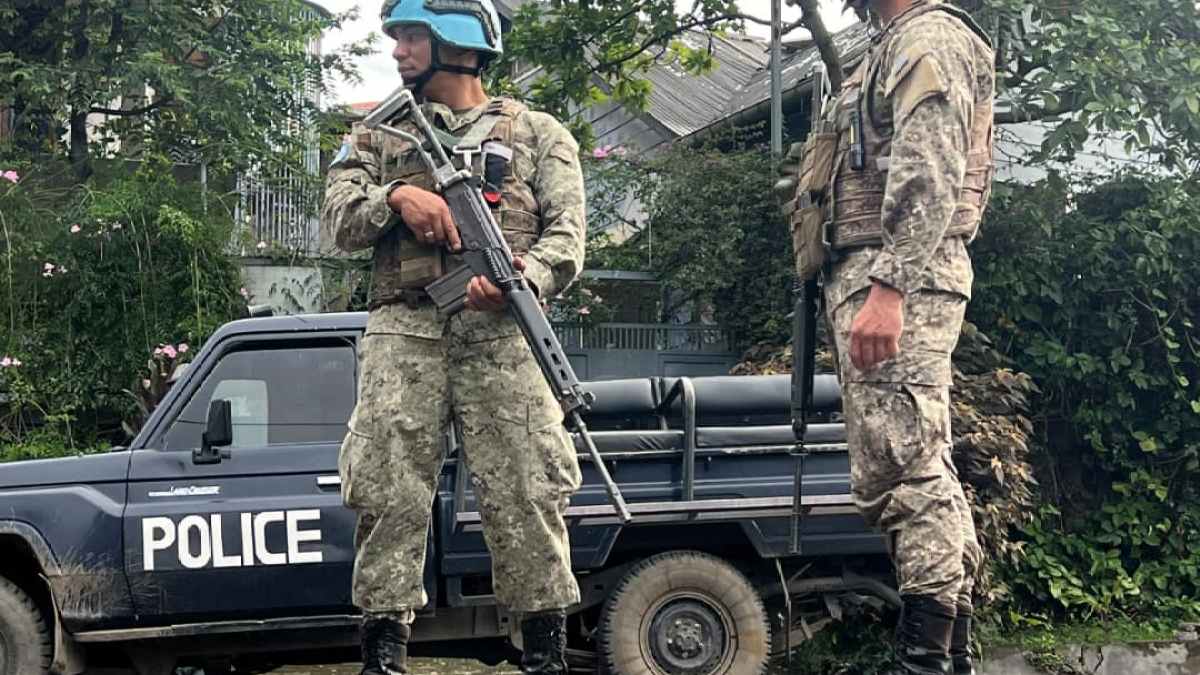

Bukavu, DRC – For residents of eastern Democratic Republic of the Congo (DRC), the succession of diplomatic initiatives meant to end years of conflict is becoming increasingly difficult to reconcile with the violence unfolding around them.
In North and South Kivu provinces, fighting between the Congolese army and the Front for the Refoundation of the Nation (FRN), an armed and political coalition led by former President Joseph Kabila, has continued despite international efforts to secure a settlement. Civilians remain exposed to attacks, displacement and the disruption of essential services.
The latest escalation has raised questions about whether negotiations in Washington and Doha can deliver security on the ground, and whether the separate diplomatic efforts are sufficiently coordinated to make progress.
“One meeting follows another, and they all end up being much the same,” said Blaise Chasumba, a resident of Bukavu, the provincial capital of South Kivu. “But the real peace that the warring parties are dangling before us is far from becoming a reality on the ground. We continue to lose our loved ones and our homes.”
A conflict with deep historical roots
The Washington Accords, signed in December 2025, seek to address tensions between the DRC and neighbouring Rwanda. The Doha process, by contrast, is intended to resolve the conflict between the Congolese government and the Congo River Alliance (AFC), which includes the Rwanda-backed M23 armed group.

The distinction is important: an agreement between Kinshasa and Kigali cannot, on its own, resolve the confrontation between the Congolese government and armed groups operating inside the country.
Advertisement
The Doha Framework for a Comprehensive Peace Agreement was signed by the DRC government, the AFC and M23 on November 15, 2025. In August 2026, representatives of the two sides, alongside Qatar, the United States, Togo, the African Union Commission and Switzerland, agreed on a road map to advance negotiations and establish a mechanism to review implementation. Fighting has nevertheless continued.
The roots of the conflict stretch back decades. The 1994 genocide in neighbouring Rwanda and the flight of former Rwandan soldiers and militia members into what was then Zaire helped create the conditions for successive wars. The presence of armed groups linked to the genocide, and the emergence of the Democratic Forces for the Liberation of Rwanda (FDLR), became a persistent source of tension between Kinshasa and Kigali.
The First and Second Congo Wars, which began in 1996 and 1998, drew in several neighbouring countries. Although the conflicts formally ended, disputes over land, political representation, citizenship and control of natural resources continued to drive violence in the east.
M23 emerged in 2012 after a mutiny by former members of the National Congress for the Defence of the People (CNDP). The group had been integrated into the Congolese army under a March 23, 2009 peace agreement, which its leaders later accused the government of failing to honour. The United Nations and conflict researchers have documented the movement’s origins in the breakdown of that integration process.
The diplomatic landscape has since become more complicated. Established in October 2026 under Kabila’s leadership, the FRN says it has succeeded the AFC and assumed its commitments. The precise relationship between the new coalition and the earlier AFC/M23 structure remains important when assessing who is represented in the negotiations.
On the battlefield, an offensive in early November underlined the fragility of the diplomatic process. FRN fighters advanced through Kahuzi-Biega National Park and along National Road 3, a strategic route linking Bukavu with areas farther north.
Conflict monitoring reports said the fighters captured several localities, including Bitale and the centre of Bulambika on November 8 . The Congolese army said it had halted the advance at Bulambika and was preparing a counteroffensive. Local and military accounts differed over the extent of the fighters’ territorial gains.
Diplomatic commitments, limited progress
The fighting has driven further displacement and placed additional pressure on communities already struggling with years of conflict. Humanitarian organisations have warned that conflict is also making it harder to maintain essential services.
Advertisement
Doctors Without Borders, known by its French initials MSF, said it had reduced its staff presence in the Bunyakiri health zone, relocating some personnel to Bitale and Bukavu as the security situation deteriorated.

“We remind all parties to the conflict of the importance and the obligation to respect and ensure the protection of healthcare facilities, civilian populations and humanitarian staff, in accordance with international humanitarian law,” MSF said in a statement sent to Al Jazeera.
The Congolese armed forces, known by their French acronym FARDC, have blamed recent attacks in North and South Kivu on the Rwandan army and fighters allied with the FRN. The army says it is preparing operations to recover lost positions.
Rwanda denies supporting armed groups in eastern DRC, citing the presence of the FDLR as a security threat. The dispute has remained central to tensions between the two countries.
In a resolution adopted in February 2025, the UN Security Council condemned M23’s offensive and described direct support and participation by the Rwanda Defence Force. It called on Rwanda to end its support and withdraw its forces from Congolese territory. The resolution also condemned support provided by Congolese forces to armed groups, particularly the FDLR, and called for the group’s neutralisation.
The African Union (AU) has acknowledged the gap between diplomatic commitments and conditions on the ground. In a communique issued after a Peace and Security Council meeting on October 26 , it said implementation of commitments under the Washington and Doha processes remained limited. It called for better coordination between the initiatives and urged inclusive, nationally owned dialogue.
The AU’s assessment points to a central weakness in the peace efforts: Agreements and diplomatic meetings have not translated into a sustained improvement in security. The bloc has stressed that a lasting settlement requires political dialogue involving wider sections of Congolese society, including women, young people and civil society organisations.
Civilians demand a voice in the peace process
For some Congolese, negotiations between governments and armed groups are not enough. They want a broader political process that addresses the grievances sustaining the conflict.
Dieumerci Mungu Akonkwa, North Kivu coordinator for Action for Democracy and Development in the Congo, said the negotiations had yet to produce tangible improvements for civilians.
“Since these negotiations began on the ground, there has been no progress. All that is happening is that the lives of peaceful civilians are being cut short. The war continues to create displaced people, and women are being raped,” he said.
Akonkwa called for an inclusive national dialogue, pointing to proposals put forward by Catholic and Protestant church leaders. Such a process, he argued, could bring political actors and civil society into discussions that extend beyond negotiations between the government and armed groups.

The challenge is not only to secure commitments from the parties to the conflict, but to address the local disputes, weak state institutions and impunity that have helped sustain violence in eastern DRC. Without progress on those issues, a political agreement risks leaving the underlying causes of insecurity unresolved.
Advertisement
For residents, however, the immediate measure of progress is simpler: whether the fighting stops, essential services remain available and families can return home.
Chasumba said people were also waiting for those responsible for the destruction to address their losses.
“We are eager to see compensation for the damage caused by the war. Unfortunately, at this rate, we can see that we are in for a long-running saga, full of twists and turns,” he said.
Related News
France tightens security in anticipation of weekend protests
Israeli forces kill four in Gaza as fifth Palestinian dies of wounds
Congress defeat: How Trump’s allies are distancing themselves from Iran war