What are the holes in the UK’s ban on imports from Israeli settlements?
 09 September 2026

Britain has announced a ban on imports of goods produced in illegal settlements in the occupied West Bank as part of a wider package of measures targeting expanding Israeli settlements and intensifying settler pogroms against the Palestinians.
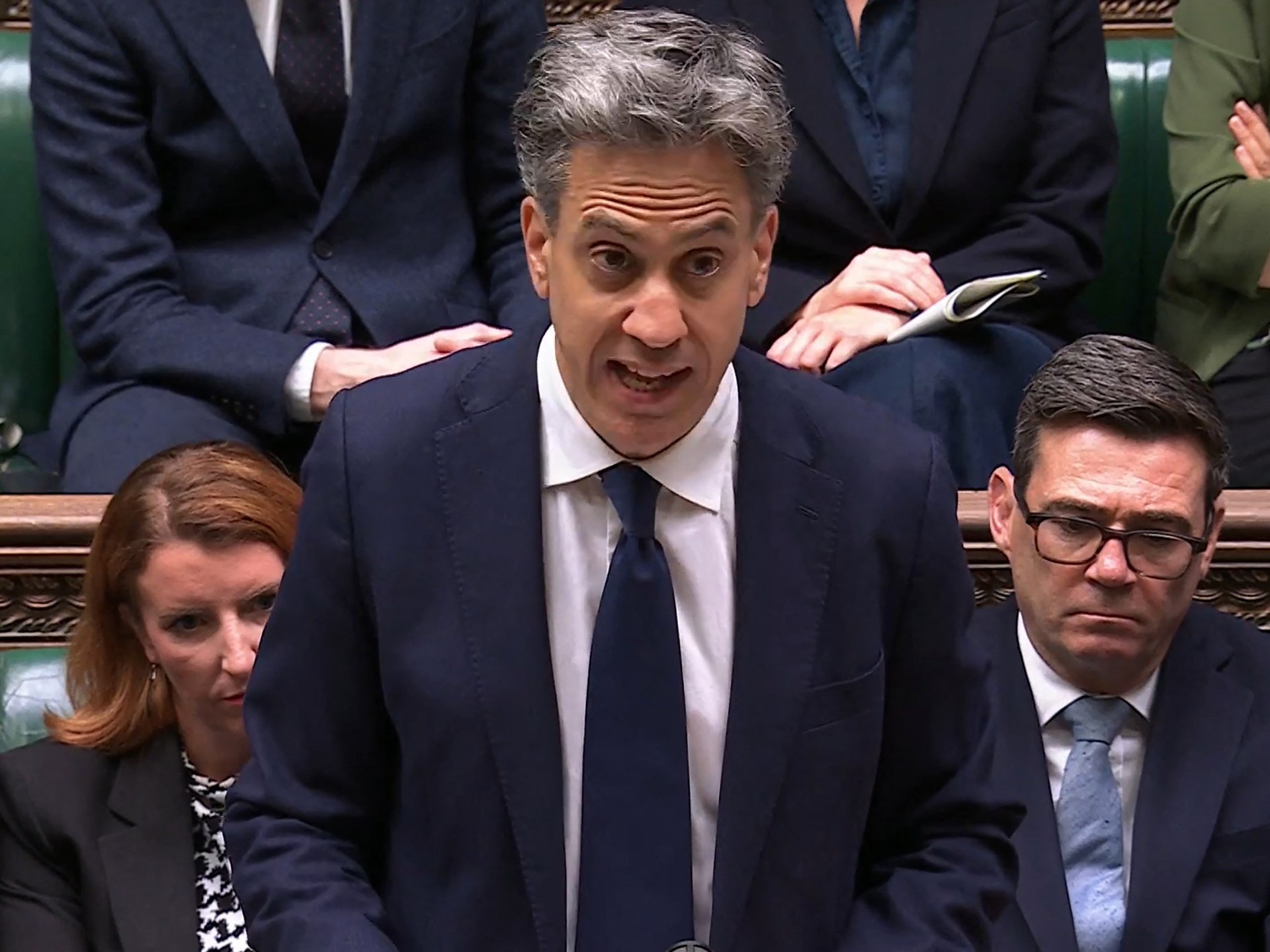
In a speech to Parliament, UK Foreign Secretary Ed Miliband dialled up the rhetoric compared with previous British governments, accusing Israel of carrying out “ethnic cleansing” in Palestine and reaffirming the UK’s longstanding position that Israeli settlements across the occupied West Bank are “unlawful”.
- list 1 of 4In maps and charts: Russian and Ukrainian attacks on civilian targets
- list 2 of 4Flash floods surge through Morocco’s Atlas Mountains
- list 3 of 4Authorities in India rescue baby orangutans dumped in forest
- list 4 of 4Turkish jets perform dramatic flyover above Egypt’s pyramids
end of list
But beyond the language of the announcement, what will the measures materially change? What percentage of Britain’s total trade with Israel is sourced from the illegal settlements?
Also, how will officials distinguish between goods produced inside Israel, those from the settlements, and Palestinian goods in the occupied territory? And could the government’s promise to target companies profiting from settlements ultimately force it to take action against companies to which it has awarded billions of pounds in public contracts? Here is what we know.
What exactly has the UK announced?
The government has outlined five measures:
Banning the import of goods from illegal Israeli settlements into the UK; taking action on services by creating new designation powers to target individuals and companies that support, facilitate or profit from illegal settlement activity; banning the advertising or promotion of land and property in illegal settlements; strengthening the UK’s existing global human rights sanctions regime to target those responsible for serious violations of international humanitarian law, including in Palestine; using that regime to sanction several extremist settlers who have supported or incited pogroms against Palestinian communities.
Advertisement
On the surface, the first measure is straightforward, and it outlines that goods produced in Israeli settlements will no longer be allowed into Britain. But to figure out how much trade that will actually stop is considerably more difficult.
How much trade will the import ban actually affect?
First, this is not a ban on trade with Israel. Far from it. The UK has a free-trade agreement with Israel, and that trading relationship is set to continue. Trade in goods and services between the two countries totalled about £6bn ($8.1bn) in 2025, according to UK government figures.
The new ban applies specifically to goods imported from Israeli settlements in the occupied Palestinian territory.
So how much are those imports worth? The government itself acknowledges that it is “difficult to obtain accurate figures for UK trade” with Israeli settlements.
Al Jazeera asked the British government how much the UK imports specifically from Israeli settlements, but did not receive a response by the time of publication of this article.
Official UK trade statistics distinguish between trade with Israel and trade with Palestine. But they do not distinguish between goods produced by Palestinians in the occupied West Bank and those produced by Israeli settlers living in the same territory. Some 750,000 Israeli settlers live illegally on Palestinian land across the occupied West Bank and East Jerusalem.
That means the Palestine figures cannot simply be read as a measure of Britain’s trade with Israeli settlements. But they do give some indication of the relatively small scale of trade recorded with the Palestinian territory.
The latest government figures, covering the four quarters to the end of March 2026, put total UK-Palestine trade at £40m, up from £38m in 2025.
While the UK says it will “take action” on services, it is not outlined as being included in the initial ban. That means services connected to finance and insurance, logistics, legal services and tourism will not automatically be prohibited in the same way as physical goods.
Meanwhile, the UK goods exported to Israeli settlements, which form the majority of the trade, will also not be included in the ban. That means that over the latest four quarters, the UK imported just £6m worth of goods recorded as coming from Palestine. In theory, even if every one of those imports had come from Israeli settlements, the ban would have affected no more than £6m of that recorded trade over the year.
This is equivalent to just 0.1 percent of the roughly £6bn (some $8bn) in annual trade between the UK and Israel.
Advertisement
The value of settlement goods within that £6m could be considerably smaller. That £6m represents goods Britain records as imports from Palestine – not goods specifically originating in the illegal Israeli settlements. It can therefore include products grown or manufactured by Palestinians living under occupation in the West Bank.
Among the largest categories of goods Britain imports from Palestine are fruit and vegetables, vegetable oils, and coffee, tea and cocoa – precisely the kinds of agricultural products that can be produced by Palestinian farmers as well as Israeli settlement businesses.
This also means Britain is therefore preparing to ban a category of imports whose current value it cannot accurately quantify. So if Britain cannot accurately measure the flow of settlement goods into the country, how will it identify and stop them at the border?
Could settlement goods simply be labelled as Israeli and escape the ban?
While the figure for the occupied Palestinian territory includes some settlement goods, there is another route by which goods from Israeli settlements can make it to Britain. And, again, it is very difficult for the UK government to keep track of this.
A June 2026 report by the Global Echo Litigation Center called Importing Occupation examined shipments of fresh produce from Israel to Europe and found that settlement goods were systematically concealed within supply chains.
That means goods labelled as Israeli – and which would therefore, in theory, be counted within the roughly £6bn UK-Israel trading relationship – can include products originating in Israeli settlements.
In fact, the investigation found that roughly one in six shipments it examined contained products originating in Israeli settlements, according to the organisation.
Goods produced in the occupied Palestinian territory could consequently reach markets presented as products of Israel.
That exposes a potential weakness in Britain’s proposed system. If settlement goods are concealed within Israeli supply chains and presented as Israeli products, identifying them at the border – and enforcing the import ban – becomes considerably more difficult.
So how does the UK government enforce it?
The government has not yet set out in detail how the new import ban will be policed. Britain does, however, already operate a system intended to distinguish goods produced in Israeli settlements from those produced within Israel’s internationally recognised borders.
The distinction currently matters because of tariffs. Under the UK-Israel trade agreement, qualifying Israeli products can receive preferential tariff treatment. Products originating in Israeli settlements in territory illegally occupied since 1967 cannot.
To claim those preferences, importers must provide proof of origin. That documentation must include the postcode and name of the city, village or industrial zone where a product obtained its originating status.
HM Revenue and Customs maintains a detailed list of locations that are not eligible for preferential treatment under the UK-Israel agreement, including settlements and industrial zones in occupied territory.
Advertisement
Since September 2025, another requirement has been added. Importers seeking Israeli tariff preferences must use customs document code Y864, declaring that the goods did not originate in territories brought under Israeli administration since June 1967.
In other words, Britain already has a mechanism for finding out where this product was actually made.
But, under the existing rules, a settlement product can still enter Britain – it just cannot get preferential treatment available to qualifying Israeli goods.
And a postcode-based origin regime works only if the origin being declared is accurate. If a product grown or manufactured in a settlement can be consolidated, repackaged or otherwise passed through an Israeli company before export, customs officials need a means of establishing where the product actually originated rather than simply where it was exported from.
Banning all Israeli goods would plainly solve the origin problem – there would no longer be a need to distinguish settlement products from other Israeli imports – but that is not the policy Britain has announced. Its much larger trading relationship with Israel will continue.
Will Britain end up sanctioning companies it already does business with?
Goods, however, are only one part of the government’s announcement. Potentially more consequential is its promise to create new designation powers targeting individuals and companies that “support, facilitate or profit from” illegal settlement activity.
That wording raises a very different question. What happens when the company profiting from settlement activity is also doing business with the British government?
An Al Jazeera investigation published last week found more than £2.1bn ($2.8bn) in UK public-sector contracts were awarded to 17 companies and entities linked to illegal Israeli settlements.
Companies owned by Motorola Solutions, the US technology and communications giant, accounted for more than £1.7bn ($2.3bn) of that total, the vast majority, through its British subsidiary Airwave Solutions.
Other contracts identified by Al Jazeera were held by companies belonging to four major corporate groups: German building materials multinational Heidelberg Materials, French engineering group Egis, Spanish train manufacturer CAF and Chinese conglomerate Fosun.
All of the companies identified in Al Jazeera’s investigation were connected to corporate groups whose activities have been linked to Israeli settlements, including through infrastructure, transport, communications or commercial operations.
The government’s latest announcement, therefore, creates a potentially awkward contradiction. Britain says it intends to acquire new powers to designate companies that profit from illegal settlement activity.
So how broadly does the government intend to use those powers? If companies profiting from settlement activity fall within these parameters, some could potentially find themselves targeted by the same government from which their corporate groups or subsidiaries hold major public contracts.
That could have consequences well beyond the comparatively small flow of physical goods from settlements. For example, what would then happen to the Home Office contract with Airwave Solutions, owned by Motorola Solutions, worth 1.562 billion pounds ($2.13bn) to provide the secure communications network used by police, fire and ambulance services across England, Scotland and Wales?
The overriding question is what this designation would mean for existing public contracts – including whether sanctions could require, permit or prompt the government to terminate or restructure them.
Advertisement
Al Jazeera has asked the government whether it is reviewing its existing public-sector contractors for links to Israeli settlement activity, whether companies holding government contracts could be designated under the new powers, and what would happen to existing contracts if they were.
The UK government has not responded to Al Jazeera’s request for comment.
Related News
Israel tells UK to close East Jerusalem consulate within 30 days
Why aid entering Gaza may not reach those who need it

Two Palestinians killed by Israeli tank fire in southern Gaza