

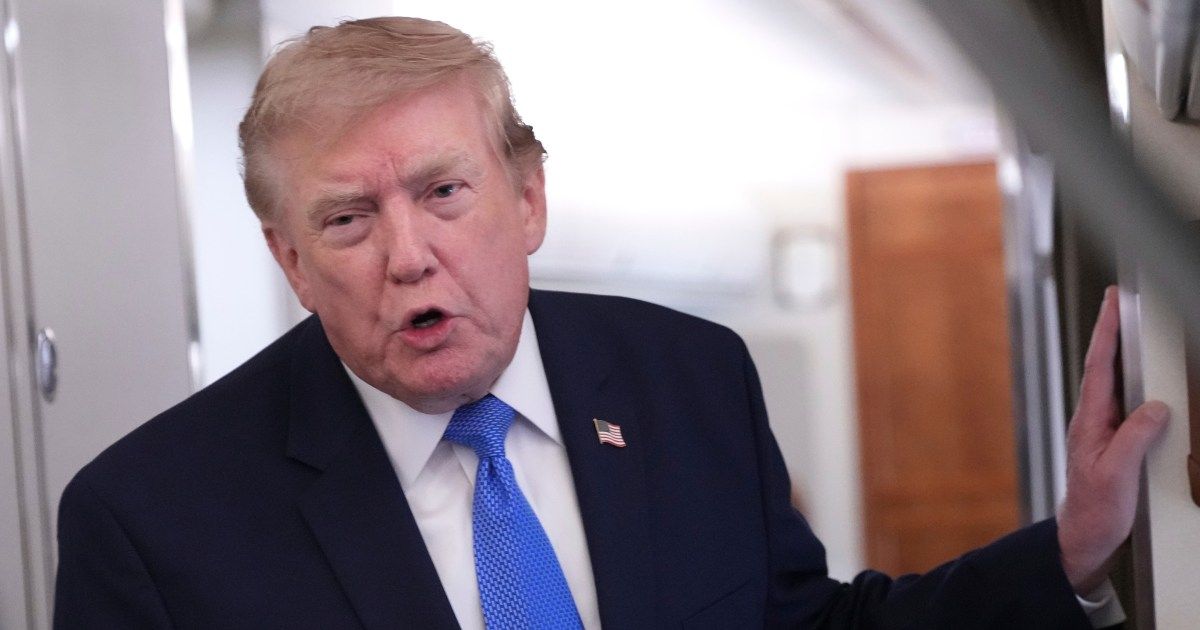

United States President Donald Trump told reporters on Sunday that an agreement with Iran is imminent and new talks were set to begin on Monday.
But at a news conference on Monday, an Iranian Ministry of Foreign Affairs spokesman said: “We are not going to host a delegation or be guests of a country during these days.”
Here is what we know so far about the prospect of new negotiations:
What has Trump said?
As he was returning to Washington, DC, from a weekend in New Jersey on Sunday, Trump told reporters that new negotiations were to begin on Monday after calling off what he said would have been “massive strikes” on Iran.
He did not provide any details about where the talks would be taking place or who would participate.
When reporters asked the US president if there was a deadline for an agreement with Iran, he declined to answer.
Instead, he responded: “Would I rather make a deal? I’m not looking to kill people because people die, a lot of people die, and we don’t want that.”
On Monday, Trump again said an attack that the US had planned against Iran would have been the “biggest attack since World War II” but he had decided to call it off.
“And the deal is imminent, having to do with the Hormuz Strait and ultimately the denuclearisation of Iran,” Trump said.
Are negotiations taking place, and who is taking part?
Reporting from the Qatari capital, Doha, on Monday, Al Jazeera’s Osama Bin Javaid said that just before Trump’s announcement, an unnamed source had hinted that mediators were ready to fly to Tehran, where an indirect negotiation session would be held.
Advertisement
Bin Javaid added that the talks would likely first focus on ongoing discussions between Iran and Oman for a deal on control of the critical Strait of Hormuz.
He reported: “There are going to be intermediaries. We’re hearing from our sources that the Pakistani interior minister and especially the Qataris are going to be sending emissaries so that this can take place as soon as possible.”
“We don’t know the specific details, but we do know something is in the making,” he reported.
On Monday, however, Esmaeil Baghaei, spokesman for the Iranian Foreign Ministry, said: “We are not going to host a delegation or be guests of a country during these days.” It was unclear if the spokesman was referring to direct talks only, meaning that indirect talks via mediators could go ahead.
Reporting from Tehran, Al Jazeera’s Tohid Asadi said: “Indeed, Iran is talking to the Omanis. They are saying that all these talks are focused on reopening the Strait of Hormuz and on finding measures and trajectories to do so.
“Iran is [conducting the talks] in a bilateral way, denying any potential foreign intervention in that regard.”
Is a peace deal really ‘imminent’?
Trita Parsi, executive vice president of the Quincy Institute for Responsible Statecraft, told Al Jazeera on Monday that Trump’s repeated escalations and then cancellations of attacks on Iran have harmed prospects for a negotiated settlement to the war.
“I think this has become somewhat of a tiresome pattern,” he said.
“At some point, all credibility for negotiations is going to be lost. The credibility of actually sticking to a deal is questionable. The credibility of any incentives that are offered is questionable. And obviously, the credibility of the threats is degraded.”
Alan Eyre, a distinguished diplomatic fellow with the Middle East Institute in Washington, DC, told Al Jazeera the only important talks taking place right now are those between Iran and Oman about the Strait of Hormuz.
He explained that Iran has decided it is not worth talking directly to the US because it “can’t count on anything the US says”.
“Nothing has changed. President Trump has promised to annihilate Iran five or six times and then backs down at the last minute. I think it’s highly doubtful there are talks, that he’s reaching an agreement with Iran on the nuclear issue or the Strait of Hormuz,” Eyre said.
Charles Kupchan, a senior fellow at the Council on Foreign Relations, said while he believes a deal on the Strait of Hormuz is achievable, a fuller peace agreement on Iran’s nuclear programme and other issues remains far more elusive.
Advertisement
“Do I think that there may be a framework for opening the Strait of Hormuz? Maybe, could be. Do I think that there’s an actual agreement on the nuclear issue? Absolutely not. That is far off in the distance, if at all achievable,” he told Al Jazeera.
Is a deal on the Strait of Hormuz close?
On Sunday, Iranian Foreign Minister Abbas Araghchi said negotiations between Tehran and Oman on the future management of the Strait of Hormuz were in their “final stages”, the Iranian news agency IRNA reported.
The critical waterway, through which one-fifth of the world’s oil and liquefied natural gas supplies were shipped before the US-Israel war on Iran began, has become the most urgent issue on the agenda for talks with the US.
It was essentially closed by Iran in early March after the US and Israel began their air strikes on February 28. Iran allowed few ships to pass through the strait until it signed a memorandum of understanding with the US on June 17.
However, the vague wording of that agreement triggered a dispute over which routes ships should take, and Iran attacked several ships that were following an Oman-approved route through the southern part of the waterway. The strait was then closed again last week, and the US restarted its naval blockade on Iranian ports.
Last week, Oman presented a proposal backed by other Gulf countries for the future management of the strait to Iran, which rejected it and made counterproposals.
Iran’s state media reported on Sunday that Araghchi had spoken by phone with his Saudi counterpart, Prince Faisal bin Farhan Al Saud, and Pakistan’s military chief, Field Marshal Asim Munir, to discuss diplomacy to resolve the crisis.
Baghaei said negotiations would be about agreeing on a new route through the Strait of Hormuz.
Baghaei added that Tehran has been holding talks with Oman “for the past seven to eight days”.
“Some progress has been achieved,” he said, adding that talks with officials from the region and outside the region are being held as well.
Why did Trump pause strikes on Iran, and will fighting resume?
On Monday, Trump told reporters he called off major attacks on Iran on Friday at the request of “the three primary groups” – Qatar, Saudi Arabia and the United Arab Emirates – which had urged him to hold off and pursue a deal instead.
Oil prices fell by more than $4 a barrel after Trump called off his planned attacks on Iran’s infrastructure.
Brent crude futures slid $4.08, or 4.64 percent, to $83.85 per barrel late on Sunday while West Texas intermediate crude was at $80.66 a barrel, down $4.01, or 4.74 percent, according to the Reuters news agency.
However, US officials have made it clear they are still prepared to launch more attacks on Iran.
US Secretary of Defense Pete Hegseth repeated Trump’s claim that the Pentagon was ready to attack Iran at “levels not seen since World War II”.
He added that the US remains “locked and loaded” in an X post on Monday.
Related News
Children face higher threat of US deportation as legal support deal expires

‘Escaping Beijing’: Why some young Chinese are quitting the capital
Israel launches military incursion into Syria amid UN condemnation