
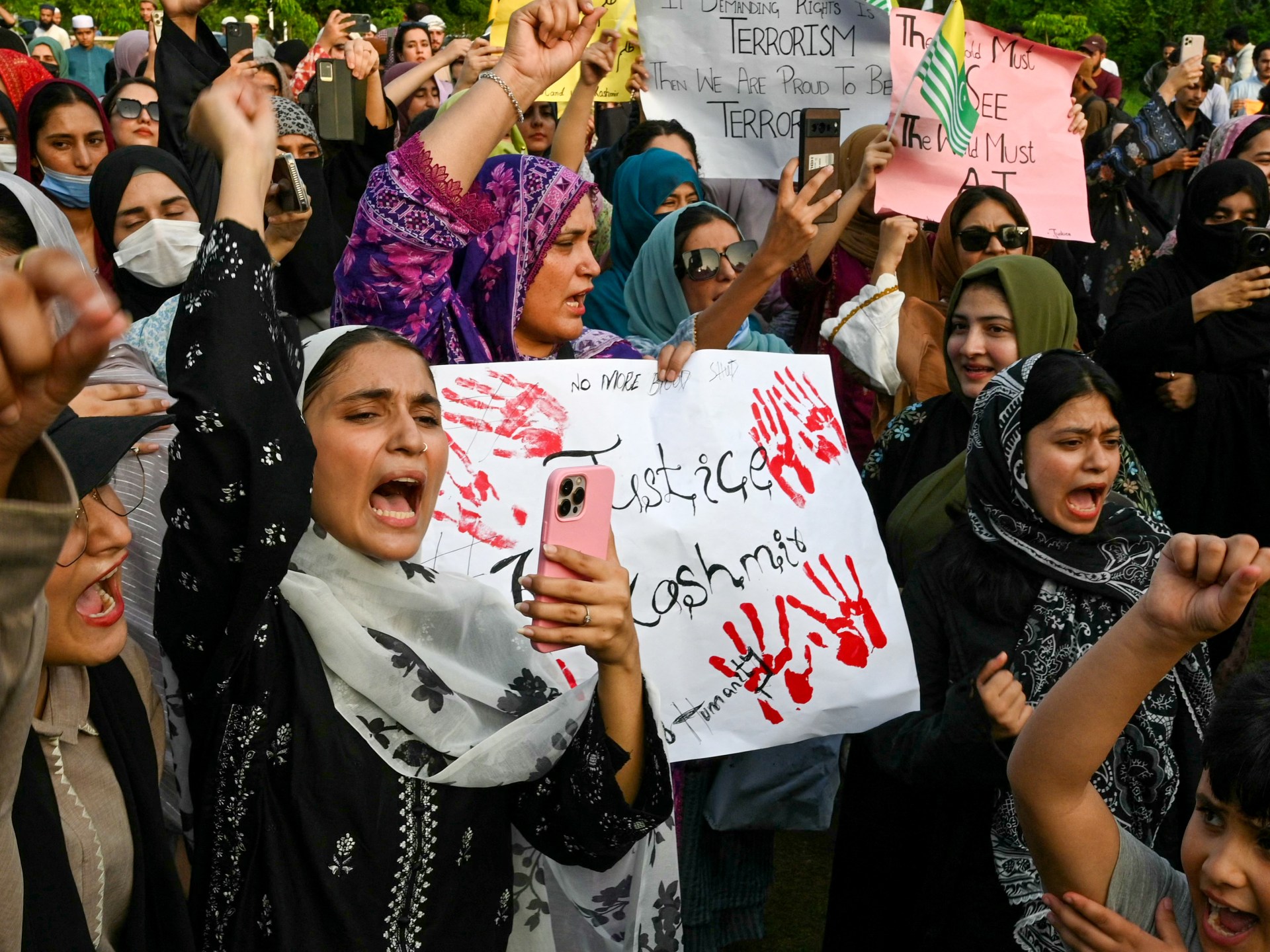

Watchdogs have raised concerns over mounting reports of deadly clashes during regional elections in Pakistan-administered Kashmir, where a banned activist group has boycotted the vote and staged protests.
The clashes between police and protesters earlier this week killed more than 30 people in the region, according to the leaders of the Joint Awami Action Committee (JAAC).
- list 1 of 3Pakistan’s Kashmir votes: Why the election hinges on 12 disputed seats
- list 2 of 3Thousands march in Pakistan-administered Kashmir amid election unrest
- list 3 of 3Kashmiri activist Khurram Parvez and journalist Irfan Mehraj freed on bail
end of list
In a video statement on Wednesday shared by Arab News Pakistan, JAAC committee member Sardar Umar Nazir claimed 20 of the group’s supporters had been killed during a march on Monday, when the first round of voting took place.
He listed reports of at least 10 other protesters being killed the following day in the towns of Rawalakot, Mirpur and elsewhere, including during sit-ins.
“Our demand was peaceful, it was peaceful, we tried to keep it non-violent and bullets were fired at it,” said Nazir in the video statement.
Pakistani authorities said a member of the security personnel was killed and five more were injured in clashes on Monday.
Rights group Amnesty International called the reports of lethal force against protesters in the area “disturbing” and urged an investigation.
Pear Pandya, a senior analyst at conflict monitor ACLED, said the violence in Pakistan-administered Kashmir “is bound to overshadow the legitimacy of the entire electoral exercise”.
Monday’s first-round vote – covering the districts of Mirpur, Kotli and Bhimber – will be followed by two more rounds on August 2 and August 10.
Pakistan’s primary governing party, the PML-N, won nine out of the 13 seats that were up for election on Monday.
Advertisement
No justification to ‘mete out violence’
JAAC was banned by the local government under “anti-terrorism laws” in June, causing deadly protests to erupt in Pakistan-administered Kashmir.
Banking, roads and internet services have largely been disrupted since then, hindering the flow of information.
Pakistani officials have justified the crackdown by alleging that armed and India-backed fighters joined the Kashmiri protesters. India has rejected similar accusations in the past.
Amnesty has called the ban on JAAC unlawful and said it does not provide justification for authorities to “mete out deadly violence against protesters”.
The rights group has also urged Pakistani authorities to ”restore all communications access and allow media and independent observers into the area”, its acting regional director for South Asia, Isabelle Lassee, said.
‘Controversial’ seats
One of JAAC’s central demands regarding the regional elections is the abolition of 12 assembly seats reserved for Kashmiri refugees.
JAAC supporters say the seats are used by major Pakistani political parties to tip the composition of the local parliament in their favour with those who mostly live outside the region.
To form a regional government, the PML-N would likely need the support of some of the 12 representatives, said Hasan Askari, a political analyst.
“But when their government is dependent on those 12 controversial seats, how would it be able to find a solution for this issue?” Askari told the Reuters news agency.
Even among the candidates that did not boycott the vote on Monday, the results were contested. Parties accused each other of ballot box stealing and vote rigging.
Related News
US-Iran talks in Doha: What were the outcomes and what’s next?
US judge sides with NAACP over proposed mail-in ballot restrictions

Hunger is falling but is still higher than pre-COVID levels: UN report