

A Kenyan court has suspended a plan to establish an Ebola quarantine facility for United States nationals exposed to the virus following a backlash from health workers and rights activists.
High Court Judge Patricia Nyaundi on Friday ordered a halt to the agreement on the facility, pending a ruling in a legal challenge brought by activists. The case should be heard next week.
- list 1 of 4World Cup dark horses: Unheralded Netherlands should not be written off
- list 2 of 4NATO states slam Russia after drone crashes in Romania
- list 3 of 4South Korea’s SK Hynix enters exclusive $1 trillion club
- list 4 of 4Gaza parents brave dental dilemma: Costly treatment or food on the table?
end of list
The proposed arrangement emerged amid fears that the disease could spread beyond Central Africa. An outbreak centred on the eastern Democratic Republic of the Congo (DRC) and crossing into Uganda has killed more than 200 people.
As countries seek to avert the spread internationally, the US struck a deal to isolate and monitor potentially exposed citizens in Kenya rather than transport them directly home for treatment.
The Katiba Institute, a Kenyan rights group, said in a petition challenging the planned facility, which was due to start operating on Friday, that it was being established in secrecy and unilaterally and that it “raises grave constitutional concerns”.
The filing warned of “grave and imminent risks” to public health, arguing in court that bringing Ebola-exposed individuals into Kenya, which has no known cases of the virus, could increase the risk of the disease spreading in the country.
National biosecurity
When the legal challenge was issued, it was unclear where the facility was to be located, or whether the Kenyan government had formally approved the plan.
Nairobi has publicly acknowledged discussions with Washington over support for Ebola preparedness efforts, but has not directly addressed the reports about a quarantine facility.
Advertisement
“The secretive, unilateral establishment of an Ebola quarantine facility raises grave constitutional concerns regarding the rights to life, health, fair administrative action, public participation, and parliamentary oversight,” the Katiba Institute said in a statement.
US Secretary of State Marco Rubio said Washington intended to commit $13.5m towards Kenya’s Ebola preparedness efforts, though he did not publicly confirm details of the proposed quarantine arrangement.
US officials later said a facility with 50 isolation beds, intended to quarantine US nationals arriving from the DRC, was due to open on Friday.
The facility was to be managed by US medical staff at Laikipia Air Base, about 200km (124 miles) from the capital, Nairobi, they added, according to the AFP news agency.
The Kenyan doctors’ union on Thursday issued a 48-hour strike alert in preparation should the government proceed with the deal, accusing authorities of putting public health at risk.
The union said the US appeared unwilling to allow Ebola-exposed individuals onto its soil and warned Kenya should not become a “dumping ground”.
“As the vanguard of Kenya’s healthcare system, we are utterly disgusted by the government’s apparent willingness to trade national biosecurity and the lives of its citizens for foreign aid,” the union’s secretary-general, Davji Atellah, said in a statement.
The Law Society of Kenya also warned the country lacked “the high-containment infrastructure required to safely manage such a facility”, potentially exposing the public to serious health risks.
‘Catastrophic collision’
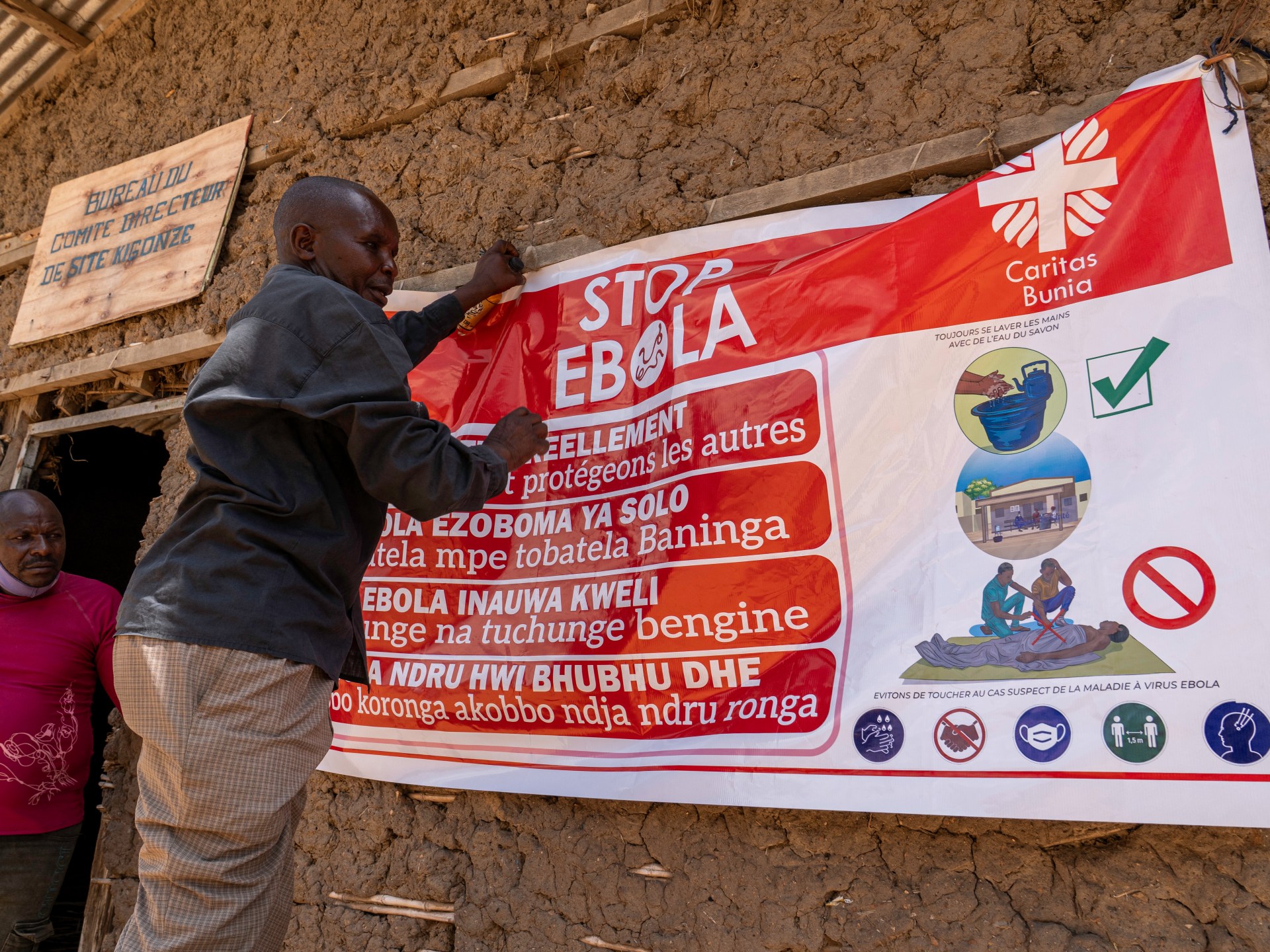
The dispute comes as health authorities race to contain the outbreak of the Bundibugyo strain of Ebola in northeastern DRC, where overstretched health workers, limited medical supplies, and ongoing conflict and displacement have hampered efforts to stop the virus from spreading.
Unlike several other forms of Ebola, the Bundibugyo strain has no approved vaccine or specific treatment.
World Health Organization Director-General Tedros Adhanom Ghebreyesus said the outbreak was heavily concentrated in Ituri province in northeastern DRC, which accounts for more than 90 percent of reported cases, with smaller numbers also detected in North Kivu and South Kivu provinces.
The region has been at the centre of conflict for decades, as armed groups compete for control of the vast mineral wealth it holds. Huge numbers of displaced people huddled in refugee camps and the breakdown of state services are complicating efforts to quash the outbreak.
Advertisement
“Eastern DRC now faces a catastrophic collision of disease and conflict,” Tedros wrote on social media on Wednesday.
The Congolese government has confirmed more than 1,000 suspected cases and at least 220 deaths since declaring the outbreak on May 15.
WHO believes the true scale of the outbreak is likely much larger, warning the virus had been spreading undetected for weeks before it was identified by authorities.
Uganda has also confirmed seven cases and one death linked to the outbreak.
President Donald Trump criticised governments during previous outbreaks for shipping infected US nationals home.
Earlier this month, a doctor working in DRC and testing positive for Ebola was sent to Germany for medical care, while a missionary was taken to the Czech Republic.
Washington’s refusal to repatriate US nationals for treatment but to send them to third countries, where quality of care may be questioned, has also led to criticism from US doctors, with one calling it “a moral abdication of what this country owes its own”, according to The Associated Press news agency.
Concern is now rising in Europe. Italian Prime Minister Giorgia Meloni urged European Union leaders on Friday to strengthen border vigilance and coordination to prevent the virus from spreading to the continent.