
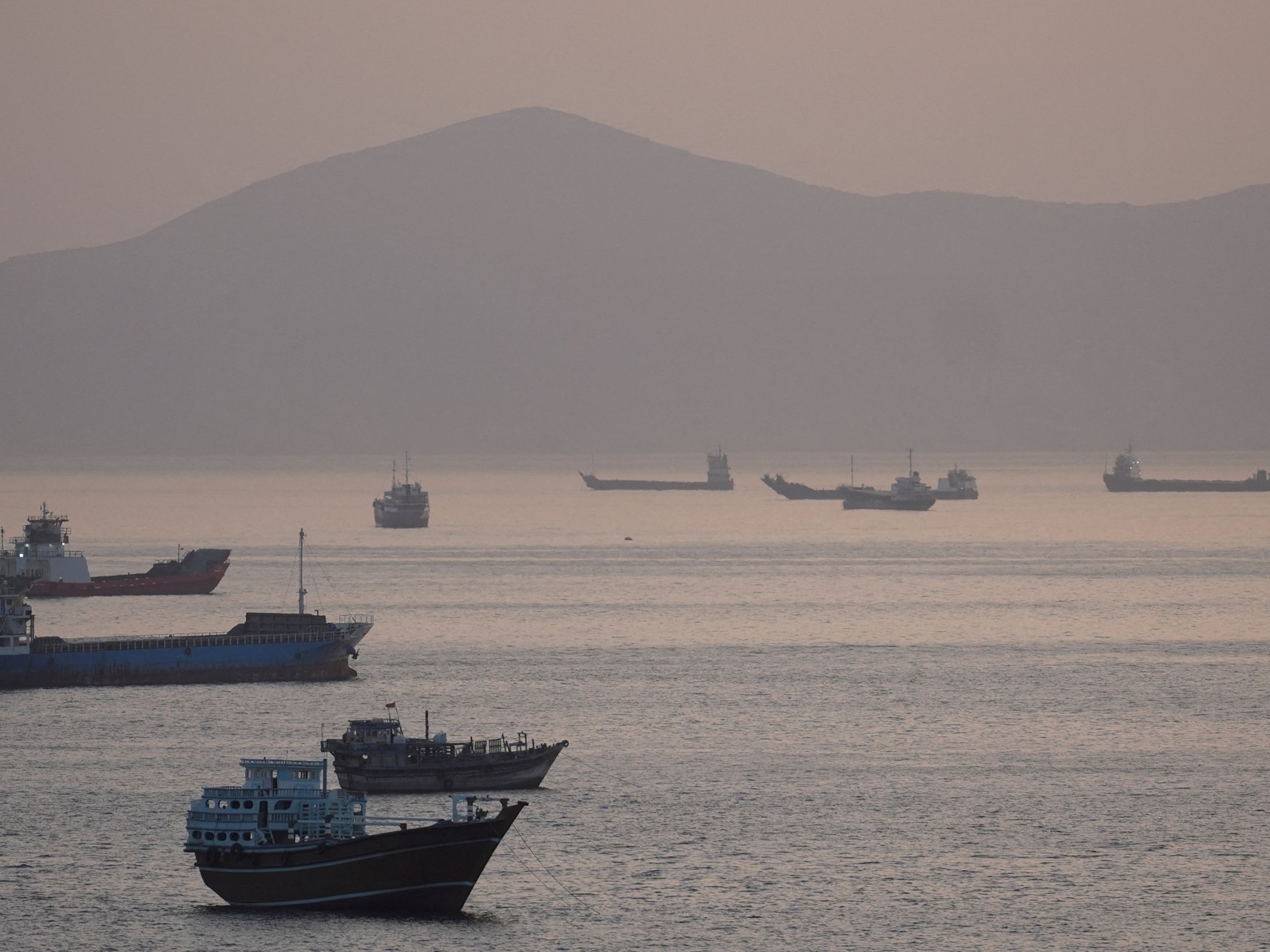

Iran’s military has warned the United States Navy to stay out of the Strait of Hormuz after President Trump said the US will “help free up” ships stuck in the strategic waterway.
The Iranian military said US forces will be attacked if they enter the strait and told commercial ships and oil tankers to refrain from moving unless they are coordinating with Iran, Ali Abdollahi, the head of the forces’ unified command, said in a statement on Monday.
- list 1 of 3Why are maritime laws failing to secure the seas?
- list 2 of 3Strait of Hormuz blockade and other major naval sieges in modern times
- list 3 of 3OPEC+ announces symbolic oil output rise during Strait of Hormuz closure
end of list
“We warn that any foreign armed forces, especially the aggressive US army, will be attacked if they intend to approach and enter the Strait of Hormuz,” the statement said.
On Sunday, Trump said he was launching the campaign – dubbed “Project Freedom” – at the request of countries whose vessels are stranded in the strait, whom he referred to as “neutral and innocent bystanders”.
“For the good of Iran, the Middle East, and the United States, we have told these Countries that we will guide their Ships safely out of these restricted Waterways, so that they can freely and ably get on with their business,” Trump said in a post on Truth Social, without specifying which countries called for Washington’s help.
“Many of these Ships are running low on food, and everything else necessary for largescale crews to stay on board in a healthy and sanitary manner,” Trump said, adding that any interference in the operation would “unfortunately, have to be dealt with forcefully”.
US Central Command said it would support the effort with 15,000 military personnel, more than 100 land- and sea-based aircraft, along with warships and drones.
Advertisement
“Our support for this defensive mission is essential to regional security and the global economy as we also maintain the naval blockade,” Admiral Brad Cooper, the CENTCOM commander, said in a statement.
Al Jazeera’s Resul Serdar Atas, reporting from Tehran, said any US intervention in the Strait of Hormuz will be viewed by Iran as a violation of the ceasefire that came into effect on April 7.
“The Iranians are quite clear. They are saying they’re going to respond and engage militarily. And in such a case, that will be the end of the ceasefire.
“The Iranian military establishment and political officials here say that the war has changed many things. And that there is a new regime [in the Strait of Hormuz] and Iran in one way or another is going to keep control over the waterway,” said Atas.
Iran has been blocking nearly all shipping from the Gulf, other than its own, for more than two months, sending global energy prices soaring.
In the US, petrol has risen to an average of $4.44 per gallon, up from less than $3 before the war started, spurring inflation.
Trump had previously suggested that he is comfortable with the status quo of the competing blockades in the strait, arguing that the US siege was “more effective than bombing”.
However, a US move to ease the Iranian blocking of the strait could alter the relative calm that had persisted against growing tensions in the past weeks.
Harlan Ullman, chairman of the Killowen Group and a former US naval officer, said Trump’s latest plan could lead to a dangerous escalation.
“Iran has huge amounts of drones and small craft that could make this very, very difficult,” Ullman told Al Jazeera. “I would hate to see a confrontation where an American warship is hit, because then the Americans will have no other option except to retaliate.”
Related News
Timeline: How Mali went from democracy beacon to instability
Mali rattled by ongoing armed attacks: What to know
How Hezbollah’s fibre optic drones test Israel’s sophisticated radar system