‘The homeland is the homeland’: Venezuelans brace for possible US attack
 05 December 2025
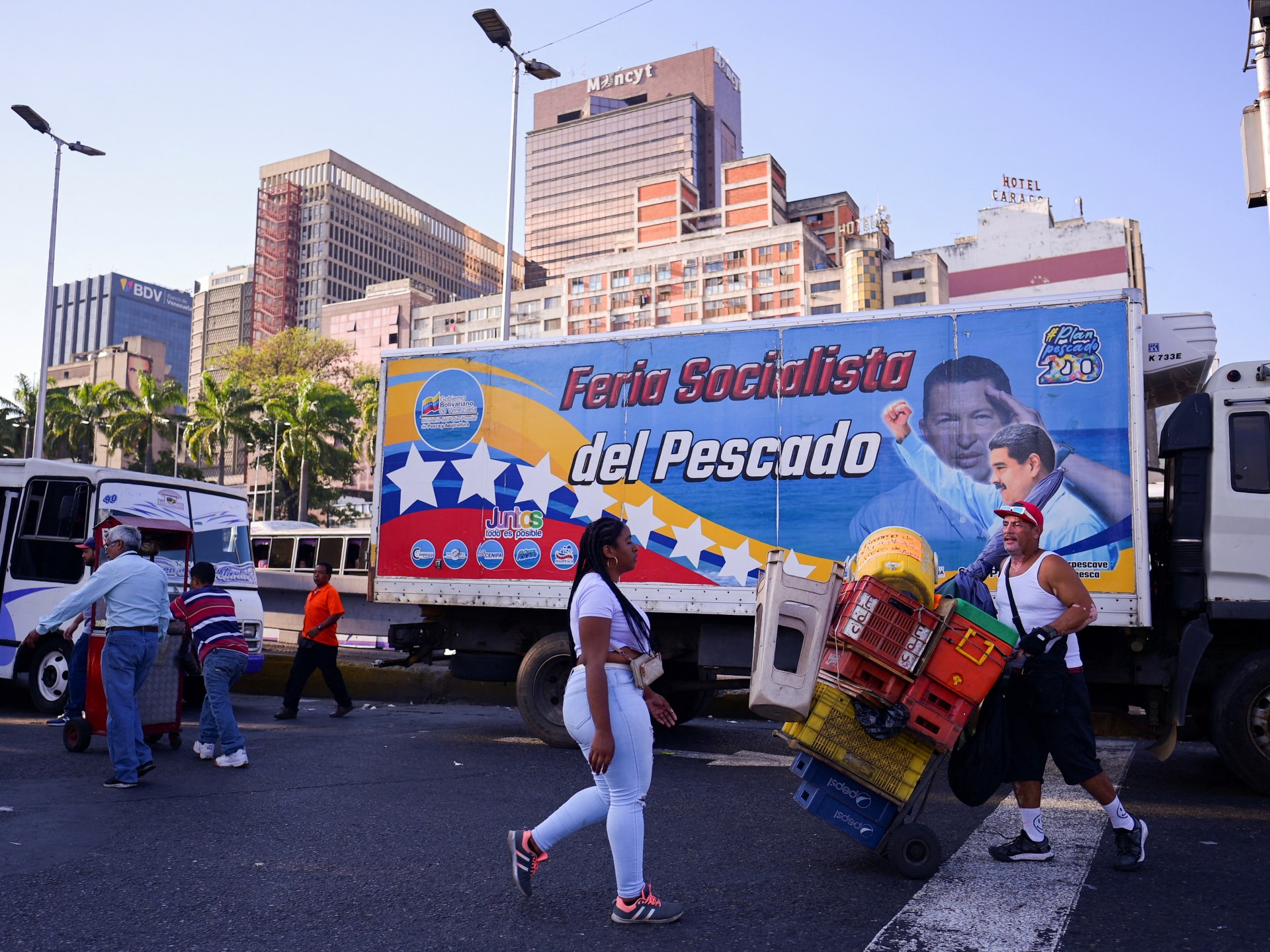

Caracas, Venezuela – In the bustling plazas of Caracas, the rhythm of daily life carries on. Street vendors sell chocolates and frozen fruit, while shopkeepers stock shelves amid the afternoon rush. Yet beneath this familiar routine, a new tension hums.
With United States military assets deployed near the Venezuelan coast and rhetoric heating up between Washington and Caracas, the capital’s residents find themselves divided – a few by hope, others by scepticism, and still others by a fierce instinct to defend their homeland.
For some, the presence of foreign ships offshore represents a long-awaited answer to prayer. For others, it is an imperial affront to a sovereign nation.
“The homeland is the homeland, and my army is my army,” says David Oropeza, a 52-year-old farmer and merchant who sells frozen strawberries and blackberries he harvests himself. Despite a health condition that requires treatment three times a week, he says he would be willing to fight if the US attacked.
“I would be knee-deep in the dirt with those people. I would face [the invaders] with them [the Venezuelan army],” Oropeza tells Al Jazeera, as he waits for a bus in downtown Caracas, staring at the horizon. “I would help however I could.”
‘A positive change’
The US has conducted nearly two dozen strikes since September in the Caribbean Sea and the Pacific Ocean, killing more than 80 people. In the latest attack on Thursday, four people were killed. The administration of US President Donald Trump has not presented evidence to support its claim that the targeted boats contained narcotics or smugglers, nor that they were headed to the US. It has also offered no legal justification for the operations – actions many experts say violate international law.
Advertisement
Meanwhile, Trump has also said that the US is preparing to attack alleged drug traffickers “on land”, suggesting that a direct military operation against Venezuela might be imminent.
Trump has deployed the world’s largest aircraft carrier, USS Gerald R Ford; thousands of troops; and F-35 military jets to the Caribbean in recent weeks, in the biggest show of force in the region in several decades.
For some in Venezuela, this US pressure on Venezuelan President Nicolas Maduro is good for the country.
Carolina Tovar, 60, sits on a bench in one of the city’s busiest squares. A vendor selling chocolates and sweets, she says that with US pressure, “Venezuela is going to be free”.
“The day will come when we obtain liberty,” she says. “I think Maduro already feels a lot of pressure”.
Her comments reflect widespread frustrations and despair in Venezuela. Maduro – whose nearly 12 years in office have been marked by deep economic and social crisis, and by repeated US efforts to pressure or unseat his government – was sworn in for a third term in January.
He was declared the winner of July’s election by Venezuela’s electoral authority and top court, though detailed tallies confirming his victory were never released.
According to the opposition, their count of the voting records shows their candidate Edmundo Gonzalez won by a wide margin – a result that has led the US and several other governments to recognise him as president-elect. Independent observers have also questioned the election.

But Tovar is in a minority in the country, per polls. Most Venezuelans are far more worried about daily survival, low salaries and inflation, rather than geopolitics – and they do not support US pressure or an attack on their country.
According to a poll by Caracas-based firm Datanalisis last month, a majority of Venezuelans continue to oppose economic sanctions on the country. The poll found that 55 percent of respondents disagree with sectoral, financial or oil sanctions, while only 21 percent agree with them.
When it came to a foreign military attack, 55 percent of Venezuelans opposed it, while 23 percent said they would support it.
The reasons most cited by those who oppose an attack are civilian deaths, risk of civil war, chaos and prolonged economic deterioration. Supporters of a foreign push for change in Venezuela said they believe it would help strengthen democracy, bring peace and help usher in economic improvement.
Advertisement
The poll suggests that most Venezuelans do not side with either the opposition or President Maduro. Sixty percent described themselves as politically unaffiliated, compared with 13 percent supporting the government and 19 percent backing the opposition.
“I can understand that some Venezuelans believe this type of pressure from the US could bring about political change and improve the situation,” says a government official with a degree in international affairs, speaking to Al Jazeera on condition of anonymity because they are not authorised to speak to the media.
“However, from my perspective, external interference is never positive in any country,” the official says. “We’ve seen that in Panama, we’ve seen it in Syria, Libya – and in many countries in the Middle East.”
‘The homeland is the homeland’
A few blocks away from Tovar, Oropeza is cynical – about Venezuela and its elites, and about Trump and his intentions. But he is clear that war isn’t the answer to any of those problems.
“Nobody wants war. We want peace,” Oropeza says. He then reflects and refers to those whom he believes do want war.
“US politics moves a lot with its weaponry, and that generates money for whoever occupies the presidency,” he argues, noting that troop mobilisation on the Venezuelan side likely enriches the local elite as well. “Who is getting rich? Them, and those we don’t know.”
Oropeza, who describes himself as a former supporter of the late President Hugo Chavez – Maduro’s mentor and predecessor, says he is not a follower of the current president.
Still, he draws a hard line in the sand regarding his sovereignty. His scepticism of the government does not translate into support for foreign attacks on his country.

In recent months, Maduro has responded to rising tensions with his own show of force. Troops and militia members have been mobilised, and soldiers have tested anti-air systems along the Caribbean coast.
By November, the government went further, announcing a “massive” mobilisation of troops and civilians to prepare for any potential US action.

Scepticism and resources
Among the younger generation, some believe that the US interest in Venezuela is fundamentally to do with the country’s natural resources.
“I think we are screwed,” Diego Mejia, a 24-year-old supermarket stocker, says, as he hangs out with his friends.
He doubts an invasion is imminent. “If the United States … wanted to come here, they would have come already.” But he is clear about what he thinks the US is after. “Venezuela is a country with too many resources,” he notes, citing oil and uranium. “They are interested in Venezuela because they need its resources.”
Advertisement
Venezuela holds the world’s largest proven oil reserves, more than five times more than the US, and significant natural gas fields, making its energy sector a central pillar of global strategic interest.
Beyond hydrocarbons, Venezuela is also rich in gold, diamonds, bauxite, iron ore and rare minerals such as coltan – materials essential for electronics, aerospace technologies and modern manufacturing.
But like many others, Mejia leans on faith to deal with the anxiety of a potential military clash with the world’s biggest superpower. “I have my faith that God is not going to let anything happen here,” he says.
The fact that the streets aren’t empty, and people have not started hoarding food, suggests that many share the view that an attack isn’t imminent.

The fear of the unknown in Venezuela
Others aren’t so sure.
For Dalibeth Brea, a 34-year-old homemaker watching her child play in a park, the situation evokes a complex mix of hope and maternal fear. The tension is tangible even in her social circle; a friend refused to be interviewed due to fear of repercussions at her government job.
Brea says she hopes the pressure might catalyse modernisation. “Internally … it seems positive because it could bring something good to the country. Certain developments that we see in countries outside, I would like to arrive here,” she says.
However, the prospect of violence terrifies her. Unlike Oropeza’s willingness to fight, Brea’s instinct is to hide.
“I would shelter myself out of fear,” she admits. Her contingency plan is simple: “Food at home, and keep all my family in one place.”
As the sun sets over a city caught in the crosshairs of geopolitics, Brea echoes the uncertainty felt by millions.
“I don’t know if something will happen,” she reflects. “Something tells me yes, but something tells me no.”
(Elizabeth Melimopoulos contributed reporting on this article from Canada)

Related News
US imposes visa sanctions against Haitian official on governing council
Tehran shrouded in thick smog as Iran burns dirty fuel amid energy crisis
Trump’s boat bombings: How the US has long used ‘double-tap’ strikes