Zelenskyy says US ‘too often’ pushes Ukraine, not Russia, for concessions
 15 February 2026
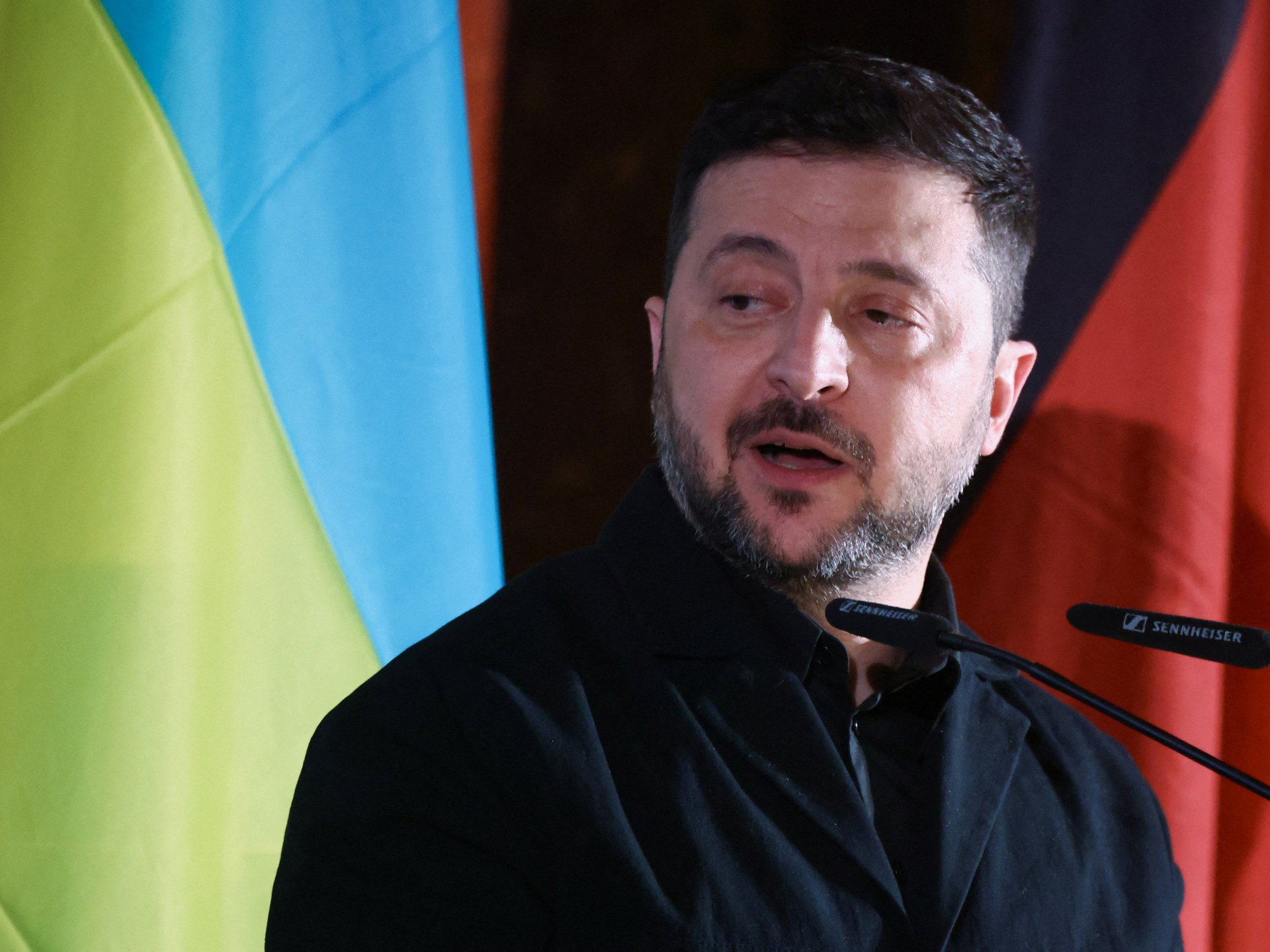

Ukrainian President Volodymyr Zelenskyy has expressed hope for United States-brokered peace talks with Russia next week, but warned that Kyiv was being asked “too often” to make concessions and pressed his allies for “clear security guarantees”.
Zelenskyy’s speech at the annual Munich Security Conference on Saturday came as US President Donald Trump seeks to broker a deal to end Europe’s biggest war since 1945.
- list 1 of 3Russian strike kills father, 3 children in Ukraine, wounds pregnant mother
- list 2 of 3On Ukraine, ‘liberal’ war hawks make the far right look like peacemakers
- list 3 of 3Russia bans WhatsApp, pushes state-backed alternative
end of list
Ukraine and Russia, which invaded its neighbour in February 2022, have engaged in two recent rounds of talks mediated by Washington in Abu Dhabi, UAE, described by the parties as constructive but achieving no breakthroughs.
The three sides are due to sit down in Geneva, Switzerland, again this week.
In his speech, Zelenskyy said he hoped the trilateral talks in Geneva on Tuesday and Wednesday “will be serious, substantive” and “helpful for all of us”.
“But honestly, sometimes it feels like the sides are talking about completely different things,” Zelenskyy said.
“The Americans often return to the topic of concessions, and too often those concessions are discussed only in the context of Ukraine, not Russia,” he said.
The Ukrainian leader also argued that there would be a greater chance of ending the war if European countries had a seat at the negotiating table, something Moscow has opposed.
“Europe is practically not present at the table. It’s a big mistake to my mind,” he said. And Ukraine, he said, “keeps returning to one simple point”.
“Peace can only be built on clear security guarantees. Where there is no clear security system, war always returns,” Zelenskyy said.
Advertisement
Among the most contentious issues in the negotiations is Russia’s demand for a full withdrawal of Ukrainian troops from the remaining parts of Ukraine’s eastern region of Donetsk that it still controls. Ukraine has rejected a unilateral pullback, while also demanding Western security guarantees to deter Russia from relaunching its invasion if a ceasefire is reached.
Zelenskyy, in remarks to reporters, said the US had proposed a security guarantee lasting for 15 years after the war, but Ukraine wanted a deal for 20 years or longer. He added that Putin opposes the deployment of foreign troops in Ukraine, as it would deter any future aggression by Russia.
Zelenskyy said Russia had to accept a ceasefire monitoring mission and an exchange of prisoners of war. He estimated that Russia currently has about 7,000 Ukrainian soldiers, while Kyiv has more than 4,000 Russian personnel.
He also acknowledged feeling “a little bit” of pressure from Trump, who on Friday urged him not to miss the “opportunity” to make peace and told him “to get moving”. Zelenskyy also called for greater action from Ukraine’s allies to press Russia into making peace, both in the form of tougher sanctions and more weapons supplies.
Trump has the power to force Putin to declare a ceasefire and needs to do so, Zelenskyy said. Ukrainian officials have said a ceasefire is required to hold a referendum on any peace deal, which would be organised alongside national elections.
Zelenskyy also expressed surprise at Russia’s decision to change its delegation to the Geneva talks and said it suggested to him that Russia wanted to delay any decisions from being agreed.
The Kremlin had said the Russian delegation would be led by Putin’s adviser Vladimir Medinsky, a change from negotiations in Abu Dhabi, where military intelligence chief Igor Kostyukov was in the lead. Ukrainian officials have criticised Medinsky’s handling of previous talks, accusing him of delivering history lessons to the Ukrainian team instead of engaging in constructive negotiations.
In his main speech at the Munich event, Zelenskyy also denounced Putin as a “slave to war”.
He drew parallels between the current talks and the 1938 Munich Agreement, when European powers let Hitler take part of the erstwhile Czechoslovakia, only for World War II to break out the following year.
“It would be an illusion to believe that this war can now be reliably ended by dividing Ukraine, just as it was an illusion to believe that sacrificing Czechoslovakia would save Europe from a great war,” he warned.
Advertisement
Related News
Trump says US will send second aircraft carrier to Middle East ‘very soon’
US treasury secretary declines to rule out future Federal Reserve lawsuits
Somalia, Saudi Arabia sign agreement on military cooperation