

Washington, DC – The United States Senate is expected to hold an initial vote on a resolution to rein in US President Donald Trump’s war with Iran, with top Democrat Chuck Schumer saying he fears “now more than ever” that the administration is planning to deploy boots on the ground.
The procedural vote expected on Wednesday represents the first time US lawmakers will be put on the record on their position towards the war, which the US and Israel began on Saturday, and which has since seen retaliation from Iran spread across the Middle East.
- list 1 of 3NATO defences destroy missile fired from Iran over Mediterranean: Turkiye
- list 2 of 3Is the CIA planning to arm Kurdish forces to spark an uprising in Iran?
- list 3 of 3Why are the US and Israel framing the ongoing conflict as a religious war?
end of list
The vote will determine whether the chamber will move forward with further debate on the resolution and a final vote, or if any effort to assert congressional authority over the Trump administration’s military actions will be swiftly scuttled. A separate measure is expected to face an initial vote in the US House of Representatives tomorrow.
Speaking from the Senate floor, US Democrats condemned what they described as shifting justifications for the war and why the US needed to immediately attack Iran.
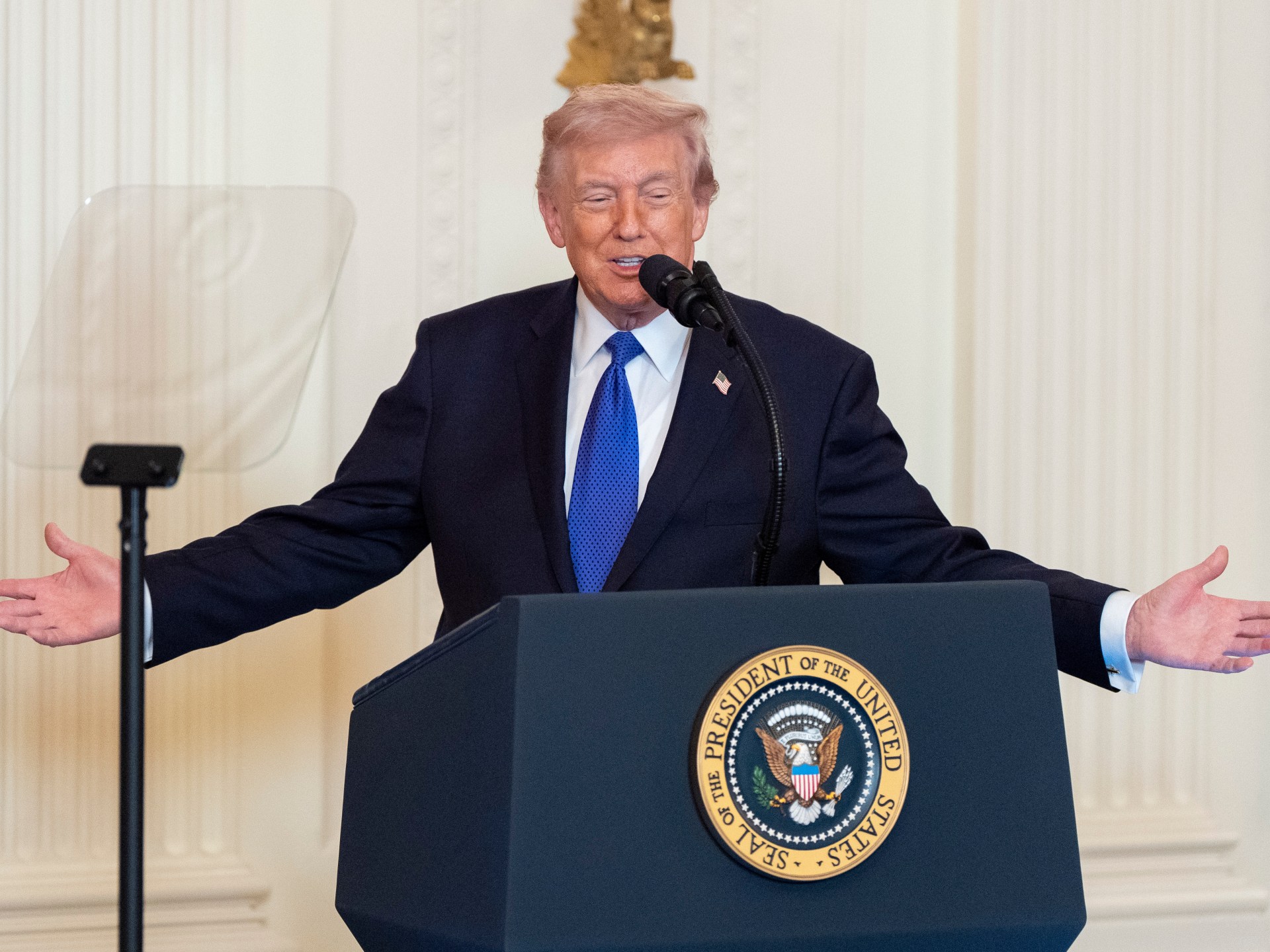
The top Democrat in the chamber, Schumer, portrayed Trump as a president willing to swiftly change his narrative, unmoored by evidence or his past positions.
“Whatever pops into his head, he says immediately. He picks one plan one day, then he picks the total opposite the next. He doesn’t think it through, he doesn’t check the facts,” he said.
“He is surrounded by ‘yes’ men; this is dangerous,” Schumer said, adding that recent briefings from the administration had provided “zero clarity” on its end goals and timeline.
Advertisement
Pentagon Chief Pete Hegseth on Wednesday said that the operation had just begun, with more US assets being sent to the region.
Schumer said the statement showed “it is clear they are widening the war … and I fear now more than ever that we are going to put boots on the ground, and that’s precisely what the American people fear.”
Comparison to 2003 invasion of Iraq
For his part, Democrat Dick Durbin pointed to the array of rationales the Trump administration has given for launching the war, while presenting scant concrete evidence supporting the various claims.
Trump has suggested that Iran was seeking to rebuild its nuclear programme, which he has said was “obliterated” in strikes last year; he has suggested that Iran was seeking to develop a long-range missile to strike the US; his Secretary of State, Marco Rubio, told reporters that close US-ally Israel was planning to attack Iran, which would likely lead to retribution against US assets in the region; Trump has said Iran was the one planning an imminent attack on Israel.
Most enduringly across the messaging, the Trump administration has sought to frame the totality of Iran’s actions since the Islamic Revolution in 1979 as representing an immediate threat.
Many US constitutional scholars have long argued that presidential powers, under Article Two of the US Constitution, are constrained to using the military for self-defence in responding to immediate threats to the country, beyond which congressional approval is needed.
Under international law, the concept of “imminence” is also important in determining whether an attack on a sovereign country is legal.
“Let me tell you my experience having been here on the vote to go to war in Iraq, it is far easier to get into a war than it is to get out of a war,” Durbin said. “We knew at the time that there was a possibility that a larger war would emerge than just a simple invasion, and it did – for nine years.”
Republicans defend Trump
Wednesday’s vote is the beginning of an uphill battle for supporters of the war powers resolution.
Republicans hold a slim majority in both the Senate and the US House of Representatives, and the party has largely coalesced around Trump’s message, even as influential members of Trump’s “Make America Great Again” (MAGA) movement have increasingly voiced dismay.
Democrats and independents that caucus with the party hold 47 seats in the Senate, compared to 53 held by Republicans. At least one Democrat, John Fetterman, has said he will oppose the resolution, while one Republican, Rand Paul, is co-sponsoring it.
Advertisement
That means all remaining Democrats and four Republicans would need to vote in support of constraining Trump’s powers. The math is equally challenging in the House, where Democrats hold 214 seats to Republicans’ 218.
Speaking from the Senate floor, Republican John Barrasso said: “Democrats would rather obstruct President Trump than obliterate Iran’s national nuclear programme”.
“Trump communicated our objectives within hours of the first strike: destroy Iran’s missile industry, and that includes their missiles, their launchers and the production capacity missiles they were stockpiling, destroy Iran’s navy, destroy Iran’s terrorist proxy network, stop Iran from ever getting a nuclear weapon,” he said.
“President Trump absolutely acted within his Article Two ..s constitutional powers to achieve these goals,” he said.
Why does it matter?
Even if supporters of the war powers vote manage to reach majority support in both the House and Senate, the resolution would still be vetoed by Trump.
Lawmakers would then need a two-thirds majority in both chambers to override Trump’s veto, a much higher barrier to clear.
Still, advocates have long argued that requiring war powers votes forces lawmakers to engage on the subject and gives constituents the ability to message their elected officials about the war, with early polls showing dismal approval of Trump’s strikes.
“Votes and debates on the Iran War Powers Resolution are essential because they force accountability,” said Hassan El-Tayyab, the legislative director for Middle East policy at the Friends Committee on National Legislation, a Washington, DC based nonprofit.
“By taking the measure up, members of Congress put themselves on record, shine a light on the administration’s actions, and compel necessary concessions,” he told Al Jazeera.
El-Tayyab said the pending vote has already increased pressure on the administration to provide more information to Congress, pointing to a handful of Republicans who have expressed scepticism.
“This proves that the debate is not abstract politics,” El-Tayyab said. “It’s our government exercising its war powers with transparency and vigilance.”
Related News

Israel installed security at Epstein’s Manhattan apartment for ex-PM Barak
Mapping Russian attacks and territorial gains across Ukraine
Indonesia, Morocco, Kosovo among 5 countries to send troops under Gaza plan