
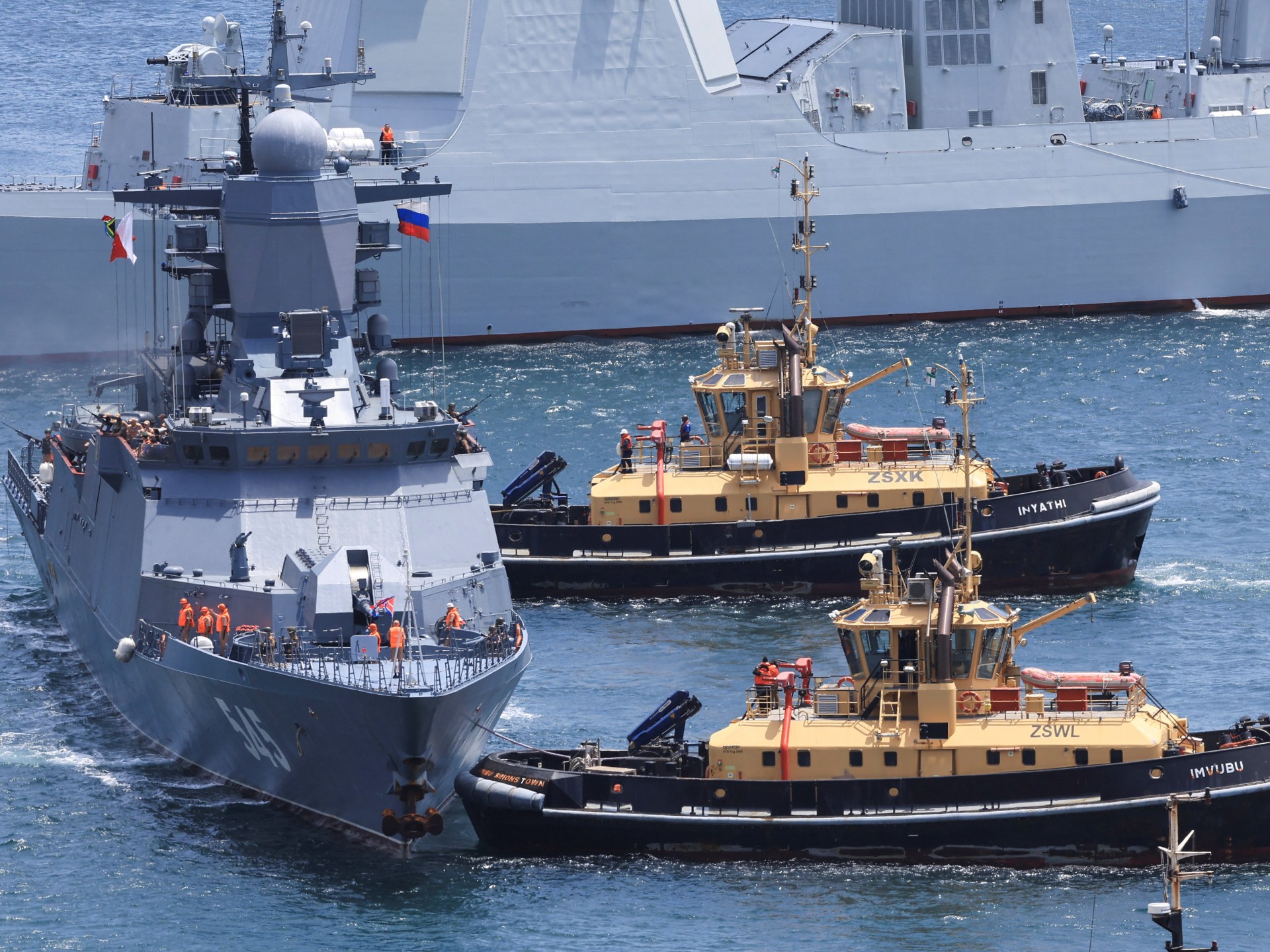

South Africa has defended weeklong naval drills with Russia, Iran, China and other countries as “essential”, describing the manoeuvres off its coast as a vital response to rising maritime tensions globally.
The “Will for Peace 2026” exercises that began on Saturday off the coast of Cape Town come just days after the United States seized a Venezuela-linked Russian oil tanker in the North Atlantic, saying it had violated Western sanctions.
- list 1 of 4Chinese, Russian and Iranian warships arrive for drills in South Africa
- list 2 of 4Trump’s war on South Africa betrays a sinister threat
- list 3 of 4Venezuela’s Maduro to appear in New York court: What to expect
- list 4 of 4US says it wants to control Venezuelan oil indefinitely. Can it?
end of list
The seizure, part of a continued US pressure campaign against Venezuela, followed US attacks on the South American country and the abduction of its president, Nicolas Maduro.
The naval exercises also come at a time of heightened tensions between US President Donald Trump’s administration and several BRICS Plus countries, including China, Iran, South Africa and Brazil.
Captain Nndwakhulu Thomas Thamaha, South Africa’s joint task force commander, told the opening ceremony on Saturday that the drills were more than a military exercise and a statement of intent among the BRICS group of nations.
“It is a demonstration of our collective resolve to work together,” Thamaha said. “In an increasingly complex maritime environment, cooperation such as this is not an option, it is essential.”
The exercises also aimed to “ensure the safety of shipping lanes and maritime economic activities”, he added.
BRICS, originally made up of Brazil, Russia, India, China and South Africa, has expanded to include Egypt, Ethiopia, Iran, Saudi Arabia, the United Arab Emirates and Indonesia.
Advertisement
Lieutenant Colonel Mpho Mathebula, acting spokesperson for joint operations, told the Reuters news agency that all member states had been invited to this week’s naval exercises.
China and Iran deployed destroyer warships to South Africa, while Russia and the United Arab Emirates sent corvette vessels and South Africa dispatched a frigate. Indonesia, Ethiopia and Brazil have joined as observers.
Asked about the timing of the event, South Africa’s Deputy Defence Minister Bantu Holomisa said on Friday that the drills were planned long before the current spike in global tensions.
“Let us not press panic buttons because the USA has got a problem with countries. Those are not our enemies,” Holomisa said.
“Let’s focus on cooperating with the BRICS countries and make sure that our seas, especially the Indian Ocean and Atlantic, they are safe,” he said.
Previously known as Exercise Mosi, the drills were initially scheduled for November but postponed due to a clash with the G20 summit in Johannesburg, which was boycotted by the Trump administration.
Washington has accused the BRICS bloc of “anti‑American” policies and warned that its members could face an additional 10-percent tariff on top of existing duties already applied worldwide.
South Africa has also drawn US criticism for its close ties with Russia and a range of other policies.
That includes the South African government’s decision to bring a case against top US ally Israel to the International Court of Justice, accusing the Israeli government of committing genocide against Palestinians in the Gaza Strip.
South Africa also drew criticism for hosting naval drills with Russia and China in 2023, coinciding with the first anniversary of Moscow’s invasion of Ukraine.
The three nations first conducted joint naval drills in 2019.
Related News
Venezuelan interim leader tones down criticism, ready to ‘work with the US’
Somali minister says Israel plans to displace Palestinians to Somaliland
Bangladesh mourns Khaleda Zia in state funeral with massive crowds