


Health and environment advocacy groups in the United States are suing the Environmental Protection Agency (EPA) over the Trump administration’s decision to withdraw a key 2009 climate change ruling known as the “endangerment finding”.
That finding had established that greenhouse gases are a risk to public health and environmental safety, given that they are the primary drivers of climate change. It formed the legal basis for many regulatory policies aimed at curbing climate change.
When US President Donald Trump, who has called climate change a “hoax” and a “con job”, rescinded the declaration in February this year, the EPA supported the move, deeming it the “single largest deregulatory action in US history”.
The lawsuit, filed on Wednesday this week, alleges that the Trump administration’s decision will risk the health and welfare of US citizens.
“Repealing the Endangerment Finding endangers all of us. People everywhere will face more pollution, higher costs, and thousands of avoidable deaths,” Peter Zalzal, the associate vice president of clean air strategies at the Environmental Defense Fund, one of the plaintiffs, said in a statement.
Trump’s revocation of the endangerment finding is the latest in a series of steps he has taken to prioritise deregulation, boost fossil fuel production and reverse climate regulations.
But Trump is not the first US president to enact policy damaging to the environment. Here’s how decades of US policy have harmed the environment before he arrived in the White House
Advertisement
What is the ‘endangerment finding’?
The endangerment finding was established under the presidency of Democrat Barack Obama. It states that carbon dioxide and other greenhouse gases pose a threat to public health and welfare.
That ruling allowed the EPA under President Obama to move forward on policy aimed at limit the release of greenhouse gases in the US, Michael Kraft, professor emeritus of political science and public and environmental affairs at the University of Wisconsin-Green Bay, told Al Jazeera.
Under the endangerment finding, power plants were required to meet federal limits on carbon emissions or risk being shut down. This forced oil and gas companies to invest more to detect and fix methane leaks, curb flaring, and improve tailpipe and fuel‑economy standards to enable automobile companies to manufacture more efficient, lower‑emitting vehicles.
What does rescinding it mean?
“By allowing for increased pollution, these recent changes [by the Trump administration] will harm practically every single person on the planet,” Washington, DC-based policy researcher Brett Heinz told Al Jazeera.
“People living near fossil fuel facilities will be some of the most immediately affected, as they will be exposed to the new air and water pollution unleashed by deregulatory policies,” Heinz added.
Without the endangerment finding in place, the EPA has lost a key legal basis on which to limit greenhouse gas emissions, making it easier for coal plants, oil refineries and petrochemical complexes to run older, dirtier equipment for longer, expand without installing modern pollution controls, and emit more soot, smog‑forming gases and toxic chemicals into nearby communities.
Heinz explained that higher greenhouse gas emissions from burning fossil fuels in power plants, cars and industry as well as continued deforestation will also amplify the dangers posed by natural disasters. This is because increased warming exacerbates heatwaves, storms, floods and droughts, and raises sea levels – all of which turn existing natural hazards into more frequent and more destructive disasters.
“The only people who will benefit from these decisions are a small handful of wealthy fossil fuel executives and shareholders, who will see healthy profits while the world grows sick. These fossil fuel elites, many of whom contributed money to Trump’s presidential campaign, have now gotten a return on this investment,” Heinz said.
Experts say that Trump’s decision to entirely do away with environmental policy is unlike any president before him.
Advertisement
“The White House’s tidal wave of new pro-pollution policies is completely unprecedented. While past administrations have modified environmental rules, the second Trump administration is essentially trying to eliminate them entirely. So far, this has been the most radically anti-environmental presidency in American history,” Heinz said.
How have previous US presidents endangered the environment?
Trump is by no means the first US president to enact policy which is damaging to the environment, however.
Under Republican Theodore Roosevelt, who was president from 1901 to 1909, Congress passed the Reclamation (Newlands) Act of 1902, which treated land and rivers primarily as raw material for large infrastructure projects rather than as ecosystems in need of protection.
This was furthered by Democrat Harry Truman, who was president from 1945 to 1953 and pushed for rapid post‑war industrial and suburban expansion by commissioning the construction of interstate highways and promoting car‑centric development.
Under Republican Dwight Eisenhower, who was president from 1953 to 1961, the interstate highway system burgeoned, and the private car became a developmental priority in the US.
While Republican Richard Nixon, who was president from 1969 to 1974, signed key environmental laws, he also backed massive fossil‑fuel expansion. Under Nixon, the highly toxic herbicide, known as Agent Orange, was used by the US military during the Vietnam War.
Republican Ronald Reagan, who was president from 1981 to 1989, appointed people to the EPA and the Department of Interior who pushed for expanded oil, gas, coal and timber extraction on public lands.
To facilitate this, they favoured deregulation and industry interests, and rolled back existing environmental policy, slashing budgets for EPA enforcement of the Clean Air and Clean Water Acts, easing rules on toxic emissions and pesticides, and opening up more federal land – including wilderness and wildlife habitat – to oil, gas, mining and logging activities.
Republican George W Bush, who was president from 2001 to 2009, refused to ratify the 1997 UN-backed emissions reductions Kyoto Protocol and actively undermined global climate negotiations by formally withdrawing US support for Kyoto in 2001, appointing senior officials who questioned climate science, and pushing voluntary, industry-friendly approaches instead of binding emissions cuts.
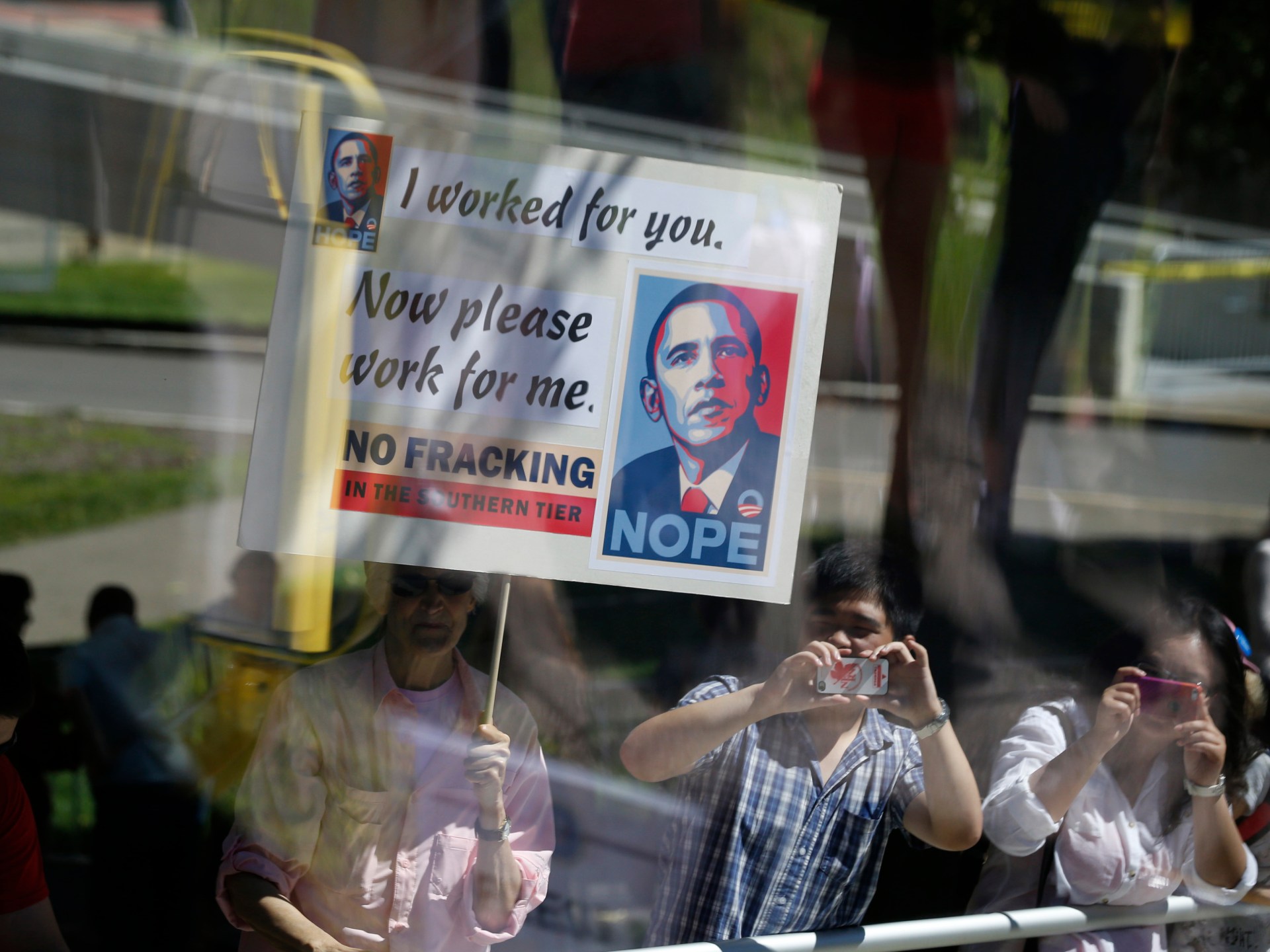
While Obama, who was president from 2009 to 2017, introduced several landmark climate regulations, he also oversaw the fracking boom, making the US the world’s largest oil and gas producer, and locking in long-term fossil infrastructure.
Fracking, or hydraulic fracturing, involves blasting water, sand and chemicals into shale rock to release oil and gas, a process believed to cause methane leaks, groundwater contamination, heavy water use and increased local air pollution.
Democrat Joe Biden, who was president from 2021 to 2024, approved large fossil projects such as the Willow project in Alaska. This involved oil development on federal land in the National Petroleum Reserve, projected to pump hundreds of millions of barrels of crude over several decades.
Advertisement
Figures released by the the US Bureau of Land Management (BLM) suggested that the project would release 239 million to 280 million tonnes of greenhouse gases over its lifetime. The project, approved in 2023 and ongoing, was projected to continue for 30 years.
Biden also backed LNG export growth by approving new and expanded export terminals and long‑term export licences, allowing companies to lock into multidecade contracts to ship US gas to Europe and Asia.
Is this a partisan issue?
No.
“The failure of US policymakers to aggressively tackle global warming is not so much a Democrat versus Republican matter,” Steinberg said.
“It’s neoliberalism, a form of corporate freedom, that is the heart of the problem. A bipartisan consensus on the need for economic growth has led to a general trend toward weakening environmental regulations,” he added.
The US once led the world in conservation by creating an extensive national park system in the 19th century, Ted Steinberg, a history professor at the US-based Case Western Reserve University, told Al Jazeera.
“That was then. US corporate interests, especially the fossil fuel industry, combined with the one-party political system, in which both Republicans and Democrats indenture themselves to the business class, have caused the United States to drag its feet on global warming,” Steinberg said.
What is the history of Washington’s impact on the environment?
The US has historically been the largest contributor to global warming, experts say.
“As in most countries, US environmental policy has been a response to the problems caused by industrialisation and urbanisation, starting in the mid-19th century and proceeding from there, happening at the local, state and national levels,” Chad Montrie, a history professor at the University of Massachusetts Lowell, told Al Jazeera.
“Much of that policy has been limited and inadequate, especially when corporations were able to exert their influence, but in some cases, it has been ahead of what other nations were doing,” Montrie, who specialises in environmental history, added.
There was a time when environmental policy was bipartisan. The EPA was, in fact, created by Republican President Richard Nixon in 1970.
“It wasn’t until the rise of pro-business politics in the 1980s that Republicans like President Reagan took a hard turn against environmental protections,” Heinz said.
“The Democratic Party continues to believe in environmental protection and climate-friendly policies to some degree, while the Republican Party has become one of the few political parties worldwide that completely denies the scientific facts around climate change.”
How does this affect the rest of the world?
“US policy often sets the standards for policy in other parts of the world, both because of its cultural influence and because of the control that the US has over global bodies like the International Monetary Fund,” Heinz said.
“Right now, the US is actively pushing dirty fossil fuels on the rest of the world and even threatening some of its allies for trying to negotiate new environmental agreements.”
Heinz explained that this pressure, coupled with soaring energy prices, seems to have convinced Europe to retreat from some of their climate goals. Household electricity prices jumped by about 20 percent across the European Union between 2021 and 2022, according to Eurostat data.
Heinz said that if the latest United Nations Climate Change Conference, or COP negotiations are any indication, global climate ambition appears to be on the decline right now.
Advertisement
The latest conference concluded in November 2025 in Brazil with a draft proposal which did not include a roadmap for transitioning away from fossil fuels, nor did it mention the term “fossil fuels” at all. This drew rebuke from several countries attending the conference.
“So long as Donald Trump remains in office, the hope of future generations relies upon the nations of the world coming together and acting responsibly to preserve a healthy environment at a time when the United States has gone truly mad.”
Related News
‘We killed dogs’: Israeli troops kill two children, parents in West Bank
Israeli attacks kill 13 in Gaza, including 2 children and a pregnant woman
Cuban President Diaz-Canel says talks held with US amid Trump threats