

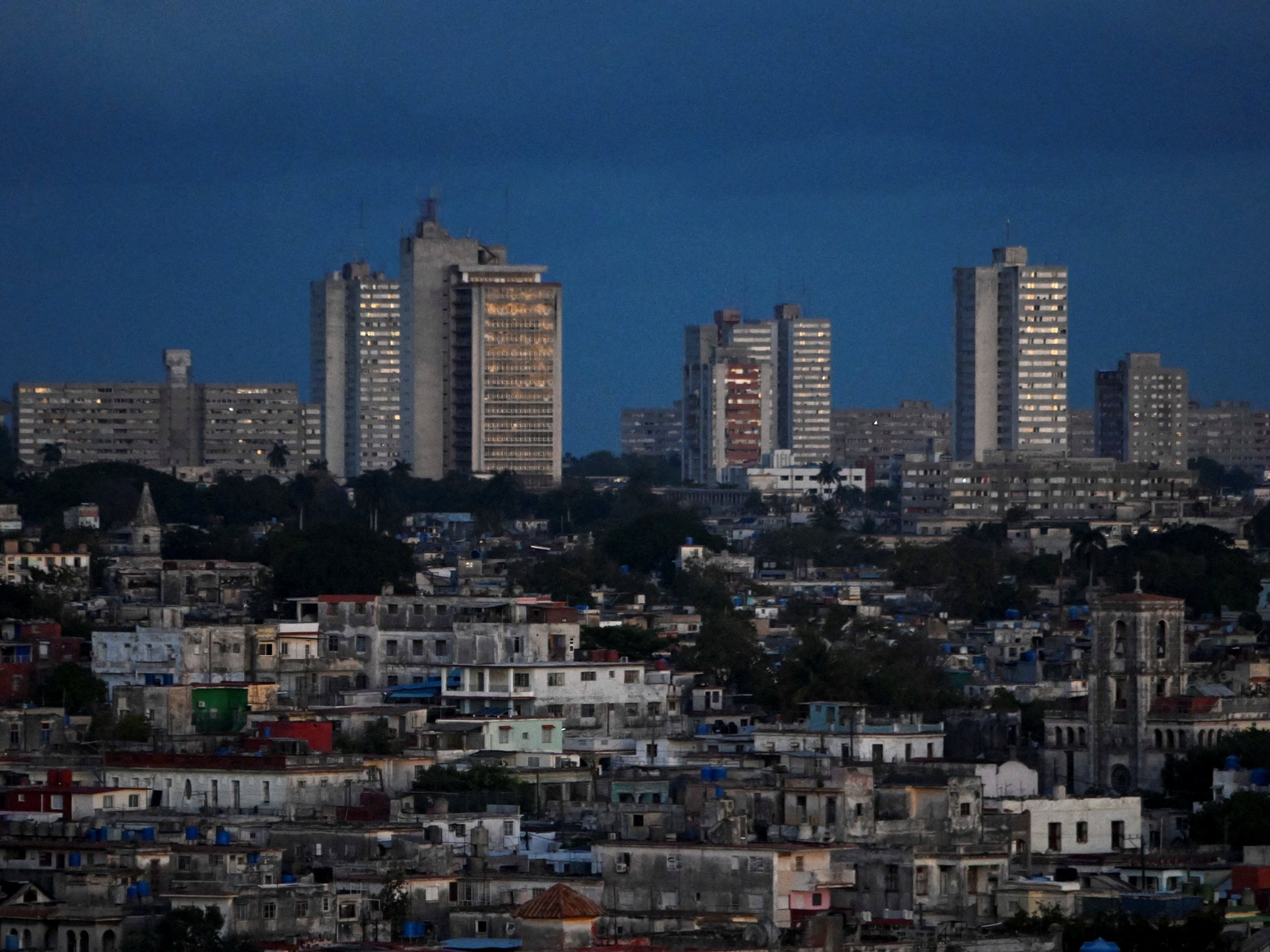

The Cuban government has said it is prepared for any potential United States attacks as the island-nation begins to recover from yet another blackout under a punishing oil blockade imposed by Washington that has pushed its economy to the brink.
Deputy Foreign Minister Carlos Fernandez de Cossio responded on Sunday to US President Donald Trump’s threats this week to take over Cuba, insisting that it had “historically been ready to mobilise as a nation for military aggression”.
- list 1 of 3‘Can’t live like this’: Cuba hit by second nationwide blackout in a week
- list 2 of 3Aid flotilla for Cuba sets sail from Mexico
- list 3 of 3Trump wants to overthrow the Cuban president
end of list
“We don’t believe it is something that is probable, but we would be naive if we do not prepare,” de Cossio told NBC’s Meet the Press.
His comments were aired a day after the latest collapse of the country’s ageing nationwide grid that had left millions of people in the dark. Saturday’s outage was the second in the past week and the third in March.
The state-run Electric Union and the Ministry of Energy and Mines said some 72,000 customers in the capital, Havana, including five hospitals, had electricity again early on Sunday. But the number represented only a fraction of Havana’s total population of approximately two million.
The Cuban Electric Union, which reports to the Ministry of Energy and Mines, said the total disconnection of the national system was caused by an unexpected shutdown of a generation unit at the Nuevitas thermoelectric plant in Camaguey province, without providing details on the specific cause of the failure.

Trump, who started blocking oil from reaching the island after abducting Cuba’s ally, Venezuelan President Nicolas Maduro, early this year, has warned potential oil exporters that they could face high tariffs.
Advertisement
According to President Miguel Diaz-Canel, Cuba has not received oil from foreign suppliers for three months. The country produces barely 40 percent of the fuel it needs to power its economy.
On March 16, Trump escalated his rhetoric against Cuba, arguing the leadership was on the verge of collapse and saying he expected to have the “honour” of taking the country.
De Cossio denied that the nature, structure, or makeup of the Cuban government was up for negotiation in what Havana has called a “serious and responsible” dialogue with Washington launched earlier this month. He added that a change of the ruling system was “absolutely” off the table in discussions.
This week, General Francis Donovan, head of the US Southern Command overseeing armed forces in Latin America, told lawmakers at a US Senate hearing on Trump’s military action in the region that troops were not rehearsing for an invasion of Cuba or actively preparing to take over the Communist-run island.
But, he added, the US stood ready to address any threats to the US embassy, to defend its base at Guantanamo Bay, and aid US government efforts to address any mass migration from the island, if needed.
The Cuban government reportedly refused a request by the embassy in Havana to allow it to import diesel for its generators in response to the oil blockade, The Associated Press reported on Saturday, citing two US officials.
Related News
Iran names Khamenei’s son as new Supreme Leader after father’s killing
UN’s failure to stop Iranian attacks sending ‘dangerous signal’: Qatar
Israel says it killed Iran Intel minister in third assassination in 2 days
