
Economic survival in Gaza decimated by Israeli counts on small initiatives
 06 January 2026

After more than two years of Israel’s genocidal war on Gaza, the daily unbearable churn of mass death and mourning, with homes, hospitals and schools destroyed, the besieged Palestinian territory also faces the fastest and most damaging economic collapse on record.
That is according to the United Nations, which says Gaza’s unemployment rate has reached 80 percent.
- list 1 of 4Gaza’s tech workers code from rubble as Israel’s war destroys digital life
- list 2 of 4Palestinian economy faces critical downturn amid escalating fiscal crisis
- list 3 of 4Poverty, unemployment skyrocket in the Gaza Strip after Israel’s war
- list 4 of 4Displaced Gaza families struggle as winter storm hits
end of list
Yet despite Israel’s suffocating blockade on the Strip, Palestinians are improvising businesses to survive.
For many people, survival now depends on skills and small initiatives, rather than formal jobs.
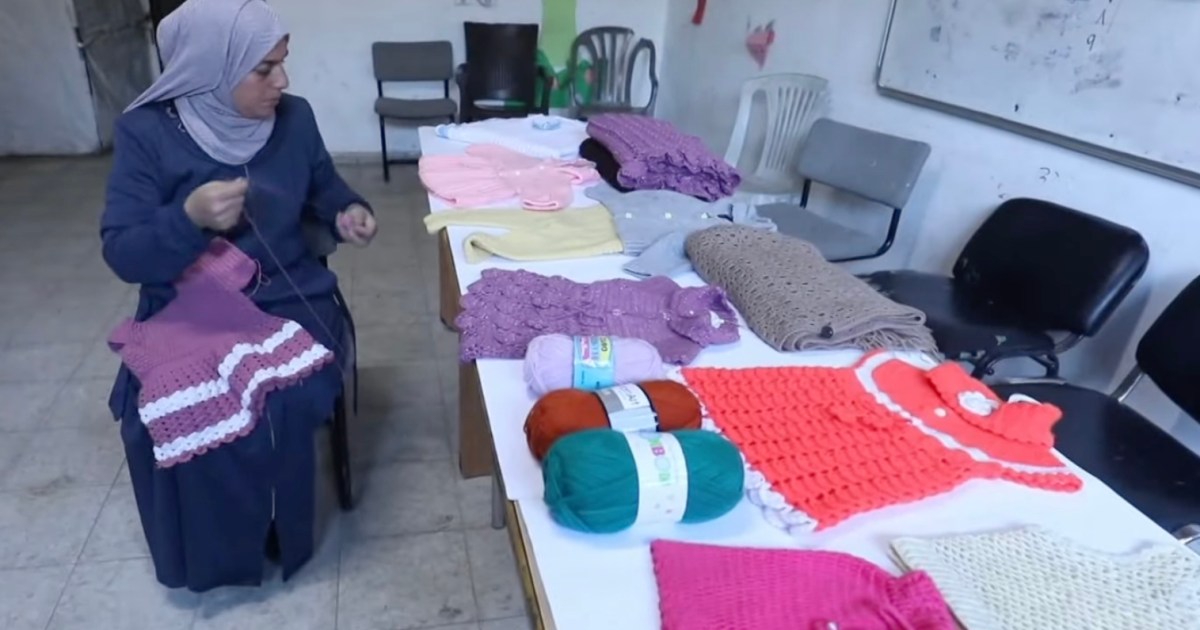
Widowed and responsible for a household of five, Um Mohammed al-Jarjawi relies on knitting to provide for her family – and sometimes passes on her skills to the next generation.
Every day inside her home, al-Jarjawi prepares food for her grandchildren. Moments later, she heads out to work.
“I started learning knitting when I was 10 years old,” she told Al Jazeera. “Later, I attended courses at specialised centres. I discovered that I was skilled at the craft and began training others.
“After my husband passed away, I needed to support my household. I focused on working to provide for my family while improving my skills.”

Small-scale businesses have expanded, ranging from solar-powered phone-charging stations to women knitting baby clothes. They provide households with short-term means of survival, but it is not enough to restore economic stability or generate sustainable, protected employment.
Advertisement
With 70 percent of electricity networks destroyed, Gaza’s power system has collapsed, forcing people to improvise.
For Wasim al-Yazji, a makeshift solar-powered charging station is a fragile lifeline that provides some income – but cannot solve the power crisis.
“I opened this charging station to help my family with basic needs, some food and small expenses. I try to support my household through it,” al-Yazji told Al Jazeera.
His home used to have a supermarket beneath it, but it was destroyed.
“My charging station depends on solar panels, so if the sun doesn’t shine, the charging power is weak and I can’t work for days. Sometimes a whole week passes under clouds without any income,” he said.

Gaza’s labour market has virtually collapsed, with the UN reporting that the enclave now faces one of the highest unemployment rates in the world.
For many young men and women, jobs are nowhere to be found, forcing them to pace the streets or wait endlessly for a chance to work.
“I’ve been looking for a job for months,” Mohammed Shatat told Al Jazeera. “Even temporary work is hard to find. Every day feels the same… I go from place to place, asking, hoping, but there’s nothing.”
Families are finding ways to survive amid the devastation and destruction, but these informal ventures are no solution to the economic crisis: With hundreds of thousands of people still out of work, unemployment remains a tremendous challenge across the Strip.

Related News
Israel to block dozens of aid groups working in war-battered Gaza

Handshake in Dhaka: Can India and Pakistan revive ties in 2026?

Bangladesh opposition leader Tarique Rahman returns after 17 years in exile