
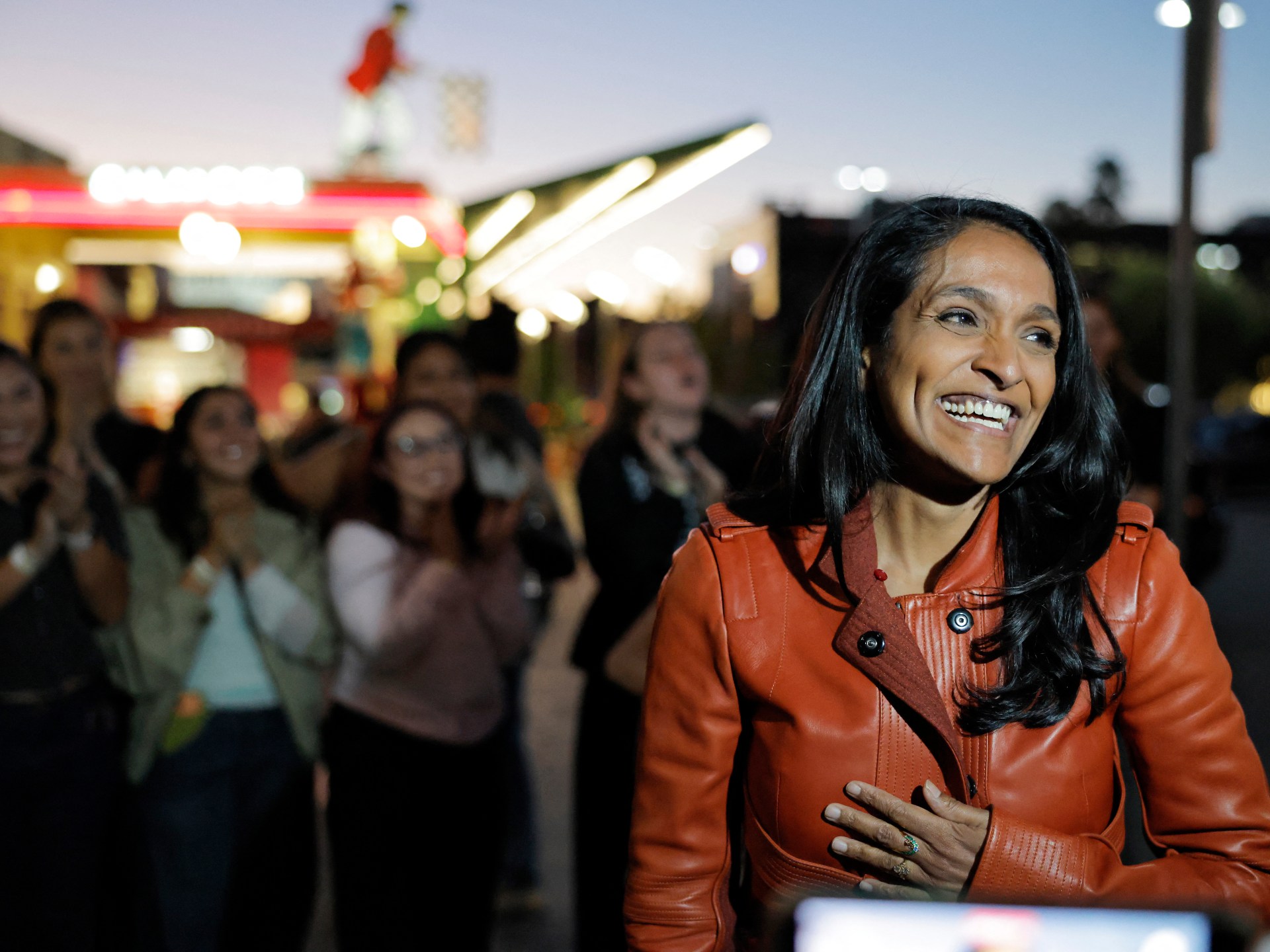

Nithya Raman, mayor-elect of Los Angeles, held back tears as the enormity of her victory began to sink in.
“This city has given me and my family so much,” Raman, an Indian-born urban planner who came to the United States at the age of six, told supporters in Los Angeles on Thursday night, after projections showed her winning the mayoral race.
- list 1 of 3The blame game: How the US midterm shock is shaping Israel’s race for PM
- list 2 of 3Generation Z and young voters help redefine US politics after midterms
- list 3 of 3Harmeet Dhillon, top US civil rights official under Trump, resigns
end of list
“The idea that Angelenos voted for an immigrant to be their next mayor at this moment in American history is so deeply moving to me,” the 45-year-old said.
Raman’s victory means that three of the world’s most influential cities – New York, Los Angeles and London – will now be led by individuals of South Asian descent.
A democratic socialist, she also gives the progressive movement another leader in a major US city, after New York and Washington, DC.
The result came amid a dominant showing by Democrats in US midterm elections, in which the party wrested control of both chambers of Congress and scored its biggest landslide victory in half a century. Democratic Socialists of America (DSA), which backed Raman’s campaign, also claimed an impressive series of wins, with 105 of its endorsed candidates on track to secure elected office, according to the group.
For Raman, the victory provides a bigger platform to address central planks of her political vision for the US’s second-largest city, including tackling its longstanding homelessness crisis and expanding affordable housing.
The Asian Democrats of Los Angeles County (ADLAC) congratulated Raman on becoming the first Asian-American elected to lead Los Angeles and said it looked forward to working with her to “deliver for our communities”.
Advertisement
“We saw a wave of change across the country this election, and Los Angeles was no exception,” ADLAC President Zahra Hajee said. “The political establishment should take note: Voters want real solutions and a government that actually works for them.”
From southern India to LA City Hall
Raman was born in the state of Keralam, in southern India, and moved to the US with her family at the age of six.
She studied at Harvard University before earning a master’s degree in urban planning from the Massachusetts Institute of Technology (MIT).
After completing her studies, Raman moved back to India and launched an initiative to improve urban governance in the southern city of Chennai.
In 2013, she moved to Los Angeles, where she co-founded a nonprofit organisation to support people experiencing homelessness. The organisation, SELAH Neighborhood Homeless Coalition, stresses that unhoused people are “fellow members of our community worthy of the same dignity, respect and representation afforded to any housed person”.

Raman also spent a year as entertainment director of Time’s Up, an organisation founded by Hollywood figures to raise money for legal support for victims of sexual harassment.
Her foray into politics came in 2019, when she shocked Los Angeles’s political establishment by defeating incumbent city councilman David Ryu and becoming the first DSA-backed candidate elected to the council. She credited a major grassroots organising drive for that victory.
Raman’s run for mayor this year came as another surprise to the local political scene, as most Democratic Party leadership stuck with incumbent mayor Karen Bass. Raman entered the race at the 11th hour, reversing her earlier endorsement of one-time ally Bass. She said Los Angeles had reached a “breaking point” and was “no longer a place of opportunity for too many”.
Bass was endorsed by prominent Democrats such as California Governor Gavin Newsom, former Vice President Kamala Harris and former House Speaker Nancy Pelosi.
In the end, none of that mattered.
Homelessness ‘a moral failing’
Raman’s mayoral campaign focused on expanding affordable housing, addressing the city’s decades-old homelessness crisis and protecting immigrants.
Her campaign described the city’s housing crisis as “the compounding moral crisis of our time”. Growing desensitisation to homelessness, it added, “is a moral failing”.
Advertisement
“Every time we see one of our neighbors living and dying on the streets, we should be shocked,” a campaign policy statement said. “Instead, in Los Angeles, it has become routine.”
Raman envisions a new approach to addressing homelessness, including expanding medical teams for people living in encampments or on the streets, alongside huge new investment in housing.
She estimates her policies will halve the number of people sleeping in tents and encampments throughout the city by 2028, when the Olympic Games will come to Los Angeles. As of 2025, the city had some 44,000 homeless people, including 27,000 staying on the streets, in vehicles or encampments, according to the Los Angeles Homeless Services Authority.
Raman has also pledged to replace the city’s police chief, whom she says has “lost the confidence” of residents by failing to curb federal immigration raids carried out by the Immigration and Customs Enforcement (ICE) agency.
“Federal raids have left Angelenos afraid to live in the city they call home – where they work and raise their families,” said Raman’s campaign. “That has to stop.”
While Raman was championed by many progressive voices, she had a rift with the DSA over the organisation demanding that she not make the Boycott, Divestment and Sanctions (BDS) movement against Israel an official part of her platform.
Raman has said she believes Israel is committing “genocide” in Gaza and that the best way for Los Angeles residents to express solidarity with Palestinians is through “non-violent protest, legislative action, and diplomatic pressure, including BDS”.
In a close vote, the DSA decided against revoking the endorsement granted to Raman by its local Los Angeles chapter, and ultimately celebrated her election victory.
In her victory speech, Raman promised to restore what she called an ambitious, creative and entrepreneurial Los Angeles.
“For too long our broken and unjust status quo has convinced Angelenos that this is the best that we can do,” she said.
‘I am myself’
Raman joins a growing number of leaders with immigrant backgrounds in global metropolises.
In New York last year, Zohran Mamdani was elected as the city’s first South Asian and Africa-born mayor. Like Raman, he has Indian roots; Mamdani’s father is a leading scholar and his mother an internationally renowned filmmaker.
Overseas, Sadiq Khan, the son of Pakistani immigrants, has been the mayor of London since 2016. And in Toronto, Olivia Chow, who moved to Canada from Hong Kong at the age of 13, has served as mayor since 2023.
Raman’s rise has drawn comparisons with Mamdani’s. Both have immigrant backgrounds, belong to the DSA and have advocated major changes to urban policy, including on housing.
Raman has said she is flattered by the comparison but is careful to distinguish herself.
“Mamdani is one of the most popular politicians in America right now, and I’m very grateful to be compared to someone who is that skilled as a communicator and a leader,” she said in an October interview with Vanity Fair.
Advertisement
“But I am different. I am myself.”
Related News

Turkiye’s parliament ratifies Mecca defence agreement

What is the Turkiye-Libya maritime deal, and why are the EU, Egypt opposed?

Grenade exercise sparked deadly fire at Canada military base, army says