

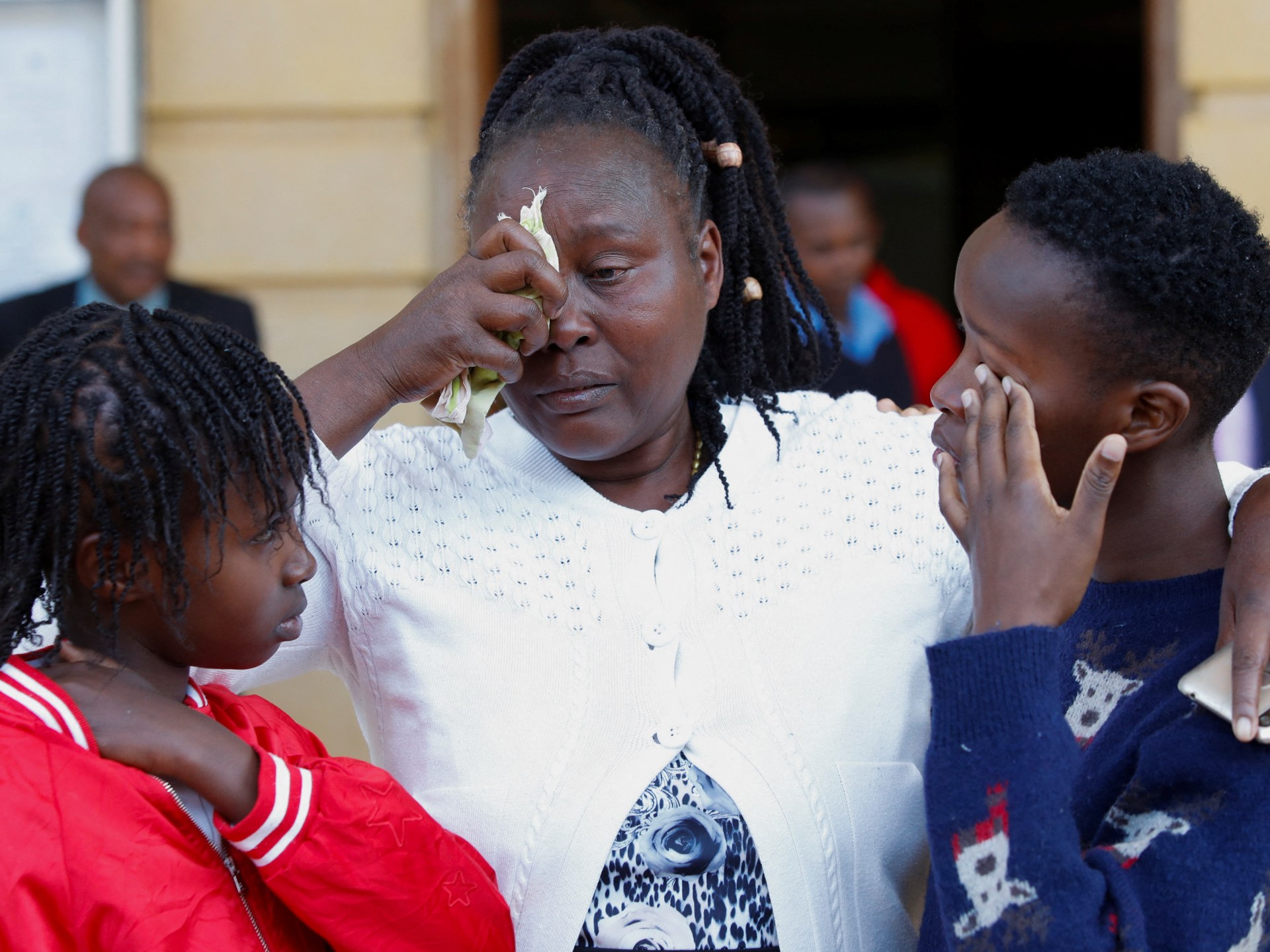

A Kenyan parliamentary report has accused British troops training in the country of widespread killings, sexual abuse and human rights and environmental abuses, following years of accumulated complaints from local communities.
The report, published on Wednesday, found that serious misconduct by British soldiers caused them to be viewed as something of an “occupying force” by local people.
- list 1 of 4Kenya court orders UK soldier’s arrest for Agnes Wanjiru death: All we know
- list 2 of 4Former British soldier contests extradition over alleged Kenya murder
- list 3 of 4Journey to Kenya: Sudan’s Jiu-jitsu Team Defies the Odds
- list 4 of 4Kenya’s Ruto on protests, power, and the state of democracy
end of list
For the past 60 years, British soldiers in the British Army Training Unit in Kenya (BATUK) have routinely trained in the East African nation, favoured for its temperate weather and realistic combat scenarios. However, they have attracted rising numbers of accusations of gross violations, ranging from killings to neglectful disposal of military grade chemicals. The most notorious case was the murder of a 21-year-old Kenyan woman, Agnes Wanjiru, which gained international media attention.
Community activists who have for years sought redress in Kenyan courts told Al Jazeera the report’s publication represented an “enormous victory” not just for Kenya, but for other African countries which host foreign military bases on their territory, but are wary of regulating them.
“The Kenyan parliament has demonstrated that the British Army is not above the law,” said James Mwangi, founder of the grassroots advocacy group, Africa Centre for Corrective and Preventive Action (ACCPA), which has been at the forefront of bringing community grievances to Kenyan courts, and which advised lawmakers during their investigation.
Advertisement
“The impunity that has been perpetrated by these forces has been appalling. The world has seen that African parliaments can take measures to combat injustices by these forces, and Kenya has become the first country in Africa to do such a thing,” he added.
Here’s what we know about the report, the most serious allegations against the British troops, and what will happen next:

What is BATUK?
BATUK (British Army Training Unit in Kenya) is a permanent training force based in Nanyuki, central Kenya. It has been stationed there since Kenyan independence from the UK in 1963 and has about 100 permanent staff and some 280 rotating short-term troops from the United Kingdom.
The unit trains British troops and provides anti-terrorism training for Kenyan troops fighting the al-Shabab armed group, as agreed in the UK-Kenya Defence Cooperation Agreement, which, since 2015, allows both armies to share intelligence and training.
In 2022, the UK government reported that BATUK had contributed more than 5.8 billion Kenyan shillings ($45m) to the local economies in which its garrisons are based, and that it employed more than 550 local staff. Local businesses close to BATUK training sites also benefit from the unit’s presence, it said.
However, there have been numerous complaints from local people about the conduct of the troops. They say mishandling of dangerous training material and unexploded bombs left in the ground have caused serious injuries, and they have complained about how British soldiers behave towards Kenyan women in the area.
Many Kenyan women say they have been left to care for children alone after British soldiers they began relationships with left the country at the end of their training.
There has been no mechanism within the UK or Kenyan justice systems to hold British soldiers under BATUK to account. On that basis, the UK government initially pushed back against Kenyan authorities’ attempts to investigate the troops’ behaviour.
In April 2024, therefore, the Kenyan parliament voted to amend the defence agreement with the UK to allow for local prosecutions of British soldiers.
What does the new report say?
The 94-page inquiry into the conduct of BATUK troops was released following a one-and-a-half-year investigation by the Kenyan parliament’s defence, intelligence and foreign relations committee.
The report examined complaints from residents in Laikipia and Samburu counties in central Kenya, close to where the BATUK camp is. Lawmakers began conducting public hearings to hear evidence in June 2024, with victims detailing harrowing accounts of mistreatment by BATUK soldiers. BATUK did not cooperate with the parliamentary investigation, the committee noted.
Advertisement
The report found that BATUK soldiers showed a “disturbing trend” of sexual misconduct, including rape, assault and the neglect of children fathered by the troops.
It found that an internal inquiry by BATUK in 2003 had mishandled evidence and failed to provide justice for women who brought complaints.
BATUK, which the report said does not conduct environmental impact assessments for its field exercises, has also caused serious environmental damage. In at least one case, a major fire killed livestock and destroyed 4,900 hectares (12,000 acres) of vegetation. BATUK also illegally dumped military waste and toxic materials openly, breaking Kenyan environmental law, the report concluded.
Additionally, the Kenyan parliament said British troops showed “gross negligence” in the way they handled unexploded ordnance during their training and that their neglect had led to multiple deaths and injuries.
Communities were routinely not informed about loud training drills, leading to shock, injury or trauma in some cases.
Kenyan workers hired to clean up ammunition debris were not provided with protective gear in line with Kenyan labour laws, the report added.
Complainants who brought claims of injuries to BATUK were not fairly compensated, the report found.

What other abuses is BATUK accused of?
Thousands of serious allegations against BATUK members have been made by locals. At the public hearings which parliament conducted, the mother of a young woman testified in June 2024 that her daughter had been the victim of a hit-and-run incident involving a BATUK truck, which left her wheelchair-bound. BATUK paid for the daughter’s hospital bills for two years, but did not compensate the family beyond that, she said.
Another mother, who attended a hearing holding her five-year-old daughter, narrated how she had been abandoned by a British soldier with whom she had been in a consensual relationship when he discovered she was pregnant. The soldier is believed to have since left Kenya. The woman said she needed child support.
Survivors of a huge March 2021 wildfire, which started at the privately-owned Lolldaiga Conservancy nature reserve in Laikipia, where BATUK carries out trainings, also brought complaints. The nature reserve houses wildlife like elephants, buffalo, lions, and the endangered Grevy zebra.
The blaze, which raged for four days, is believed to have started after BATUK used white phosphorus, a lethal chemical, during a training exercise. The resulting fire ripped through the nature reserve’s grounds, burning 4,900 hectares (12,000 acres). It killed livestock and pushed fleeing wild animals to swaths of farm land further afield. Community members said the smoke was so heavy that it lingered for days and caused eye and breathing problems.
Advertisement
One man named Linus Murangiri was crushed by a moving vehicle as he rushed to help put out the fire, the BBC reported.
In 2022, the UK’s Ministry of Defence claimed that the fire was likely caused by a camp stove that had been knocked over during an exercise.
In August 2025, the UK agreed to pay what it called a “generous” settlement to the 7,723 claimants who sued BATUK over the incident with the help of organisations like ACCPA. The BBC reported that compensation amounted to just 2.9 million pounds ($3.9m).
The British government has also supported the restoration of burned areas on the conservancy where BATUK exercises continue to be held.
What happened to Agnes Wanjiru?
Agnes Wanjiru’s killing in March 2012, allegedly by a British soldier, was the most high-profile BATUK case.
Wanjiru, the mother of a five-month-old girl, disappeared on the night of March 31, after last being seen with British soldiers at the Lion Court Hotel bar in Nanyuki. Her naked body was found two months later in a septic tank on the hotel grounds, close to the room where the BATUK soldiers had been staying. The group of soldiers had left Kenya by the time her body was discovered.
A post-mortem determined Wanjiru had been stabbed in the chest and abdomen, had a collapsed lung, and had suffered from blunt force injury to her chest. She had been beaten and was likely still alive when she was placed in the tank, it said. It was not clear whether she had been sexually assaulted.
In June 2012, the Kenyan police asked that nine soldiers be questioned by the British Royal Military Police, but say they did not receive a response. Wanjiru’s family attempted to sue BATUK in Kenya, but the UK government argued the Kenyan court had no jurisdiction over UK troops.
Wanjiru’s murder case resurfaced in October 2021 after a Sunday Times investigation revealed that a British soldier had murdered her, and that BATUK bosses knew about the involvement of the soldier in her killing, but tried to cover it up.
One soldier who went to top officials after hearing a colleague, identified at the time as Soldier X, confess to the killings was told to “shut up”. The soldier said Soldier X took him to the septic tank and showed him Wanjiru’s body. Soldier X, who was not among the nine soldiers the Kenyan police initially identified, also poked fun at the murdered woman in Facebook posts, the Times reported.
The revelation brought renewed attention to the case and, this time, UK government officials agreed to cooperate with a new investigation.
In September 2025, a Kenyan court ordered the arrest and extradition of a British national, and in November, the UK government arrested a 38-year-old suspect, Robert Purkiss. The case could mark the first time a former or current British soldier will be extradited to face trial in a foreign country, according to the UK’s Guardian newspaper.
Purkiss served as a medic in the Duke of Lancaster’s Regiment, an Infantry Regiment based in the northwest of England, and was in Kenya for a six-week training exercise at the time of Wanjiru’s death.
He appeared in a Westminster court on November 7, where a prosecutor alleged that Purkiss and others had regularly paid local women for sex and that they had been “drinking heavily” the night of Wanjiru’s murder, The Guardian reported.
Friends of Wanjiru, a hairdresser, reported that she had told them she was going out to “hustle” (earn extra money) for her daughter, prosecutors told the UK court.
The court also heard that Purkiss confessed to a colleague that he murdered Wanjiru over “sex that went wrong”.
Advertisement
Purkiss denied the allegations. His next hearing is set for December 9.

How has the UK government responded to the report?
The British High Commission in Kenya responded in a statement on Wednesday, claiming that BATUK had not been sufficiently represented during the parliamentary hearings.
The commission said it had submitted written statements which were not taken into consideration in the report, and added that it was ready to investigate new allegations against BATUK “once evidence is provided”.
“While we deeply regret the challenges which have arisen in relation to our defence presence in Kenya, we are disappointed our submission to the Committee was not incorporated into the report’s conclusions,” the statement said.
What will happen next?
The parliamentary report recommended that Kenya’s Attorney General should immediately work with the UK government to extradite Purkiss to Kenya for the ongoing trial of Wanjiru’s murder. It also ordered inquiries into other deaths of local people suspected to have involved BATUK soldiers.
Negotiations should begin with the UK within three months to hold ex-BATUK soldiers who have neglected their children to account, the report said, and compensation and psychosocial support should be provided to victims of sexual offences committed by BATUK soldiers.
More broadly, the parliamentary report also recommended that government agencies should have more direct oversight over foreign troops stationed in the country by developing a code of conduct highlighting zero tolerance of gender-based violence and environmental degradation.
Kenya similarly hosts two US military bases with fluctuating numbers of personnel. The country often hosts US-Africa military drills along with several other African countries.
Mwangi of ACCPA told Al Jazeera that the parliament’s move was a step forward for communities which have to deal with foreign militaries in Kenya and elsewhere. Injustices committed by BATUK towards local communities, he said, dated back to Kenya’s colonial history with the UK, but officials have historically been wary of interrogating soldiers due to fears that development aid from the UK government could be affected.
Kenya is a top recipient of British aid, which mostly supports healthcare and humanitarian efforts. The country was also allocated a 24.6-million-pound ($33m) development budget in 2023.
Related News

Lebanon and Israel talks raise hope of more robust, expanded truce
US-backed GHF ‘aid mission’ in Gaza ends – a timeline of violence

Trump’s boat bombings: How the US has long used ‘double-tap’ strikes
