
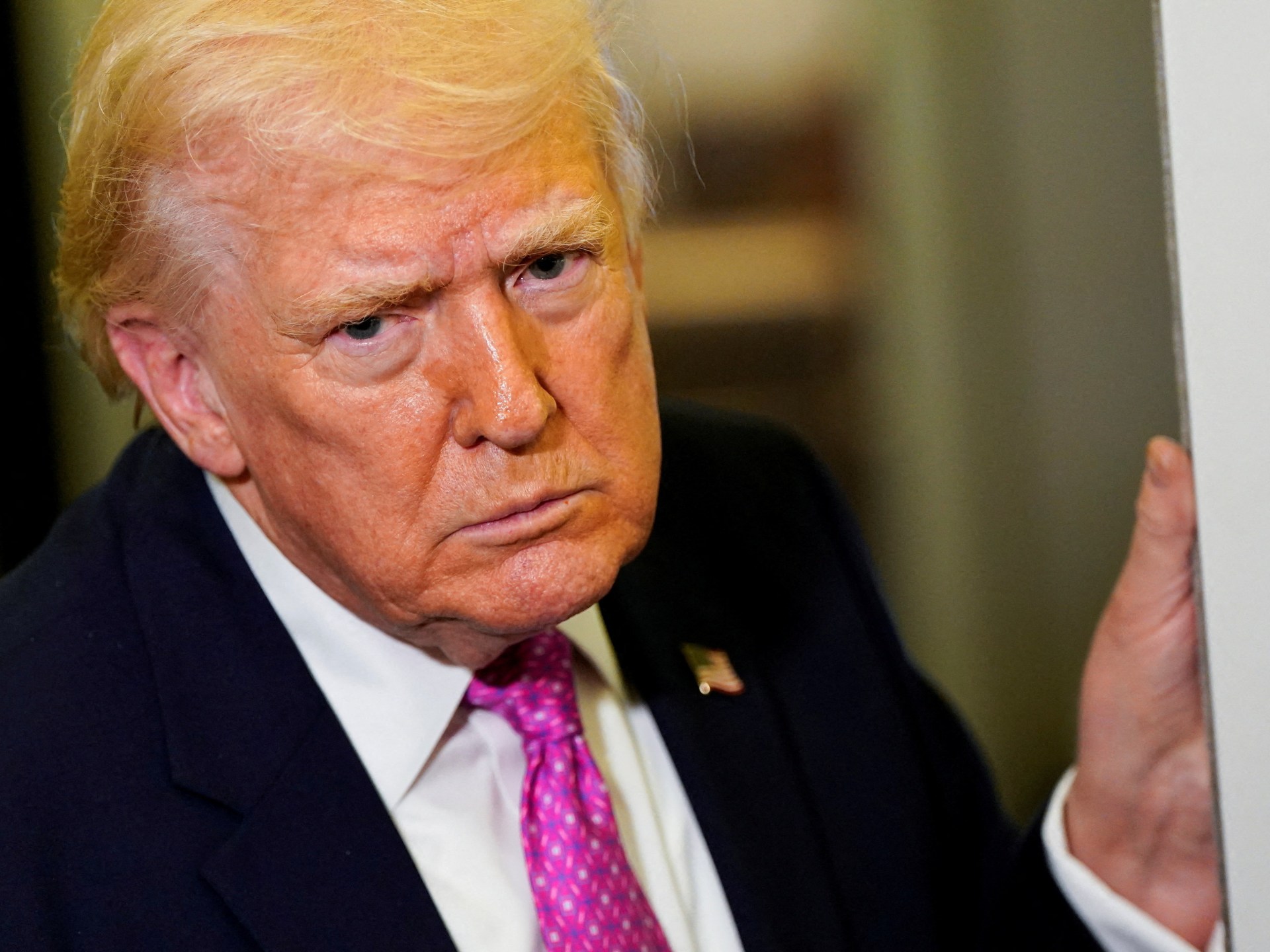

United States President Donald Trump has renewed his threat to “blow up” a range of civilian infrastructure in Iran, including all of the country’s desalination plants, in a move that would threaten the water source for millions of people and that experts say would be illegal.
Trump has been regularly warning Iran about possible US strikes against energy and electricity facilities, but he added water stations to the list of targets in his latest threat on Monday.
- list 1 of 3Schools, water, industry: What civilian targets have US, Israel, Iran hit?
- list 2 of 3Trump ‘pretty sure’ of Iran deal, but can Pakistan-led efforts end the war?
- list 3 of 3Why have the US and Israel bombed more than 75 Iranian police facilities?
end of list
“The United States of America is in serious discussions with A NEW, AND MORE REASONABLE, REGIME to end our Military Operations in Iran,” Trump wrote in a social media post.
He added that “great progress” has been made in the talks.
“But, if for any reason a deal is not shortly reached, which it probably will be, and if the Hormuz Strait is not immediately ‘Open for Business,’ we will conclude our lovely ‘stay’ in Iran by blowing up and completely obliterating all of their Electric Generating Plants, Oil Wells and Kharg Island (and possibly all desalinization plants!), which we have purposefully not yet ‘touched’,” the US president said.
International law explicitly bans making civilian sites the “object of attack or of reprisals”.
Yusra Suedi, assistant professor in international law at the University of Manchester, said Trump’s threat “reinforces the climate of impunity around collective punishment in warfare”.
“This is clearly an act of collective punishment, which is prohibited under international humanitarian law. You can’t deliberately harm an entire civilian population to pressure its government,” Suedi told Al Jazeera.
The Fourth Geneva Convention says: “Collective penalties and likewise all measures of intimidation or of terrorism are prohibited.”
Advertisement
Raed Jarrar, advocacy director at the rights group DAWN, said Trump’s threats represent “clear, public evidence of criminal intent”.
“Threatening to obliterate a nation’s power grid, oil infrastructure and water supply to coerce its government is not a negotiating tactic; it is textbook collective punishment and a war crime,” Jarrar told Al Jazeera.
Trump first issued a threat to target Iran’s electrical grid and energy infrastructure on March 21 while also giving Tehran a 48-hour deadline to reopen the Strait of Hormuz.
The US president later pushed the deadline back by five days before extending it again until April 6.
Over the past week, Trump has insisted that Iran is “begging” to make a deal and talks between Washington and Tehran are under way.
While Tehran has acknowledged receiving a 15-point ceasefire proposal from Washington through intermediaries, several Iranian officials have denied direct negotiations with the US.
Both Iran and the US have suggested that they are winning the war.
Despite the killing of several top Iranian officials, including Supreme Leader Ali Khamenei, by the US and Israel, there is no public evidence to back Trump’s claim that there is a new government in the country.
Khamenei was replaced by his son Mojtaba, an appointment that Trump denounced.
Iran has also continued to fire missiles and drones across the region and close down the Strait of Hormuz, sending energy prices soaring across the world, despite Trump’s frequent threats.
The Iranian ruling system has not faced any major antigovernment protests or defections during the conflict as the Islamic Revolutionary Guard Corps spearheads the country’s war effort.
So far, Trump’s threats to “obliterate” Iran’s civilian infrastructure have not deterred Tehran’s strikes or affected the public defiance Iranian officials are expressing.
This month, Iran accused the US and Israel of striking a desalination plant on Qeshm Island in the Strait of Hormuz. Separately, authorities have said Iranian attacks damaged water facilities in Bahrain and Kuwait.
Iran, which is less dependent on desalination plants for drinking water than some of its Gulf neighbours, has threatened civilian infrastructure across the region if its own facilities are targeted by the US and Israel.
Related News
Palestine aIly Ireland under fire for allowing weapons transfers to Israel

Mothers of the Plaza de Mayo reflect on 50th anniversary of Argentina coup
RSF attack on Sudan’s South Kordofan kills at least 14, including children