
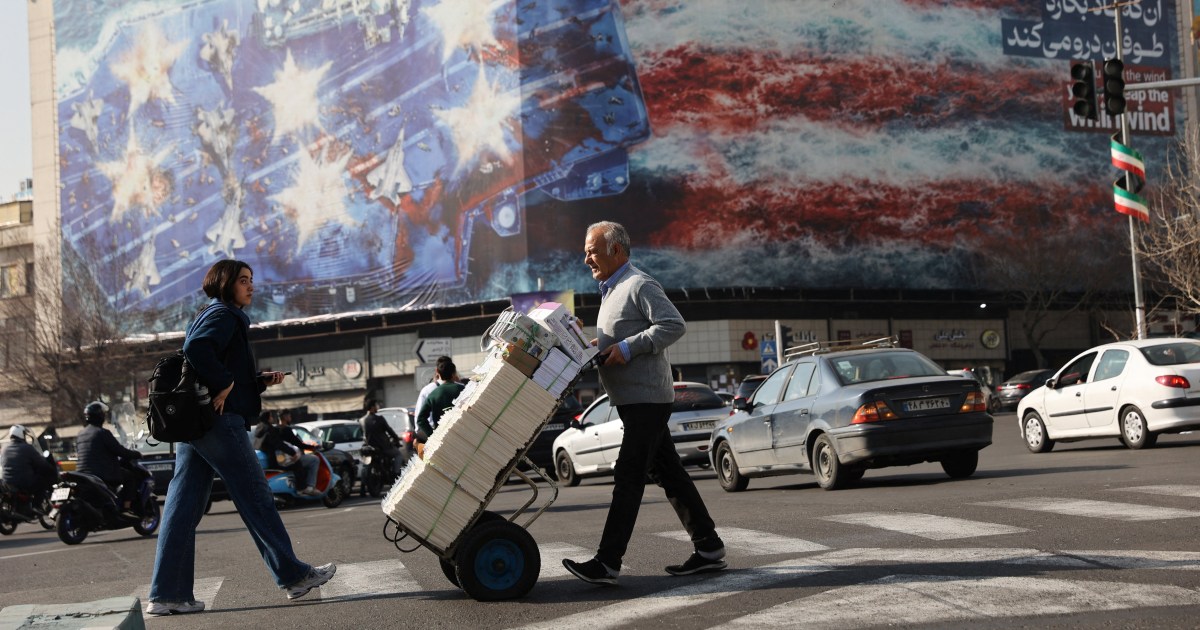

Iran and the United States are set to begin a third round of indirect negotiations over Tehran’s nuclear programme in Switzerland, with both sides maintaining their preference for a diplomatic solution despite high tensions.
Iran’s Foreign Minister Abbas Araghchi arrived in Geneva on Wednesday and met his Omani counterpart, Badr Albusaidi, who is facilitating the indirect talks scheduled for Thursday.
- list 1 of 4Iran rejects ‘fictional narratives’ of power grab after protest killings
- list 2 of 4US issues new Iran sanctions on eve of nuclear talks in Geneva
- list 3 of 4Which countries are urging citizens to leave Iran amid US threat of force?
- list 4 of 4Trump makes Iran missile, protest deaths claims; Tehran slams ‘big lies’
end of list
Before his departure, Araghchi said a “fair, balanced and equitable deal” was within reach, while reiterating that Iran was not seeking an atomic weapon and was not ready to give up its “right to peaceful use of nuclear technology”.
The talks unfolded against a backdrop of continued mistrust.
US Vice President JD Vance accused Iran of attempting to rebuild its nuclear programme and said Tehran should take Washington’s threats of military action seriously.
“The principle is very simple: Iran can’t have a nuclear weapon. If they try to rebuild a nuclear weapon, that causes problems for us,” he told reporters at the White House. “In fact, we’ve seen evidence that they have tried to do exactly that … As the president has said repeatedly, he wants to address that problem diplomatically, but of course the president has other options as well.”
The Department of the Treasury announced sanctions against more than 30 individuals, entities and vessels it said had helped finance Iran’s oil sales, ballistic missile programme and weapons production.
A day earlier, US President Donald Trump, in his State of the Union address, appeared to lay the groundwork for a potential military confrontation, accusing Iran of harbouring “sinister nuclear ambitions” and developing missiles capable of striking the US – claims that Iranian officials flatly rejected.
Advertisement
“Whatever they’re alleging in regards to Iran’s nuclear program, Iran’s ballistic missiles, and the number of casualties during January’s unrest is simply the repetition of ‘big lies’,” Esmaeil Baghaei, the Iranian Foreign Ministry spokesman, wrote on X, comparing the administration’s approach to the propaganda tactics of Joseph Goebbels, Adolf Hitler’s minister of information.
‘Big, big problem’
US Secretary of State Marco Rubio, speaking in St Kitts and Nevis, said the talks in Geneva would focus primarily on Iran’s nuclear programme and reiterated Washington’s concern about Iranian ballistic missiles, which he said Tehran was attempting to develop into intercontinental-range weapons.
Iranian insistence on excluding the missile programme from negotiations, he said, was “a big, big problem”.
The negotiations are being led on the US side by Trump’s special envoy Steve Witkoff and his son-in-law Jared Kushner. The first round was held in Oman on February 6, followed by a second session in Geneva on February 17.
Araghchi said afterwards that the two sides had reached a tentative understanding on the broad principles that would guide further discussions, though no substantive agreement had been reached.
Al Jazeera’s Tohid Asadi, reporting from Tehran, said the talks were taking place “with the rhetoric from both sides oscillating between confrontation on the one hand and engagement on the other”.
He pointed to disagreements over uranium enrichment and Iran’s demand for verifiable guarantees that sanctions would actually be lifted before it makes concessions.
“There are controversial issues beyond the nuclear dossier of the two countries, related to foreign assistance, ballistic missiles, defence capabilities, as well as regional activities of the country,” Asadi said.
“The bottom line is gaps obviously exist,” he said. “And it remains to be seen whether diplomatic engagement could pave the way for a final solution between Washington and Tehran. Until then and for the time being, if anything is certain, that is uncertainty.”
Iran’s parliament speaker, Mohammad Bagher Ghalibaf, meanwhile offered a blunt summary of Tehran’s position.
“If you choose the table of diplomacy – a diplomacy in which the dignity of the Iranian nation and mutual interests are respected – we will also be at that table,” he said, according to the semiofficial Student News Network. “But if you decide to repeat past experiences through deception, lies, flawed analysis and false information, and launch an attack in the midst of negotiations, you will undoubtedly taste the firm blow of the Iranian nation.”
Advertisement
US leverage
Iran has warned that any US strike would prompt retaliatory attacks on American military bases throughout the Middle East, where tens of thousands of troops are deployed. Tehran has also threatened to close the Strait of Hormuz, the narrow waterway through which a significant share of the world’s oil supply passes.
The status of Iran’s nuclear infrastructure remains uncertain.
Trump has claimed that US attacks on Iran last year “obliterated” the programme, yet his administration now appears to be treating it as a live threat. International Atomic Energy Agency inspectors have not been permitted to verify what, if anything, remains at the targeted sites at Fordow, Natanz and Isfahan.
US Central Command spokesman Tim Hawkins said Washington remained ready to respond to any escalation.
“Deterrence from our perspective comes through a show of strength,” he said.
“During a time of heightened tensions, we are going to make sure that we have the forces in place to protect our troops, that’s what you’re seeing. Additionally, with respect to Iran….our focus remains on ensuring we have right forces in place to protect out troops and that’s what we’re doing.”
Al Jazeera’s Kimberly Halkett, reporting from Washington, DC, said the US was seeking to ramp up the pressure on Iran with the rhetoric and also the latest sanctions.
“The goal, according to the United States, is to try and make it so that the funding for what the US says is an illegal weapons programme will be removed. But the other thing the United States is trying to do is to increase US leverage in these negotiations,” she said.
“The hope is that Iran will come to an agreement to limit its uranium enrichment programme, and also that there can be room for negotiations later on, regarding not only its support for proxies in the region, but limiting its ballistic missile programme. The US is promising, should those concessions be made, it will provide the economic relief that Iran’s economy needs,” Halkett said.
Related News
Ten skiers missing, 6 trapped after avalanche in north California mountains
Could BNP’s landslide win open a new geopolitical chapter for Bangladesh?
Deadly explosion rocks Russian military site near St Petersburg