

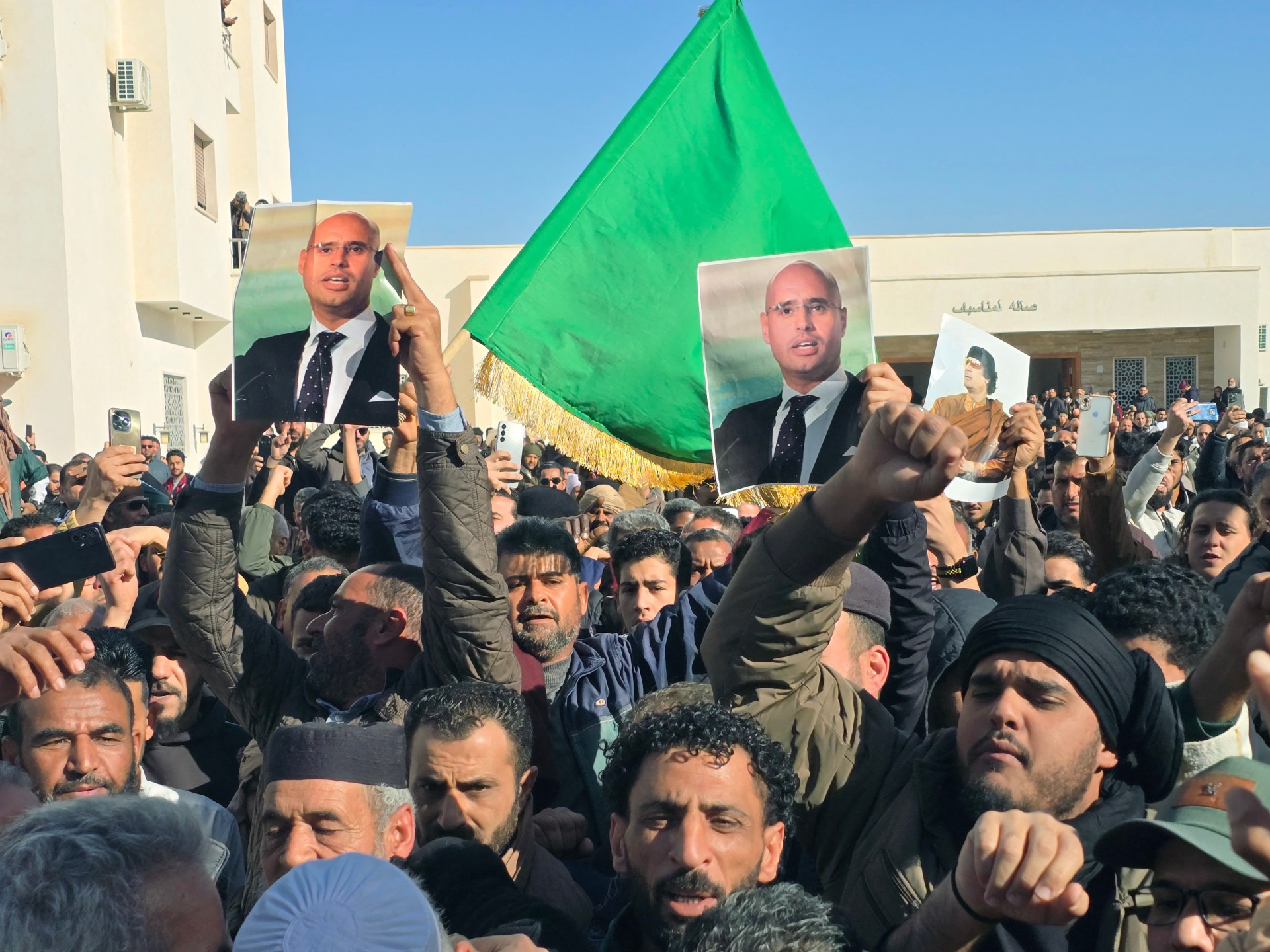

Thousands of people have attended the funeral of Saif al-Islam Gaddafi, the late Libyan leader Muammar Gaddafi’s most prominent son, who was shot dead this week.
The burial took place on Friday in the town of Bani Walid, some 175 kilometres (110 miles) south of Tripoli.
- list 1 of 3US attorney general says ‘key participant’ in 2012 Benghazi attack arrested
- list 2 of 3Thousands attend funeral for Saif al-Islam Gaddafi, son of Libyan ex-leader
- list 3 of 3‘Treacherous assassination’: Who was Saif al-Islam Gaddafi?
end of list
Nearly 15 years after the elder Gaddafi was toppled and killed in a 2011 NATO-backed uprising, thousands of loyalists turned up to mourn his son, who was once seen as the former leader’s heir apparent.
Saif al-Islam Gaddafi was killed on Tuesday in his home in the northwestern city of Zintan. His office said in a statement that he had been killed during a “direct confrontation” with four unknown gunmen who broke into his home.
The office of Libya’s attorney general said investigators and forensic doctors examined the 53-year-old’s body and determined that he died from gunshot wounds and that the office was working to identify suspects.
“We are here to accompany our beloved one, the son of our leader in whom we placed our hope and our future,” said Waad Ibrahim, a 33-year-old woman from Sirte, nearly 300km (186 miles) away from Bani Walid.
Saif al-Islam Gaddafi was once described as the de facto prime minister under his father’s iron-fisted 40-year rule, cultivating an image of moderation and reform despite holding no official position.
Championing himself as a reformer, he led talks on Libya abandoning its weapons of mass destruction and negotiated compensation for the families of those killed in the bombing of Pan Am Flight 103 over Lockerbie, Scotland, in 1988.
Advertisement
But that reputation soon collapsed when he promised “rivers of blood” in response to the 2011 uprising, which led to his arrest that year on a warrant issued by the International Criminal Court for alleged crimes against humanity.
In 2021, he announced he would run for president, but the elections aiming to unify the divided country under a United Nations agreement were indefinitely postponed.
Today, Libya remains split between Prime Minister Abdul Hamid Dbeibah’s UN-backed government based in Tripoli and an eastern administration backed by Khalifa Haftar.
The killing of Gaddafi, seen by many as an alternative to the country’s power duopoly, occurred less than a week after a reported January 28 meeting in France’s Elysee Palace, which brought together Haftar’s son and advisers to Dbeibah.
Related News
Pakistan military raids kill 41 armed fighters in Balochistan
Gaza war docudrama The Voice of Hind Rajab nominated for Academy Award
Hong Kong to sentence media mogul Jimmy Lai on national security conviction