
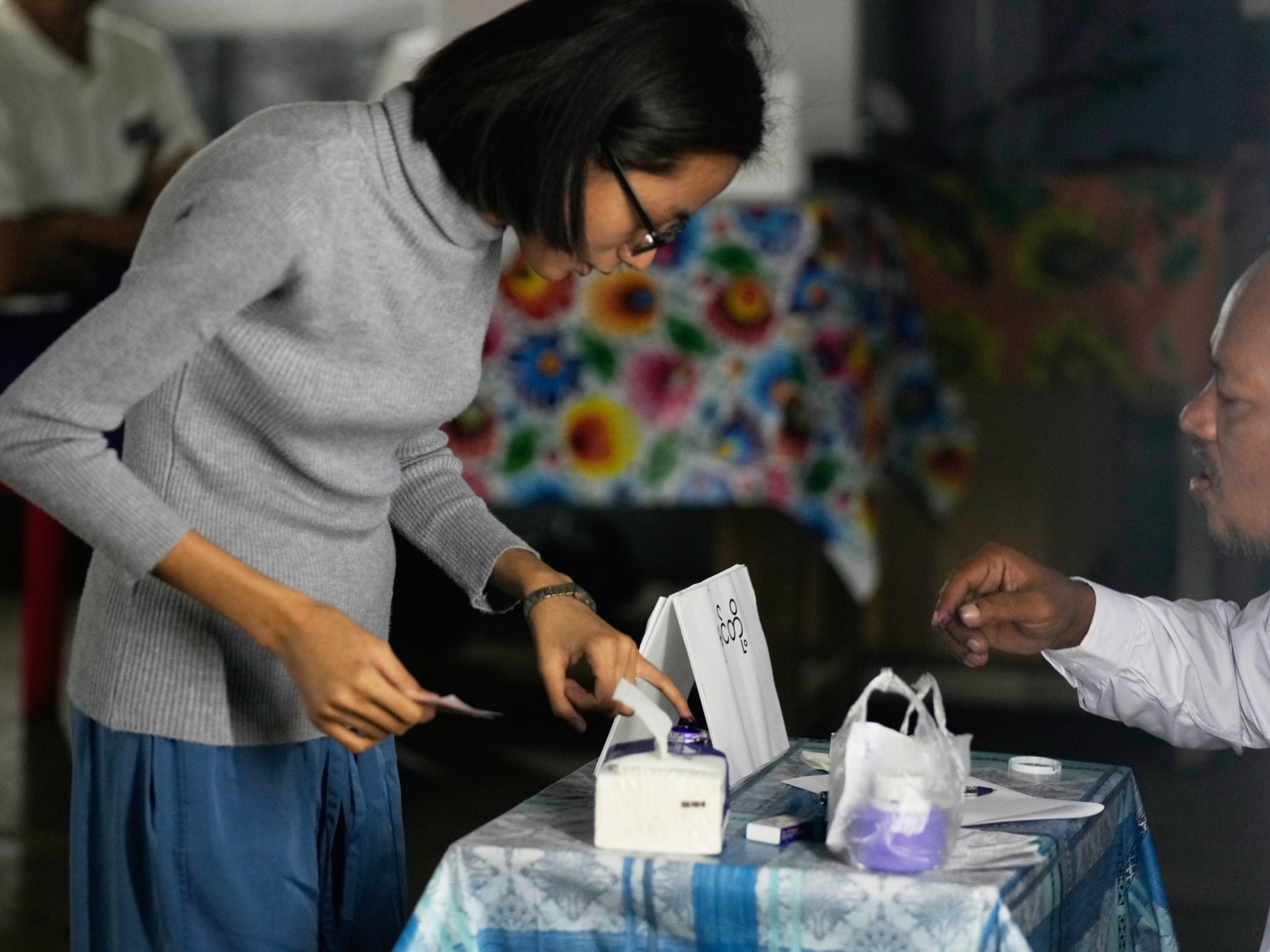

Polls have opened in Myanmar for the third and final round of a controversial general election, with a military-backed party on course for a landslide win amid a raging civil war.
Voting began in 60 townships, including in the cities of Yangon and Mandalay, at 6am local time on Sunday (23:30 GMT, Saturday).
- list 1 of 3UN probe finds evidence of ‘systematic torture’ in Myanmar
- list 2 of 3Myanmar’s military holds second phase of elections amid civil war
- list 3 of 3A ghost town votes in Myanmar election’s second phase
end of list
Critics say the polls are neither free nor fair, and are designed to legitimise military rule in Myanmar, nearly five years after the country’s generals ousted the elected government of Aung San Suu Kyi, leading to a civil war that has killed thousands and displaced more than 3.5 million people.
Aung San Suu Kyi remains in detention and, like several other opposition groups, her National League for Democracy (NLD) has been dissolved, tilting the political playing field in favour of the military-backed Union Solidarity and Development Party (USDP), which is leading in the polls.
So far, the USDP has secured 193 out of 209 seats in the lower house, and 52 out of 78 seats in the upper house, according to the election commission.
That means that along with the military, which is allocated 166 seats, the two already hold just under 400 seats, comfortably surpassing the 294 needed to come to power.
Seventeen other parties have won a small number of seats in the legislature, ranging from one to 10, according to the election commission.
Senior General Min Aung Hlaing, who heads the current military government, is widely expected by both supporters and opponents to assume the presidency when the new parliament meets.
Advertisement
The military has announced that the parliament will be convened in March, and the new government will take up its duties in April.
While the military has pledged that the election will return power to the people, rights monitors said the run-up was beset with coercion and the crushing of dissent, warning that the vote will only tighten the military’s grip on power.
A new Election Protection Law imposed harsh penalties for most public criticism of the polls, with the authorities charging more than 400 people recently for activities such as leafleting or online activity.
Ahead of the third round of voting, Tom Andrews, the UN special rapporteur on human rights in Myanmar, also called for the rejection of its outcome, calling it “fraudulent”.
“Only an illegitimate government can emerge from an illegitimate election,” he wrote on X on Saturday.
“As Myanmar’s election ends, the world must reject it as fraudulent while rejecting what follows as simply military rule in civilian clothing.”
Malaysian Minister of Foreign Affairs Mohamad Hasan told Parliament on Tuesday that the Association of Southeast Asian Nations (ASEAN), of which Myanmar is a member, did not send observers and would not certify the election, citing concerns over the lack of inclusive and free participation.
His comments were the first clear statement that the 11-member regional bloc will not recognise the election results.
In Myanmar’s second city of Mandalay, Zaw Ko Ko Myint, a 53-year-old teacher, cast his vote at a high school around dawn.
“Although I do not expect much, we want to see a better country,” he told the AFP news agency. “I feel relieved after voting, as if I fulfilled my duty.”
The previous two phases of the election have been marked by low voter turnout of about 55 percent, well below the turnout of about 70 percent recorded in Myanmar’s 2020 and 2015 general elections.
Official results are expected late this week, but the USDP could claim victory as soon as Monday.
Aung San Suu Kyi’s NLD thrashed the USDP in the last elections in 2020, before the military seized power on February 1, 2021.
According to the Assistance Association for Political Prisoners, which monitors human rights abuses in the country, at least 7,705 people have been killed since the outbreak of the civil war, while 22,745 remain detained.
But the Armed Conflict Location & Event Data Project, a monitoring group that tallies media reports of violence, estimates more than 90,000 have been killed on all sides of the conflict.
Advertisement
Related News

Trump wants to cap credit card interest rates at 10%. Would that work?
At least six killed in Pakistan as fire rips through Karachi shopping mall
What we know about the protests sweeping Iran